Nutrition · Hydration
How much water should you drink a day?
Key takeaways
- 2.7 / 3.7 Ltotal water a day for women / men, food includedUS National Academies, 2005
- 2.0 / 2.5 Lthe European reference for women / men, food includedEFSA, 2010
- 0.5–2 Lof sweat lost per hour of exercise, varying widely between peopleACSM position stand, 2007
- ~2 kgextra weight loss in 12 weeks with 500 ml water before meals, in one small trialDennis et al., Obesity 2010
DefinitionAdequate intake is the daily amount of a nutrient, here total water from drinks and food, that healthy people typically consume without signs of shortage; it is a guide, not a strict minimum.
"Eight glasses a day" is not far off for many women, but the real answer depends on your size, how much you move, the weather, and what you eat. Official figures are adequate intakes: amounts that healthy people typically drink and eat, not strict minimums. Use them as a starting point, then let thirst and urine colour fine-tune it.
How much water should I drink a day?
The US National Academies set an adequate total water intake of 2.7 litres a day for women and 3.7 litres for men; EFSA's European figures are 2.0 and 2.5 litres. Both include food, which supplies about a fifth. So from drinks, that is roughly 1.6–2.2 litres for women and 2.0–3.0 litres for men in a temperate climate.
| US total | EFSA total | From drinks (≈ 80%) | |
|---|---|---|---|
| Women 19+ | 2.7 L | 2.0 L | 1.6–2.2 L (6–9 glasses) |
| Men 19+ | 3.7 L | 2.5 L | 2.0–3.0 L (8–12 glasses) |
| Pregnancy | 3.0 L | +0.3 L | about 0.3 L more |
| Breastfeeding | 3.8 L | +0.6–0.7 L | about 0.7 L more |
Water calculator: how much should I drink?
Start from the US figure for drinks (about 2.2 litres for women and 3.0 for men), then add for exercise, hot weather, pregnancy or breastfeeding. The result is a daily target from drinks, shown in litres and 250 ml glasses, with the lower European-based figure as the bottom of your range. Thirst and urine colour fine-tune it.
Your daily water from drinks
Example shown: woman, 60 minutes of training, temperate climate: about 2.2 + 0.5 = 2.7 L from drinks, about 11 glasses of 250 ml (range 2.1–2.7 L).
Includes 0.5 L for 60 minutes of exercise. Heavy sweaters, long sessions and hot gyms need more: weigh yourself before and after training to find your own sweat loss.
Does body weight change how much water I need?
Yes, somewhat: larger and more active bodies lose more water, so they generally need more. But no official guideline sets water per kilogram, and simple ml-per-kg rules can overshoot for heavier people and undershoot for very active ones. Activity, heat and sweat rate change your needs far more than a few kilos.
That is why the calculator above starts from the official totals and adds for exercise and climate rather than multiplying your weight. If you want a personal number, two checks beat any formula: pale-yellow urine through the day, and weighing yourself before and after a workout.
How much extra water do I need for exercise and heat?
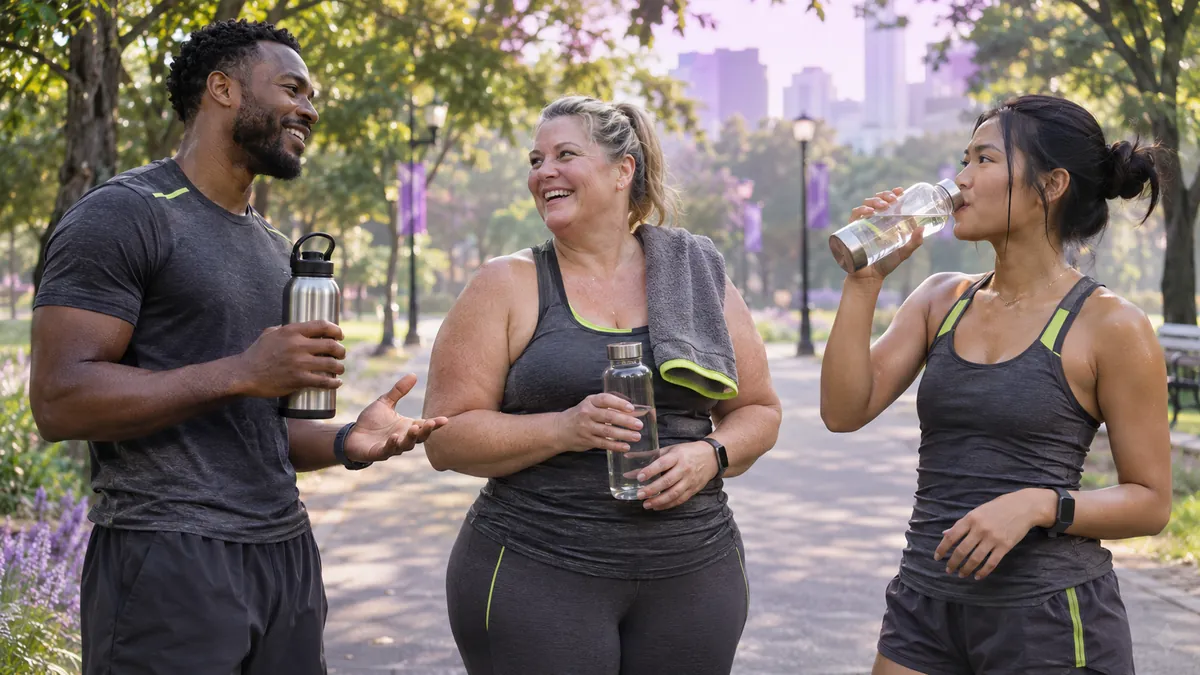
Sweat losses during exercise commonly range from 0.5 to 2 litres an hour, depending on intensity, heat, clothing and your body. A practical start is an extra 0.5 litres per hour of training, more in heat. The American College of Sports Medicine advises avoiding a loss of more than 2% of body weight during exercise.
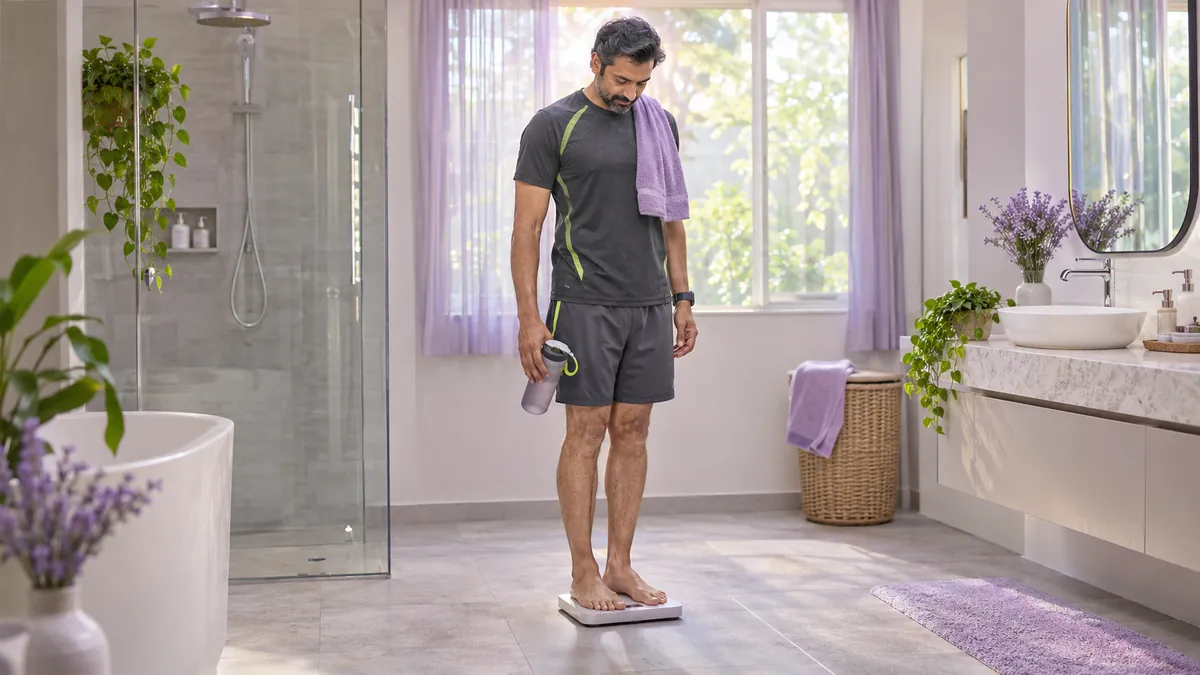
- Find your sweat rate: weigh yourself before and after a typical session (without sweaty clothes). Each kilogram lost is about a litre of sweat, minus anything you drank.
- After exercise: ACSM suggests drinking about 1.5 litres for every kilogram lost, spread over the next hours, with salty food or a sports drink after long, sweaty sessions.
- Short sessions (under an hour, temperate): water when thirsty is enough; you rarely need sports drinks.
Does drinking water help you lose weight?
A little, mainly by helping you eat less. In one 12-week trial of 48 adults aged 55–75 on a reduced-calorie diet, those who drank 500 ml of water before each meal lost about 2 kg more than those who did not. It was small and short, so treat water as a helpful habit, not a fat-loss method.
Swapping sugary drinks for water removes calories directly, which matters more. The calorie deficit itself still does the work; see our fitness and diet myths for what water can and cannot do.
What are the signs that I am not drinking enough?
The simplest signs are thirst, dark-yellow urine, peeing less often than usual, headache, tiredness and dizziness. Pale-yellow urine through the day usually means you are drinking enough. Older adults feel thirst less strongly, so they should drink regularly rather than waiting. Confusion or fainting needs urgent medical help.
Some vitamins (B2 in particular) turn urine bright yellow whatever you drink, so look at the trend, not one visit to the toilet. Long days at a desk make it easy to forget to drink at all; a bottle in sight helps, as does the movement routine in our guide for people who sit all day.
Can you drink too much water?
Yes. Drinking far more than you lose dilutes the sodium in your blood (hyponatraemia), which can cause nausea, headache, confusion and, rarely, seizures or death. It mostly happens in long endurance events when people drink large amounts by schedule. The international consensus advice is to drink to thirst during exercise.
Your kidneys can only clear so much water an hour, so forcing litres down in a short time is risky, even outside sport. Gaining weight during a long race is a warning sign that you are over-drinking.
Do tea, coffee, milk and food count towards water?
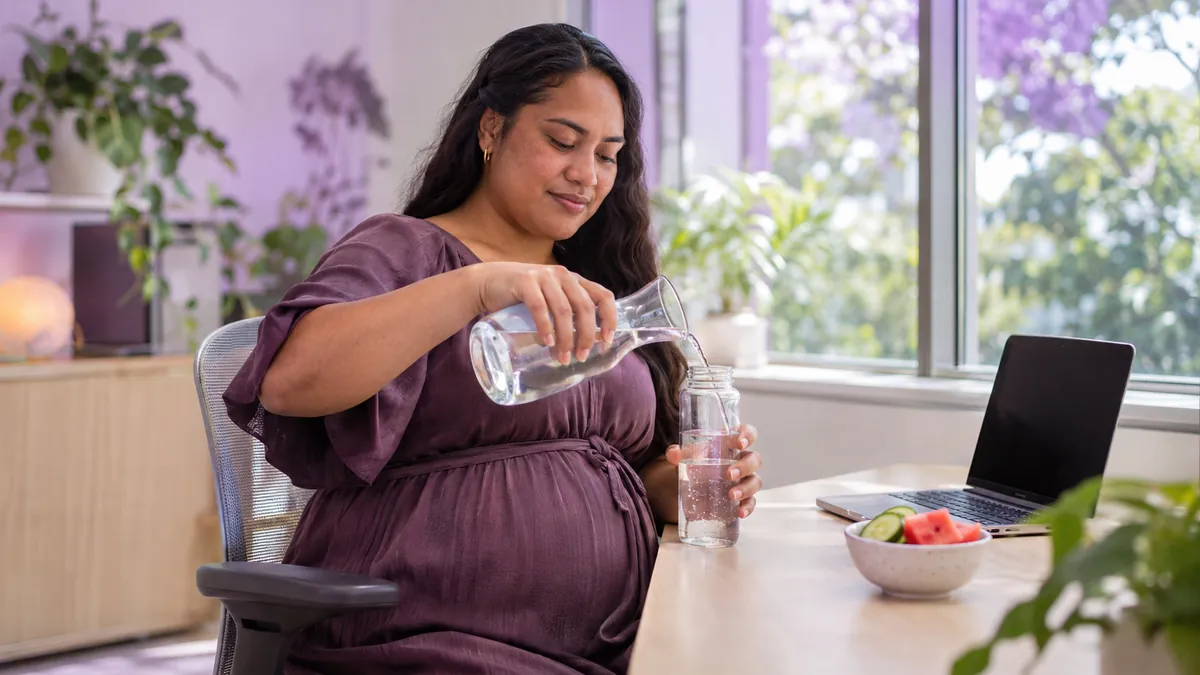
Yes. All drinks count, including coffee, tea and milk: in a study of regular coffee drinkers, moderate coffee hydrated about as well as water. Food supplies roughly a fifth of total water; fruit and vegetables such as cucumber (95% water) and watermelon (91%) add the most.
Plain water is still the best default because it has no calories or sugar. Coconut water counts too and adds potassium, but it also adds sugar. Alcohol is the exception: it increases urine output, so do not count it.
How do I make drinking water a habit?
Set a daily target, keep a bottle where you can see it, link drinks to routines (a glass on waking, one with each meal, one after training) and use reminders until it is automatic. Splitting the target into glasses shows where you stand by lunchtime.
Fitrang's Water page shows today's glasses against your goal and the days this week you hit it, and you can turn on reminders every one to three hours between the times you choose. Sleep also affects thirst and fluid balance; see what one short night does to your results.
The bottom line
Aim for about 2.7 litres of total water a day if you are a woman and 3.7 litres if you are a man (2.0 and 2.5 litres by the European figures), about 80% of it from drinks: roughly 8–9 glasses for women and 12 for men. Add about 0.5 litres per hour of exercise and more in heat, let pale-yellow urine guide you, and drink to thirst rather than forcing extra during long events.
Frequently asked questions
Is 2 litres of water a day enough?
For most women in a temperate climate, about 2 litres from drinks is close to the official figures (1.6 to 2.2 litres from drinks). Most men need more, about 2 to 3 litres from drinks, and everyone needs extra for exercise and hot weather.
How much water should I drink by weight?
There is no official per-kilogram figure. Larger, more active people generally need more, but activity, heat and sweat rate matter more than weight. Start from the official totals, add for exercise and heat, and check that your urine stays pale yellow.
Does coffee count as water?
Yes. Coffee and tea count towards your daily fluid. Caffeine has a mild diuretic effect, but a study of regular coffee drinkers found moderate coffee hydrated about as well as water. Alcohol is the drink that does not count.
How much water should I drink to lose weight?
There is no special amount. In one small trial, 500 ml of water before each meal led to about 2 kg more weight loss over 12 weeks on a reduced-calorie diet. Replacing sugary drinks with water helps more; the calorie deficit does the real work.
What colour should urine be?
Pale yellow, like straw, for most of the day. Dark yellow or amber usually means you need to drink more. Completely clear urine all day can mean you are drinking more than you need. Some vitamins turn urine bright yellow regardless.
How much water should I drink during a workout?
For sessions under an hour, drink when thirsty. For longer or hotter sessions, sweat losses of 0.5 to 2 litres an hour are common: drink to thirst, aim not to lose more than 2% of body weight, and do not drink so much that you gain weight.
Can you drink too much water?
Yes. Drinking much more than you lose, especially during long endurance events, can dilute blood sodium (hyponatraemia), which can be dangerous. Drink to thirst rather than to a schedule, and follow your doctor's limit if you have heart, kidney or liver disease.
Keep reading
 20 fitness and diet myths vs factsIncluding the water ones
 Fitness habits for people who sit all daySmall daily moves that add up
 What one short night does to your resultsSleep, hunger and recovery
 TDEE and daily calorie calculatorWhat actually drives weight loss
Sources
- National Academies of Sciences, Engineering, and Medicine. Dietary Reference Intakes for Water, Potassium, Sodium, Chloride, and Sulfate (2005). nap.nationalacademies.org
- EFSA Panel on Dietetic Products, Nutrition, and Allergies. Scientific Opinion on Dietary Reference Values for water. EFSA Journal 2010;8(3):1459. efsa.europa.eu
- American College of Sports Medicine; Sawka MN, Burke LM, Eichner ER, et al. Exercise and fluid replacement (position stand). Medicine & Science in Sports & Exercise 2007;39(2):377–390. PubMed
- Dennis EA, Dengo AL, Comber DL, et al. Water consumption increases weight loss during a hypocaloric diet intervention in middle-aged and older adults. Obesity 2010;18(2):300–307. PubMed
- Hew-Butler T, Rosner MH, Fowkes-Godek S, et al. Statement of the Third International Exercise-Associated Hyponatremia Consensus Development Conference, Carlsbad, California, 2015. Clinical Journal of Sport Medicine 2015;25(4):303–320. PubMed
- Killer SC, Blannin AK, Jeukendrup AE. No evidence of dehydration with moderate daily coffee intake: a counterbalanced cross-over study in a free-living population. PLoS One 2014;9(1):e84154. doi.org
- U.S. Department of Agriculture, Agricultural Research Service. FoodData Central. fdc.nal.usda.gov
This article is general information for healthy adults, not medical advice. If you have a medical condition, are pregnant, or take medication, talk to a doctor or registered dietitian before changing your diet, sleep or training.