Training · Home workouts
Home workout without equipment: a 20-minute plan
Key takeaways
- 2+ daysa week of muscle strengthening, plus 150–300 minutes of moderate activityWHO guidelines, 2020
- Similar musclefrom light and heavy loads when sets are taken close to failureSchoenfeld meta-analysis, 2017
- 8 weeksof load-matched push-ups built as much chest and triceps as bench pressKikuchi & Nakazato, 2017
- 6,000–10,000steps a day, where the drop in mortality risk levelled off (by age)Paluch meta-analysis, 2022
DefinitionBodyweight training is strength training that uses your own body as the resistance, such as push-ups, squats, lunges and planks, made harder by changing leverage, range or the number of limbs doing the work.
You need a floor, about two metres of space and twenty minutes. This plan trains legs, chest, shoulders, arms, glutes and core in one circuit, and every move has an easier and a harder version, so it works on day one and keeps working for months. Each exercise links to an animated demo in the Fitrang exercise library.
What is a good 20-minute home workout with no equipment?
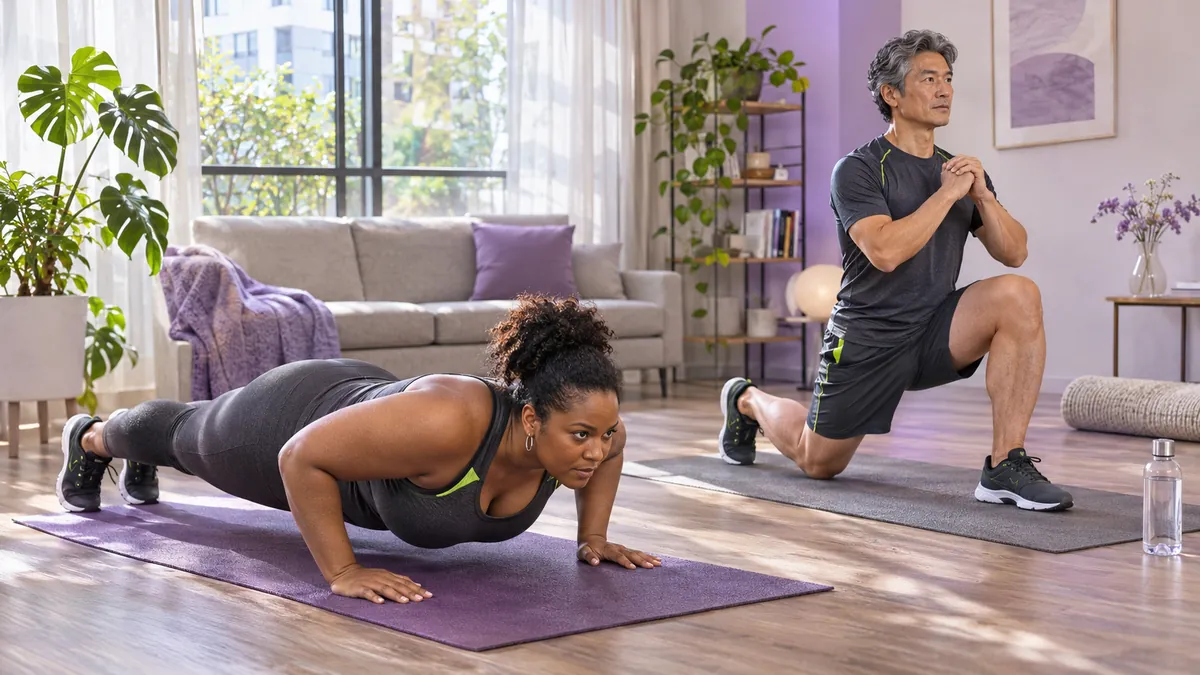
Warm up for 3 minutes, then do 6 moves back to back: work 40 seconds, take about 15 seconds to change, and rest 1 minute after each round. Do 3 rounds. Each set should end with 1–3 good reps still in the tank. That is about 20 minutes, three days a week.
| # | Move | 40 s target | Main muscles |
|---|---|---|---|
| 1 | Bodyweight squat | 12–20 reps | Thighs, glutes |
| 2 | Push-up (any version) | 6–15 reps | Chest, shoulders, triceps |
| 3 | Reverse lunge, alternating | 10–16 reps | Thighs, glutes |
| 4 | Glute bridge | 15–20 reps | Glutes, hamstrings |
| 5 | Plank | Hold 20–40 s | Core |
| 6 | Mountain climbers | Steady pace | Core, heart and lungs |
Can you build muscle without weights?
Yes, especially as a beginner. A 2017 meta-analysis found that light and heavy loads build similar muscle when sets are taken close to failure; heavy loads are better for maximal strength. The catch is progression: when a move gets easy, switch to a harder version instead of only adding reps.
Push-ups are the best-studied example. In one 8-week trial, young men doing push-ups adjusted to the same load as their bench press (about 40% of their maximum) gained similar chest and triceps thickness and bench-press strength to a bench-press group. In another, 4 weeks of progressively harder push-ups raised bench-press strength as much as bench pressing. Both studies were small and in young men, but they point the same way. The principles behind sets, reps and effort are in our workout guide.
How do I make each move easier or harder?
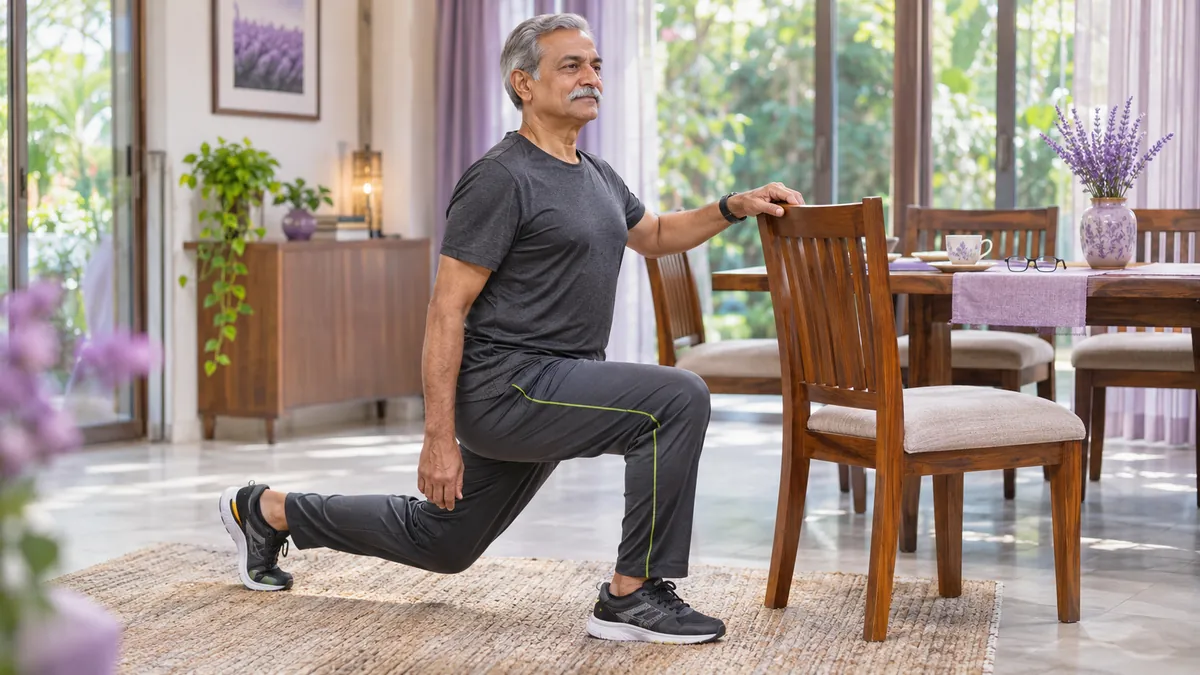
Change the leverage, the range or the number of legs doing the work. Push-ups get easier with your hands on a wall or table and harder with your feet raised; squats and lunges get harder on one leg; planks get harder on your side. Start each move at the version you can do with good form.
| Move | Easier | Standard | Harder |
|---|---|---|---|
| Squat | Wall sit or sit down to a chair and stand up | Bodyweight squat | 3-second lowering with a pause; then a pistol squat to a chair |
| Push-up | Incline push-up or kneeling push-up | Push-up | Decline push-up (feet on a sofa or step) |
| Reverse lunge | Step-up onto the bottom stair, or lunge holding a chair | Bodyweight reverse lunge | Bulgarian split squat, rear foot on a sofa |
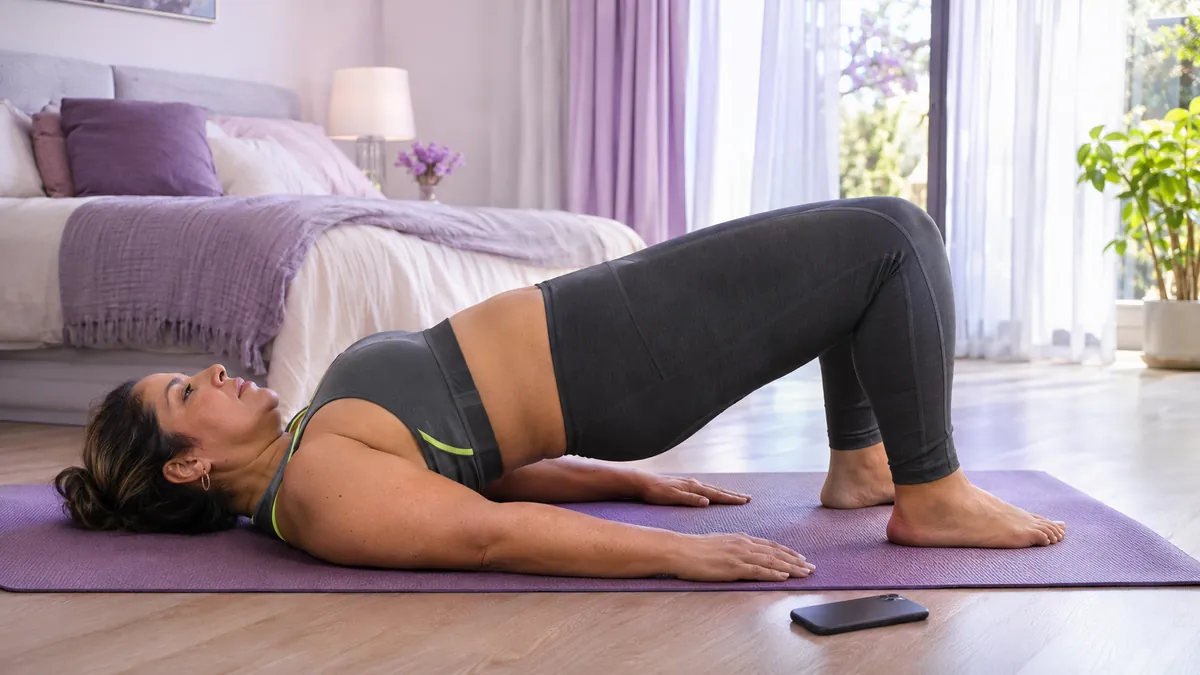
| Glute bridge | Smaller range, pause at the top | Glute bridge | Single-leg glute bridge |
| Plank | Dead bug or a plank on your knees | Plank | Side plank, 20 s each side |
| Mountain climbers | Slow climbers with hands on a sofa or table | Mountain climbers | Burpees |
How often should I do it, and how do I progress?
Do the circuit three times a week on non-consecutive days, such as Monday, Wednesday and Friday, and walk on the days in between. Over four weeks, go from 2 rounds to 3, then lengthen the work interval, then move to harder versions. After week 4, keep switching to harder variations whenever a move gets easy.
| Week | Rounds | Work / change-over | Focus |
|---|---|---|---|
| 1 | 2 | 40 s / 20 s | Learn the moves; use easier versions where needed, 2–3 reps in reserve |
| 2 | 3 | 40 s / 15 s | Full plan; note your reps in each round |
| 3 | 3 | 45 s / 15 s | Push each set to 1–2 reps in reserve |
| 4 | 3 | 45 s / 15 s | Move at least one exercise to its harder version |
Start this week, step by step
- Clear a space. A patch about your body length plus an arm’s reach each side, on a mat or rug.
- Pick three days. Monday, Wednesday and Friday, or any three with a rest day between.
- Warm up for 3 minutes. March on the spot, arm circles, slow squats to a chair and wall push-ups.
- Choose your versions. For each move, pick the version you can do for the bottom of its 40-second target with clean form.
- Run the circuit. Squat, push-up, reverse lunge, glute bridge, plank, mountain climbers: 40 seconds each, 1 minute’s rest after each round, 2 rounds in week 1 and 3 from week 2.
- Progress every week. Note your reps; when you hit the top of a target in all rounds, switch that move to its harder version.
Is a home workout enough to lose weight?
On its own, rarely. Weight loss comes mainly from eating a little less than you burn; a 20-minute circuit burns a modest amount, and daily steps add more. What strength training does is help you keep muscle while you lose fat. Combine this plan with a small calorie deficit, more walking and enough protein.
Walking is the easy win: in a 2022 meta-analysis of 15 studies, the risk of dying from any cause fell as daily steps rose, levelling off at about 6,000–8,000 steps a day in adults over 60 and 8,000–10,000 in younger adults. To set your food target, use the calorie deficit calculator or read how many calories you need. If you sit all day, our guide for desk workers shows how to fit the steps in.
How do I warm up, and how much space do I need?
Warm up for about 3 minutes: march on the spot, do arm circles, ten slow squats to a chair and a few incline push-ups against a wall. For space, a clear patch about the length of your body plus an arm's reach to each side is enough. A mat or rug stops your hands and knees aching on hard floors.
- Quiet version for flats: swap mountain climbers for slow, controlled climbers, never jump, and skip burpees. Squats with a 3-second lowering are hard and silent.
- Hot room? Open a window and keep water nearby.
- Shoes: barefoot or flat trainers both work on a non-slip floor; avoid socks on wood or tiles.
What can I add at home to make it harder?
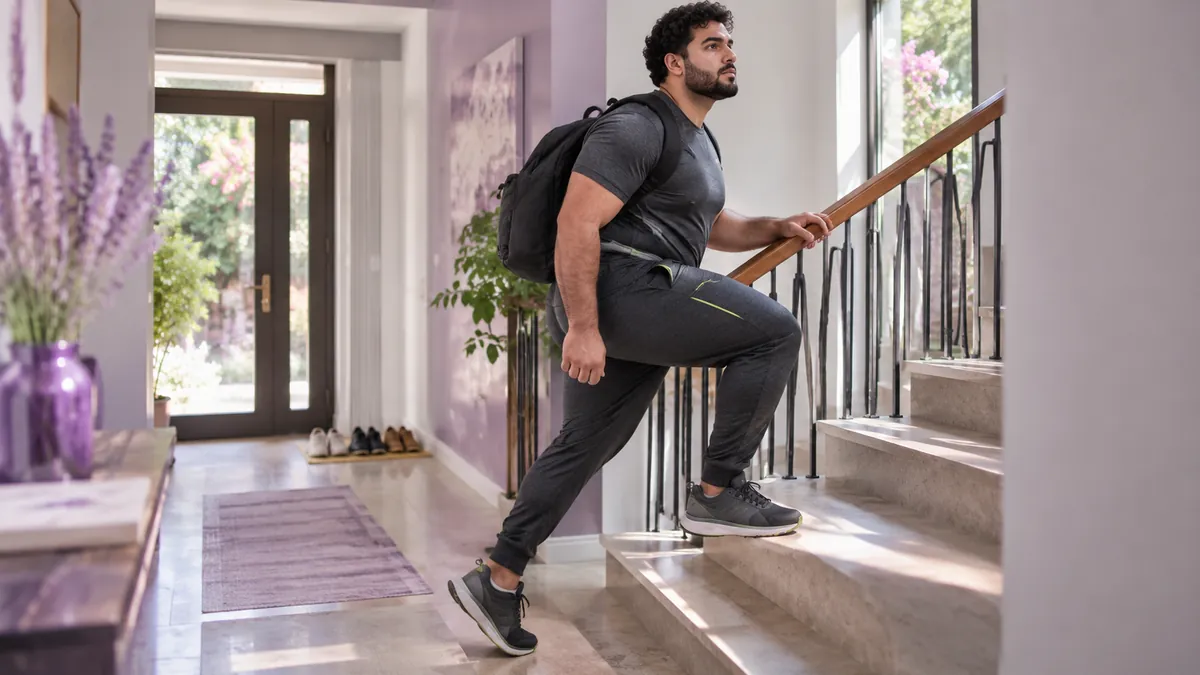
A backpack filled with books or water bottles adds load to squats, lunges and glute bridges. A resistance band lets you train your back, which bodyweight moves miss. A sturdy chair or stairs give you step-ups, decline push-ups and split squats. Add one thing at a time.
- Backpack: wear it on both shoulders for squats and lunges, or rest it across your hips for glute bridges. Start light, about 5 kg (11 lb), and pack it so nothing shifts.
- Band: a band bent-over row covers the pulling muscles of the upper back. Bands are cheap and pack flat.
- Table: an inverted row under a solid, heavy table works too, but only if it cannot tip; when in doubt, use the band.
- Chair: dips off a chair train the triceps; keep your range small if your shoulders complain, and put the chair against a wall.
How do I track this home workout?
Write down which version you did and how many reps you got in each round, then try to beat one number next time. That record tells you when to move to a harder version. In Fitrang the home programs run this plan with an interval timer and an animated demo for every move, and they work offline.
The app's programs guide explains which home program fits you: Home Bodyweight for beginners, and Home Upper / Lower once you have trained for a few months and want more volume.
The bottom line
Do six bodyweight moves (squat, push-up, reverse lunge, glute bridge, plank, mountain climbers) as a circuit: 40 seconds each, 3 rounds, about 20 minutes, three days a week. Stop each set with 1–3 reps in reserve and move to a harder version when you hit the top of the target in every round. For weight loss, pair it with more walking and a small calorie deficit.
Frequently asked questions
Can I get fit with just bodyweight exercises?
Yes. Bodyweight moves build strength and muscle when sets end close to failure and you keep making them harder, and circuits like this also work your heart and lungs. Add walking or other cardio to reach the WHO's 150 to 300 minutes of moderate activity a week.
How many push-ups should a beginner do?
There is no fixed number. Choose the version you can do for about 6 to 15 good reps, whether against a wall, on a table, on your knees or on the floor, and stop each set with 1 to 3 reps left. When you reach 15 in every round, move to a harder version.
Is a 20-minute workout enough?
Yes, for building strength, three 20-minute sessions a week cover the WHO advice of muscle strengthening on two or more days. For overall health, add walking or other aerobic activity, aiming for 150 to 300 minutes of moderate activity across the week.
How do I make bodyweight exercises harder?
Change the leverage or use one leg: raise your feet for push-ups, do Bulgarian split squats instead of lunges, single-leg glute bridges instead of bridges, and side planks instead of planks. Slower lowering, pauses and a loaded backpack also make moves harder.
Can I do this every day?
It is better on three non-consecutive days a week, because muscles adapt in the rest between hard sessions. On the other days, walk or do gentle mobility work. If you want to train more often, alternate upper-body and lower-body days.
What if I cannot do a push-up or squat yet?
Start with the easier versions: push-ups with your hands on a wall or kitchen counter, and squats down to a chair and back up. Lower the push-up surface and the chair height a little every week or two until you can do the standard moves.
Keep reading
 Which Fitrang workout program should you pick?Home and gym programs compared, with a chooser
 Sets, reps and rest explainedThe complete workout guide
 Fitness habits for people who sit all daySmall daily moves that add up
 TDEE and daily calorie calculatorWhat actually drives weight loss
Sources
- Schoenfeld BJ, Grgic J, Ogborn D, Krieger JW. Strength and hypertrophy adaptations between low- vs. high-load resistance training: a systematic review and meta-analysis. Journal of Strength and Conditioning Research 2017;31(12):3508–3523. PubMed
- Kikuchi N, Nakazato K. Low-load bench press and push-up induce similar muscle hypertrophy and strength gain. Journal of Exercise Science & Fitness 2017;15(1):37–42. PubMed
- Kotarsky CJ, Christensen BK, Miller JS, Hackney KJ. Effect of progressive calisthenic push-up training on muscle strength and thickness. Journal of Strength and Conditioning Research 2018;32(3):651–659. PubMed
- World Health Organization. WHO guidelines on physical activity and sedentary behaviour (2020). who.int
- Paluch AE, Bajpai S, Bassett DR, et al. Daily steps and all-cause mortality: a meta-analysis of 15 international cohorts. Lancet Public Health 2022;7(3):e219–e228. PubMed
- American College of Sports Medicine. Progression models in resistance training for healthy adults (position stand). Medicine & Science in Sports & Exercise 2009;41(3):687–708. PubMed
This article is general information for healthy adults, not medical advice. If you have a medical condition, are pregnant, or take medication, talk to a doctor or registered dietitian before changing your diet, sleep or training.