Training · Guide
How to work out: the complete beginner-to-intermediate guide
Key takeaways
- 2+ daysa week of strength training for all adultsWHO guidelines, 2020
- 150–300 minof moderate cardio a weekWHO guidelines, 2020
- 10–20 setsper muscle per week for steady growthSchoenfeld meta-analysis, 2017
- 1–3 RIRreps left in the tank grows muscle like failure, with less fatigueRefalo meta-analysis, 2023
- 2–3 minrest on big lifts built more muscle than 1 minSchoenfeld, 2016
DefinitionProgressive overload means making your training slightly harder over time (more reps, more weight or more sets) so your body keeps adapting.
Around the lifting, walk every day, sleep 7–9 hours and eat enough protein. Do that for a year and you will look and feel different.
Most workout advice online is either too vague ("just stay consistent") or too technical. This guide is the middle path: every term you will meet in a gym, explained in plain words, with the numbers that research supports and the mistakes that waste most beginners' first year. If you want a ready-made plan instead, jump to which Fitrang program to pick.
What do sets, reps and rest mean?
- Rep (repetition): one full movement, e.g. one squat down and up.
- Set: a group of reps done without stopping, e.g. 10 squats.
- Rest: the break between sets.
- "3 × 10": three sets of ten reps.
- Working set: a set that counts. Warm-up sets are lighter sets that get you ready and are not counted as training volume.
- 1RM (one-rep max): the most you could lift once. You never need to test it to train well.
How many reps should I do to build muscle?
Muscle grows across a wide range of reps. A meta-analysis comparing heavy (fewer than about 15 reps) and light loads (more than 15) found similar muscle growth when sets were taken close to failure; heavy loads were better for building maximum strength. In practice:
| Goal | Reps per set | Typical moves |
|---|---|---|
| Strength | 3–6 | Squat, deadlift, bench press, overhead press |
| Muscle (hypertrophy) | 6–12 | Most compound and machine lifts |
| Muscle + endurance | 12–20 | Lateral raises, curls, calf raises, bodyweight moves |
A good default for beginners is 6–12 reps on big lifts and 10–15 on small ones. Very low reps are hard to do safely before your technique is solid, and very high reps turn into a breathing test rather than a muscle test.
What are RIR and RPE, and how hard should a set be?
RIR means reps in reserve: how many more clean reps you could have done when you stopped. RPE (rating of perceived exertion) puts the same idea on a 1–10 scale. They map neatly onto each other:
| RPE | RIR | What it feels like |
|---|---|---|
| 10 | 0 | Could not do another rep: failure |
| 9 | 1 | One more rep, maybe |
| 8 | 2 | Two more reps left: hard but clean |
| 7 | 3 | Bar speed still good, clearly challenging |
| 5–6 | 4–5 | Warm-up or technique work |
Most of your working sets should land at RPE 7–9 (1–3 RIR). A 2023 meta-analysis found that going all the way to failure gives at most a trivial extra benefit for muscle growth, while adding a lot more fatigue. Keep true failure for the last set of small, safe exercises (curls, machine work), never for heavy squats or deadlifts.
What is progressive overload?
Progressive overload means making your training slightly harder over time (more reps, more weight or more sets) so your body keeps adapting. Your body adapts to what you ask of it, then stops adapting. To keep improving, the training has to get slightly harder over time. That is progressive overload, and the American College of Sports Medicine lists it as the first principle of resistance training. Ways to do it, in the order most people should use them:
- More reps at the same weight (8 → 9 → 10).
- More weight once you hit the top of your rep range on every set (then go back to the bottom of the range).
- More sets per week, added slowly, after a few months.
- Harder variations for bodyweight moves: knee push-up → push-up → feet-raised push-up.
- Better technique: a deeper squat or a slower lowering with the same weight is progress too.
This is called double progression: reps first, then weight. With a rep range of 8–12, it might look like 40 kg × 12, 12, 12 → next session 42.5 kg × 9, 8, 8 → and back up over the following weeks. Progress is never perfectly smooth. A week where nothing goes up is normal; three in a row means look at sleep, food and stress.
How long should I rest between sets?
- Big compound lifts (squat, deadlift, bench, rows): 2–3 minutes.
- Smaller exercises (curls, raises, machines): 60–90 seconds.
- Circuits and HIIT: 20–45 seconds on purpose; that is the cardio part.
Longer is not lazy. In trained men, resting 3 minutes instead of 1 between sets produced more strength and more muscle over eight weeks, simply because they could lift more in each set. If time is short, rest less on small moves, not on the big ones. A rest timer stops you guessing.
How should I warm up?
A good warm-up takes 5–10 minutes and has two parts:
- General: 3–5 minutes of easy cardio (brisk walk, cycle, skipping) until you are slightly warm.
- Specific: two to four lighter sets of your first exercise, building up. For a 60 kg squat: empty bar × 10, 30 kg × 5, 45 kg × 3, then your working sets.
What are the form basics for the main lifts?
Nearly every gym programme is built on a few movement patterns. Learn these and you can do almost any exercise. Each demo below is Fitrang's own animation; tap play to watch it loop, and follow the link for step-by-step cues and common mistakes.
Squat (knee-dominant legs)
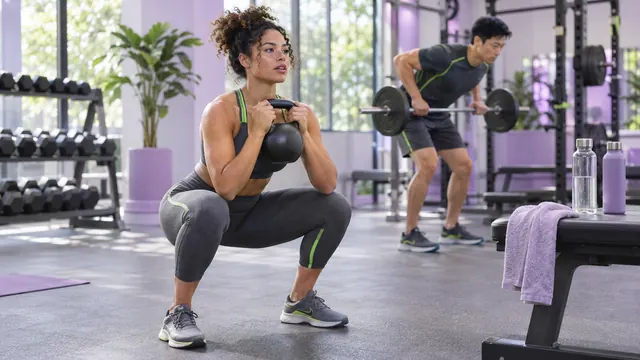
Feet about shoulder-width, brace your stomach like someone is about to poke it, sit down between your heels with your chest up, and let your knees travel forward over your toes. Go as deep as you can while your back stays flat. Start with the goblet squat if a barbell feels awkward.
Hinge (hips and hamstrings)
Push your hips back like closing a car door with your bum, keep the bar or dumbbells close to your legs, and keep your back flat. Stop when you feel a strong stretch in your hamstrings, usually around mid-shin, then drive your hips forward. The deadlift is the same pattern starting from the floor.
Push (chest, shoulders, triceps)
Hands just wider than shoulders, body in one straight line from head to heels, elbows angled about 45° from your body rather than flared out. Lower until your chest nearly touches the floor. Too hard? Hands on a bench (incline push-up). The bench press follows the same rules.
Pull (back and biceps)
Flat back, pull the elbow towards your hip, not your ear, and pause for a moment at the top. Lower slowly. Rows balance all the pushing and all the hours spent hunched over a laptop. Vertical pulls (lat pulldown, pull-up) complete the back.
How many sets per muscle per week build muscle?
Weekly volume is the number of hard sets (RPE 7+) a muscle gets in a week. A meta-analysis by Schoenfeld and colleagues found a clear dose-response: 10 or more sets per muscle per week grew muscle noticeably more than fewer than 5. Later work suggests benefits keep coming up to around 20 sets for many people, with diminishing returns and more fatigue past that.
Beginners grow on less: 6–10 sets per muscle a week is plenty for the first few months. Also, there is a limit per session; past roughly 8–10 hard sets for one muscle in one workout, extra sets mostly add fatigue. That is why spreading volume over two or three sessions a week works better than one marathon "chest day".
Weekly volume calculator (per muscle)
Example: 2 sessions × 4 hard sets = 8 sets a week, a good start for beginners. Aim for 10–20 sets a week once you have trained 6+ months, spread over 2–3 sessions, with no more than about 8–10 hard sets per muscle in one session.
Count a set for a muscle when it is a main mover (rows for back, not for biceps). Add sets slowly: two more per muscle per week, every month or so.
How many days a week should I train?
The WHO recommends muscle-strengthening activity on two or more days a week for all adults. For building muscle, training each muscle about twice a week beats once for the same total sets. That gives you three good options:
- 2 days: two full-body sessions. Enough to make real progress, especially for busy people.
- 3 days: full body A/B/A. The best starting point for most beginners (see our 3-day split guide).
- 4 days: upper/lower, twice each. The natural step after 6–12 months.
Five or six lifting days can work for experienced lifters, but more days is not automatically better. Pick the number you can keep doing during exam season, Diwali week and month-end at work.
Cardio or weights: which should I do?
Both, because they do different jobs. Weights build and keep muscle and bone, which matters more every decade after 30. Cardio trains your heart and lungs. The WHO advises adults to get 150–300 minutes of moderate activity (brisk walking, easy cycling) or 75–150 minutes of vigorous activity (running, fast cycling, HIIT) a week, plus two strength days.
Do they interfere? Not at normal amounts. Keep hard cardio away from leg day if you can (or after lifting, not before), and favour low-impact options like walking and cycling if strength is your main goal. Two or three 30-minute sessions a week will not cost you muscle.
How many steps a day should I walk?
A meta-analysis of 15 studies with over 47,000 adults found the risk of early death kept falling up to about 8,000–10,000 steps a day for adults under 60 and 6,000–8,000 for those over 60. You do not need 10,000 on day one. If you are at 3,000, aim for 5,000 this month and 7,000 next.
Easy ways in a working day: walk to the train or bus stop instead of driving or taking a taxi for short trips, take calls on foot, a 10-minute walk after lunch and dinner (it also blunts the blood-sugar rise after a carb-heavy meal), and the stairs for anything under four floors.

How do I recover between workouts?
- Sleep 7–9 hours. Short sleep makes the same weights feel heavier and, in a diet, shifts weight loss from fat towards muscle. Read what one short night does to your results.
- Eat enough protein: about 1.6 g per kg of body weight a day is where muscle gains level off in research; spread it over three or four meals. Our protein guide has a calculator and vegetarian and meat-based options.
- Leave 48 hours before training the same muscle hard again.
- Soreness is not a scorecard. It fades after the first few weeks even while you keep growing.
- Take an easy week (half the sets, lighter weights) every 8–12 weeks or when everything feels heavy.
What are the most common workout mistakes?
- No plan. Walking in and "seeing what is free" leads to random training and no progress. Follow a program.
- Not tracking. If you cannot remember last week's weight, you cannot beat it.
- Ego lifting. Too heavy, half the range of motion, form gone. Lighter and full range builds more muscle and fewer injuries.
- Program-hopping every two weeks after a new reel. Run one plan for 8–12 weeks.
- Only training the mirror muscles (chest, biceps) and skipping legs and back.
- Every set to failure, or the opposite, every set far too easy.
- Ignoring food and sleep, then blaming the program.
How do I do my first workout, step by step?
Every session in a good program follows the same order. Here it is for a typical 45–60 minute gym workout; the same steps work at home with bodyweight moves.
- Warm up generally. Do 3–5 minutes of easy cardio (brisk walk, cycle or skipping) until you are slightly warm.
- Ramp up on the first lift. Do two to four lighter sets of your first exercise, building up, e.g. empty bar × 10, 30 kg × 5, 45 kg × 3 before a 60 kg squat.
- Do your working sets. Do 2–4 sets of 6–15 reps on each exercise, stopping 1–3 reps before failure. Start with the big compound lifts (squat, hinge, push, pull).
- Rest the right amount. Rest 2–3 minutes after big compound lifts and 60–90 seconds after smaller exercises. Use a rest timer instead of guessing.
- Log every set. Write down the weight and reps of every set so you know exactly what to beat next time.
- Progress next session. When you hit the top of your rep range on every set, add the smallest weight jump (about 2.5 kg) and build the reps back up. This is double progression.
- Recover before the next session. Leave about 48 hours before training the same muscle hard again, sleep 7–9 hours and eat about 1.6 g of protein per kg of body weight a day.
What does a beginner workout week look like?
| Day | Training | Details |
|---|---|---|
| Mon | Full Body A (~45 min) | Back squat 3×8 · bench press 3×8 · dumbbell row 3×10 · lateral raise 2×15 · plank 3×1 min |
| Tue | Walk | 30–40 min brisk walk, 7,000+ steps |
| Wed | Full Body B (~45 min) | Deadlift 3×5 · overhead press 3×8 · lat pulldown 3×10 · walking lunge 2×12 · hanging knee raise 3×12 |
| Thu | Rest or easy cardio | Walk, cycle, yoga or play a sport |
| Fri | Full Body A | Same as Monday; try to add a rep or 2.5 kg |
| Sat | Cardio | 30 min cycle or Walk to Run session |
| Sun | Rest | Plan meals, sleep in |
Next week, swap A and B (B, A, B). This gives each major muscle roughly 6–9 hard sets a week, ideal for the first few months, plus around 150 minutes of moderate cardio once you count the walks.
How do I track my workouts in Fitrang?
- Pick a program in Train → Programs (or build your own routine from the exercise library). It adds the routines and can set your week.
- Start the workout. Each exercise shows your previous weights and reps next to today's sets, so you know exactly what to beat.
- Log each set with weight and reps, mark warm-up, drop and failure sets, and optionally rate the set's RPE.
- Let the rest timer run between sets; it notifies you when it is time to go again.
- Follow the next-weight hint on your first set: it suggests adding weight, holding or easing off based on last time.
- Check muscle freshness to see which muscles are fresh, recovering or tired before your next session, and use the plate calculator for barbell loading.
It works offline in the gym basement and syncs later, and your workouts feed the same Discipline Score as your food and sleep.
The bottom line
Lift 2–4 days a week with a few big movements (squat, hinge, push, pull): 2–4 sets of 6–15 reps, stopping 1–3 reps short of failure, resting 1–3 minutes. Add reps, then weight, every week or two. Walk 7,000–10,000 steps, sleep 7–9 hours and eat enough protein, and keep it up for a year.
Frequently asked questions
How many sets and reps should a beginner do?
Two to four sets of 6–12 reps on big exercises and 10–15 on small ones, stopping one to three reps before failure. Across the week, 6–10 hard sets per muscle is plenty for the first few months.
Should I train to failure?
Not usually. Research shows training to failure adds little or no extra muscle compared with stopping one to three reps short, and it adds fatigue. Use it occasionally on the last set of safe exercises like curls or machines, not on heavy squats or deadlifts.
How long should a workout take?
Forty-five to sixty minutes including the warm-up is enough for most people. If sessions run past 75 minutes, you are probably doing too many exercises or chatting between sets.
Is it okay to work out every day?
Moving every day is great; lifting hard every day is not necessary. Train the same muscle hard every 48 hours or so, and fill other days with walking, easy cardio or mobility.
Can I build muscle and lose fat at the same time?
Beginners and people returning after a break often can, with a small calorie deficit, enough protein (around 1.6 g per kg) and progressive strength training. Leaner, experienced lifters usually find it easier to focus on one goal at a time.
What should I eat before a workout?
Something light with carbs and a little protein 1–2 hours before works for most people: a banana with yogurt, a bowl of oats, or toast with eggs or cottage cheese. Training fasted is fine too if you feel good doing it.
How soon will I see results?
Strength improves in the first few weeks, mostly from better coordination. Visible muscle changes usually take 8–12 weeks of consistent training with enough protein and sleep. Measure your waist and log your lifts, not just your weight.
Keep reading
 Workout programs in Fitrang: which one should you pick?Every program compared, with a chooser
 Beginner 3-day workout splitFull-body A/B/A vs push/pull/legs
 How much protein do I need?Grams per kg by goal, with a calculator
 What one short night does to your resultsWhy recovery starts in bed
Sources
- World Health Organization. WHO guidelines on physical activity and sedentary behaviour (2020). who.int
- American College of Sports Medicine. Progression models in resistance training for healthy adults (position stand). Medicine & Science in Sports & Exercise 2009;41(3):687–708. PubMed
- Schoenfeld BJ, Ogborn D, Krieger JW. Dose-response relationship between weekly resistance training volume and increases in muscle mass: a systematic review and meta-analysis. Journal of Sports Sciences 2017;35(11):1073–1082. PubMed
- Schoenfeld BJ, Ogborn D, Krieger JW. Effects of resistance training frequency on measures of muscle hypertrophy: a systematic review and meta-analysis. Sports Medicine 2016;46(11):1689–1697. PubMed
- Schoenfeld BJ, Grgic J, Ogborn D, Krieger JW. Strength and hypertrophy adaptations between low- vs. high-load resistance training: a systematic review and meta-analysis. Journal of Strength and Conditioning Research 2017;31(12):3508–3523. PubMed
- Refalo MC, Helms ER, Trexler ET, Hamilton DL, Fyfe JJ. Influence of resistance training proximity-to-failure on skeletal muscle hypertrophy: a systematic review with meta-analysis. Sports Medicine 2023;53(3):649–665. PubMed
- Zourdos MC et al. Novel resistance training-specific rating of perceived exertion scale measuring repetitions in reserve. Journal of Strength and Conditioning Research 2016;30(1):267–275. DOI
- Schoenfeld BJ et al. Longer interset rest periods enhance muscle strength and hypertrophy in resistance-trained men. Journal of Strength and Conditioning Research 2016;30(7):1805–1812. PubMed
- Paluch AE et al. Daily steps and all-cause mortality: a meta-analysis of 15 international cohorts. The Lancet Public Health 2022;7(3):e219–e228. PMC
- Morton RW et al. A systematic review, meta-analysis and meta-regression of the effect of protein supplementation on resistance training-induced gains in muscle mass and strength in healthy adults. British Journal of Sports Medicine 2018;52(6):376–384. PubMed
- National Strength and Conditioning Association. NSCA's Guide to Program Design / Essentials of Strength Training and Conditioning. nsca.com
This article is general information for healthy adults, not medical advice. If you have a medical condition, are pregnant, or take medication, talk to a doctor or registered dietitian before changing your diet, sleep or training.