Training · Beginners
Beginner 3-day workout split

Key takeaways
- 2–3 daysa week of full-body training for novicesACSM position stand, 2009
- 2× / weekper muscle grows it better than onceSchoenfeld meta-analysis, 2016
- 10–20 setsper muscle per week is the productive rangeSchoenfeld meta-analysis, 2017
- 8–12 repson multi-joint lifts for novicesACSM position stand, 2009
- 45–60 minper session, including warm-upFitrang Full Body A/B estimate
DefinitionA workout split is how you divide your exercises across the training days of a week, for example full body every session or push, pull and legs on separate days.
If you sit at a desk most of the day and have not lifted before, three sessions a week is the sweet spot: enough stimulus to build muscle and strength quickly, little enough that it fits around work and recovers fully. This guide compares the two most common three-day layouts, gives you the exact workouts, and explains how to progress so you keep improving after the first month.
Full-body A/B/A or push/pull/legs: which 3-day split is better for beginners?
| Full-body A/B/A | Push / pull / legs | |
|---|---|---|
| How it works | Two whole-body workouts, alternated: A, B, A one week, B, A, B the next. | One day pushing (chest, shoulders, triceps), one pulling (back, biceps), one legs. |
| Each muscle trained | 3× a week (1.5× per workout type) | 1× a week |
| Exercises per session | 5–6, all compound | 5–6, more isolation |
| Missed a day? | No problem, just do the next workout in the sequence | That muscle group waits two weeks |
| Best for | Beginners, busy people, strength + size together | Intermediates who later move to 6 days (PPL × 2) |
The research is consistent: for the same weekly volume, training a muscle twice a week produces more growth than once, and beginners respond to very little volume per session. Full-body training also means every session practises the big lifts, so technique improves faster. Push/pull/legs is a fine template, but it only shines when you run it twice a week over six days. Start with A/B/A; switch later if you want to.
How do I plan my 3-day workout week?
Build your week
Shown: full-body A/B/A on Monday, Wednesday and Friday, week 1. Week 2 runs B, A, B.
Rest days: walk, stretch, sleep. Two sessions back-to-back is fine occasionally; three is not.
| Day | Workout | Exercises (sets × reps) |
|---|---|---|
| Mon | Full body A | Squat 3×6–10 · Bench press or push-up 3×6–10 · Seated row 3×8–12 · Romanian deadlift 3×8–10 · Plank 3×30–45 s |
| Wed | Full body B | Deadlift (trap bar or conventional) 3×5–6 · Overhead press 3×6–10 · Lat pulldown or assisted pull-up 3×6–10 · Split squat 3×8–10 each leg · Face pull 3×12–15 |
| Fri | Full body A | Squat 3×6–10 · Bench press or push-up 3×6–10 · Seated row 3×8–12 · Romanian deadlift 3×8–10 · Plank 3×30–45 s |
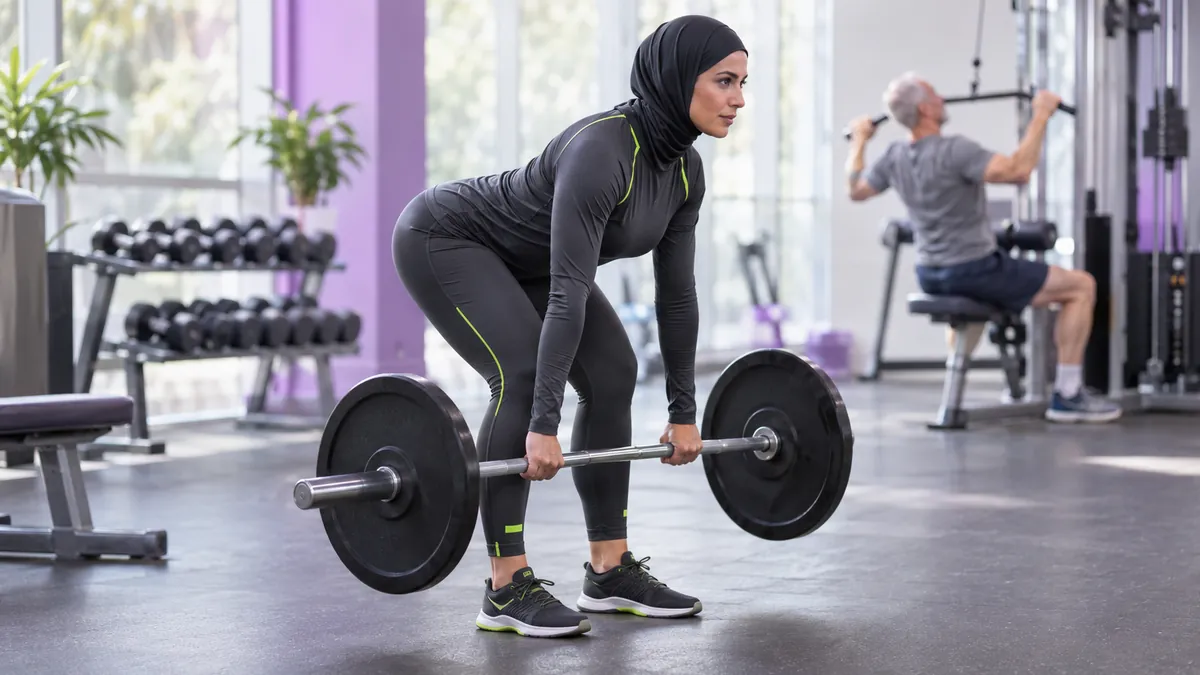
What exercises are in a beginner full-body workout?
Full body A
- Squat (goblet squat first, barbell back squat once comfortable): 3 × 6–10
- Bench press or push-up: 3 × 6–10
- Seated cable row or one-arm dumbbell row: 3 × 8–12
- Romanian deadlift (dumbbell or barbell): 3 × 8–10
- Plank: 3 × 30–45 s
Full body B
- Deadlift (trap bar if available): 3 × 5–6
- Overhead press (dumbbell or barbell): 3 × 6–10
- Lat pulldown or assisted pull-up: 3 × 6–10
- Split squat or reverse lunge: 3 × 8–10 each leg
- Face pull or band pull-apart: 3 × 12–15
Push / pull / legs (if you prefer it)
- Push: bench press 3×6–10 · overhead press 3×6–10 · incline dumbbell press 3×8–12 · lateral raise 3×12–15 · triceps pushdown 3×10–15
- Pull: deadlift or RDL 3×5–8 · lat pulldown or pull-up 3×6–10 · seated row 3×8–12 · face pull 3×12–15 · biceps curl 3×10–12
- Legs: squat 3×6–10 · Romanian deadlift 3×8–10 · leg press or split squat 3×8–12 · leg curl 3×10–12 · calf raise 3×12–15 · plank 3×30–45 s
Start this week, step by step
- Pick three non-consecutive days. Monday, Wednesday and Friday is the classic choice; any three with a rest day between work.
- Alternate two workouts. Week 1: A, B, A. Week 2: B, A, B. Each covers a squat or hinge, a push, a pull and core.
- Warm up. Five minutes of easy cardio, then two or three lighter sets of the first lift.
- Do 3 sets of 6–12 reps. Stop each set 1–3 reps before failure and rest 2–3 minutes on big lifts, 60–90 seconds on small ones.
- Progress with double progression. When every set reaches the top of the rep range, add the smallest weight step next session.
How do I progress week to week?
Beginners get stronger almost every session, and the plan should capture that. Use double progression: pick a rep range (say 6–10), keep the weight fixed until you hit the top of the range on all three sets, then add the smallest weight available (2.5 kg on a barbell, the next dumbbell up) and start again from the bottom of the range.
Double progression on the bench press, 6–10 reps
Week 1: 40 kg for 8, 7, 6 reps. Weeks 2–3 add reps at the same weight. Week 4: 10, 10, 10 reached, so week 5 goes up to 42.5 kg and starts again at 7, 6, 6.
Other rules of thumb:
- Log every set. Progress you cannot see is progress you will not make. Fitrang's workout log keeps your last weights and reps next to each exercise and times your rest.
- If you miss the bottom of the range for two sessions in a row, drop the weight 10% and build back up; usually sleep or food was the problem.
- After 8–12 weeks, take an easy week at 60% of your usual weights, then continue.
- Add volume slowly, not in week one. After three months, a fourth set on the first two lifts is plenty.

What results can I expect, and when?
Strength comes first: most beginners add 20–40% to their main lifts in the first three months, largely from the nervous system learning the movement. Visible muscle takes longer, typically noticeable by 8–12 weeks if you also eat enough protein for muscle gain (1.6–2.2 g per kg) and sleep 7–9 hours a night. If your goal is fat loss, the training protects muscle while a modest calorie deficit removes fat; the scale may barely move in month one while your waist shrinks, which is why we suggest tracking it with the Navy tape-measure body-fat method too.

How should desk workers adjust a 3-day split?
Yes, three. First, spend two extra minutes on hips and upper back in the warm-up: hip-flexor stretch, cat-camel, band pull-aparts. Second, do not skip the rows and face pulls; they are the counterweight to eight hours hunched over a keyboard. Third, schedule the sessions like meetings. Lunchtime or straight after work both beat "later tonight", which usually becomes never. More in our guide for people who sit all day.
The bottom line
Train full-body A/B/A on three non-consecutive days: two alternating workouts of about 5 compound lifts, 3 sets of 6–12 reps, resting 1–3 minutes. Add reps until you hit the top of the range, then add weight. Expect strength first and visible muscle after 8–12 weeks, and keep rows and hip work in every week if you sit at a desk.
Frequently asked questions
Is 3 days a week enough to build muscle?
Yes, for beginners and most intermediates. Three full-body sessions give each muscle 9–12 hard sets a week, two to three times a week, which is enough for steady growth if you keep adding weight and eat enough protein.
Should a beginner do full-body or push/pull/legs?
Full-body A/B/A. On three days it trains each muscle more often, every session practises the main lifts, and a missed day costs nothing because you just do the next workout. Push/pull/legs works best when run six days a week.
How many sets and reps should a beginner do?
Three sets of 6–12 reps per exercise, five or six exercises per session, stopping one or two reps short of failure. Add weight when you hit the top of the rep range on all sets.
Which days should I train on a 3-day split?
Any three with a rest day between most sessions: Monday, Wednesday, Friday is the classic, but Tuesday, Thursday, Saturday works just as well. Consistency matters far more than the specific days.
Can I do cardio on rest days?
Yes. Walking, cycling or easy jogging for 20–40 minutes on rest days helps recovery and heart health and will not hurt your lifting. Keep hard interval sessions to one or two a week.
When should I move to a 4- or 5-day programme?
When you have trained three days a week consistently for 6–12 months, your progress has slowed, and you have the time and recovery (sleep, food) to add sessions. Most people never need more than four days.
Keep reading
 How much protein do I need?The other half of building muscle
 What one short night does to your resultsWhy recovery starts in bed
 Fitness habits for people who sit all dayFitting training around a desk job
 Which Fitrang workout program should you pick?16 free programs compared, with a chooser
Sources
- World Health Organization. WHO guidelines on physical activity and sedentary behaviour (2020). who.int
- American College of Sports Medicine. Progression models in resistance training for healthy adults (position stand). Medicine & Science in Sports & Exercise 2009;41(3):687–708. PubMed
- Schoenfeld BJ, Ogborn D, Krieger JW. Effects of resistance training frequency on measures of muscle hypertrophy: a systematic review and meta-analysis. Sports Medicine 2016;46(11):1689–1697. PubMed
- Schoenfeld BJ, Ogborn D, Krieger JW. Dose-response relationship between weekly resistance training volume and increases in muscle mass: a systematic review and meta-analysis. Journal of Sports Sciences 2017;35(11):1073–1082. PubMed
- Schoenfeld BJ, Grgic J, Ogborn D, Krieger JW. Strength and hypertrophy adaptations between low- vs. high-load resistance training: a systematic review and meta-analysis. Journal of Strength and Conditioning Research 2017;31(12):3508–3523. PubMed
- U.S. Department of Health and Human Services. Physical Activity Guidelines for Americans, 2nd edition (2018). health.gov
This article is general information for healthy adults, not medical advice. If you have a medical condition, are pregnant, or take medication, talk to a doctor or registered dietitian before changing your diet, sleep or training.