Nutrition · Protein
How much protein do I need?
Key takeaways
- 0.8 g/kgofficial minimum (RDA) for adults who do not trainNational Academies DRI, 2005
- 1.6–2.2 g/kgrange for building or keeping muscleMorton et al., BJSM 2018
- 0.4 g/kgper meal, 3–4 times a day, for maximal muscle protein synthesisSchoenfeld & Aragon, JISSN 2018
- 1.2–1.6 g/kgfor active adults over 60PROT-AGE Study Group, 2013
DefinitionProtein is the macronutrient that supplies the amino acids your body uses to build and repair muscle, organs and enzymes; it has 4 kcal per gram.
Protein is the macro most people under-eat, especially desk workers who grab a sandwich at lunch and eat properly only at dinner. This guide gives you a number for your bodyweight and goal, shows how to split it across the day, and translates the grams into food. Use the calculator, then check the tables. For how it fits with carbs and fat, see the macro split guide for protein, carbs and fat.
Protein calculator: how many grams for my weight and goal?
Your daily protein target
Example shown for 70 kg, goal "build muscle", 4 meals: 112–154 g a day, about 28–39 g per meal.
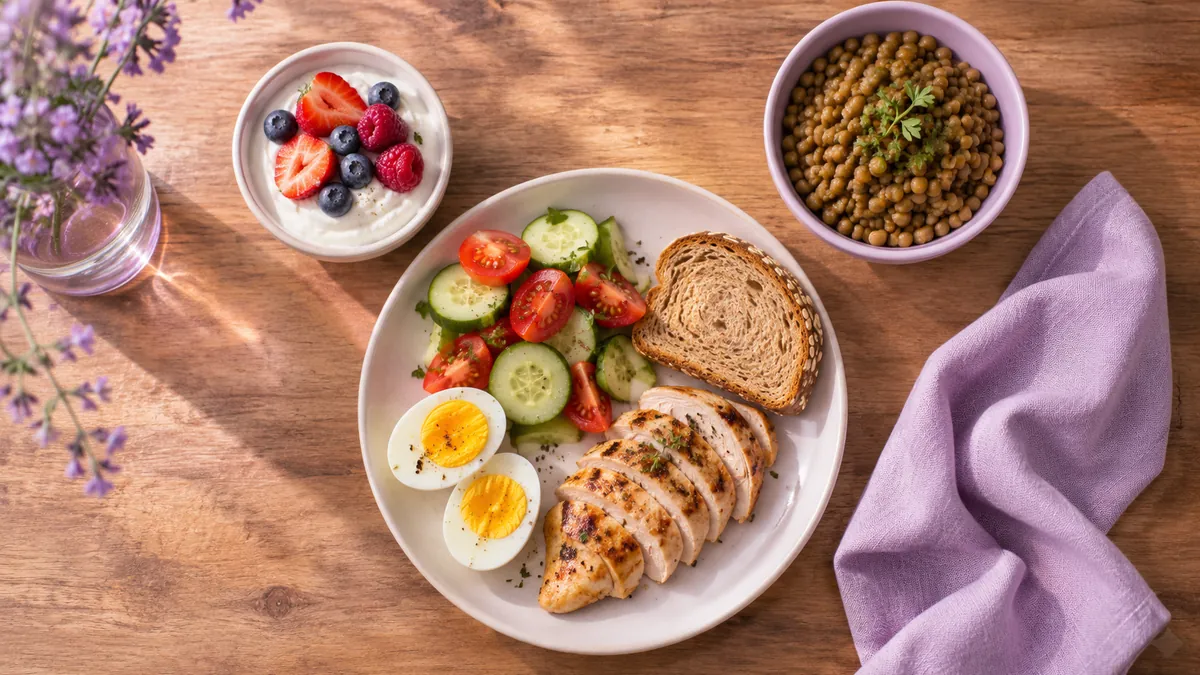
What each meal could look like (about 33 g protein)
- Breakfast: 3 eggs + 150 g Greek yoghurt
- Lunch: 110 g cooked chicken breast with rice and veg
- Snack: 1 scoop whey (30 g) in 250 ml milk
- Dinner: 150 g cooked fish, potatoes and salad
How do I work out my protein target, step by step?
- Pick the weight to use. Use your current bodyweight in kg. If your BMI is over 30, use a realistic goal weight instead.
- Pick the range for your goal. 0.8–1.0 g/kg if you do not train, 1.2–1.6 if you train 1–3 times a week, 1.6–2.2 to build muscle, 1.8–2.4 while losing fat, 1.2–1.6 if you are over 60 and active.
- Multiply. Weight × the range gives your daily grams; a 70 kg lifter at 1.6–2.2 g/kg needs 112–154 g.
- Split it across meals. Divide by 3 or 4 meals, about 0.4 g/kg each (25–40 g for most people), and include breakfast.
- Choose the foods. Use the food table below to pick a portion for each meal, then weigh it for a week until your eye is calibrated.
How much protein per day do I need for muscle gain or fat loss?
It depends on what you want your body to do.
| Situation | g per kg | g per lb | Why |
|---|---|---|---|
| Minimum to avoid deficiency (RDA; WHO uses 0.83) | 0.8 | 0.36 | Set to cover the needs of 97.5% of sedentary adults. A floor, not a target. |
| Generally active, training 1–3× a week | 1.2–1.6 | 0.55–0.7 | Covers repair from training and keeps you full on fewer calories. |
| Building muscle, lifting 3+× a week | 1.6–2.2 | 0.7–1.0 | Muscle gain plateaus around 1.6 g/kg on average; 2.2 covers people who respond to more. |
| Losing fat while keeping muscle | 1.8–2.4 | 0.8–1.1 | Higher protein in a deficit protects lean mass and is the most filling macro per calorie. |
| Adults over 60 | 1.2–1.6 | 0.55–0.7 | Older muscle responds less to each meal, so the per-meal dose needs to be higher. |
How should I spread protein across the day?
Muscle protein synthesis is switched on by each protein-rich meal for a few hours, then returns to baseline. A single enormous dinner does not keep it switched on all day. The practical sweet spot is about 0.4 g/kg per meal, 3–4 times a day, with a maximum useful dose per meal somewhere around 0.55 g/kg. For a 70 kg person that is 28–40 g per meal.
Which foods are highest in protein (veg and non-veg)?
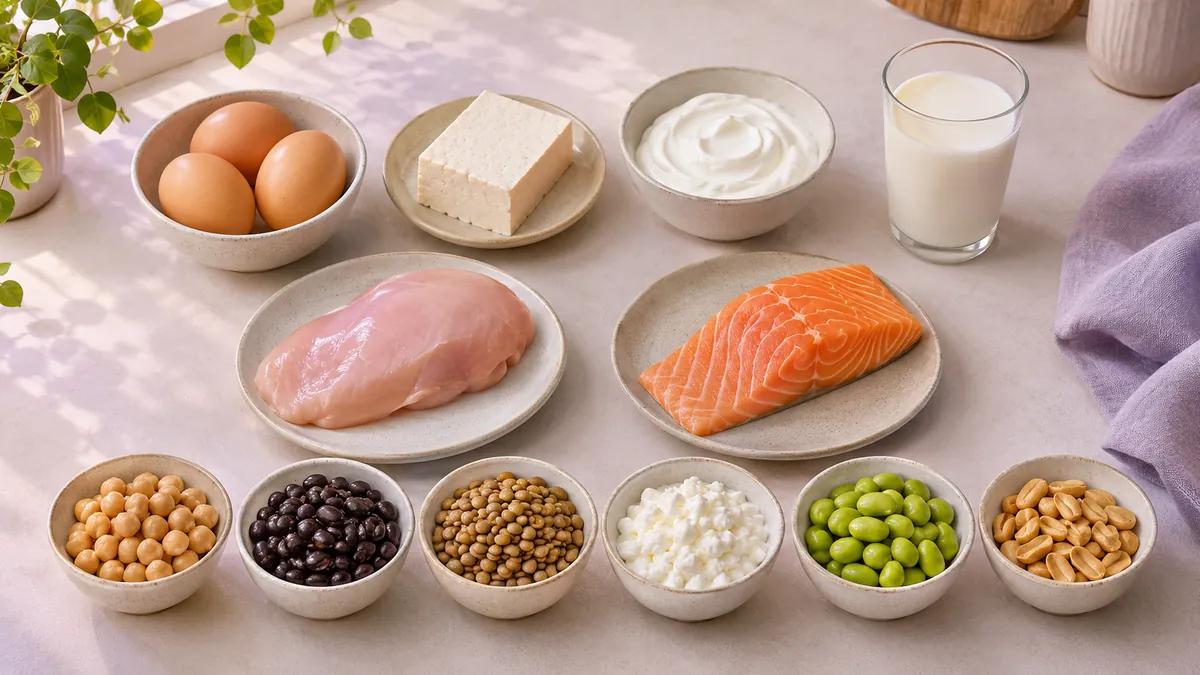
Protein per 100 g of food, as typically eaten. Plant proteins are slightly less digestible and some are low in one amino acid, so vegetarians do well mixing sources (lentils with rice, hummus with bread) and aiming for the top of their range.
| Food | Protein / 100 g | Notes |
|---|---|---|
| Chicken breast, cooked | ≈ 31 g | Cheapest dense source; 110 g gives about 33 g. |
| Fish (salmon, tuna, cod), cooked | ≈ 20–26 g | Oily fish adds omega-3. |
| Eggs | ≈ 13 g | About 6 g per large egg; yolks included. |
| Greek yoghurt, strained | ≈ 10 g | Check the label; "Greek-style" is often half that. |
| Cottage cheese | ≈ 11 g | Fairly low in fat; 200 g gives about 22 g. |
| Tofu, regular | ≈ 8 g | Firm and extra-firm (pressed) tofu carry about double, ≈ 15–17 g; silken is around 5 g. Check the label. |
| Tempeh | ≈ 20 g | Fermented soya; 150 g gives about 30 g. |
| Lentils, cooked | ≈ 9 g | Pair with rice or bread for a complete amino-acid profile. |
| Chickpeas, cooked | ≈ 9 g | Also around 8 g fibre. |
| Milk | ≈ 3.4 g per 100 ml | A 250 ml glass is 8–9 g. |
| Whey protein powder | ≈ 70–80 g | A 30 g scoop gives 22–25 g. Convenient, not magic. |
What does 140 g of protein look like in a real day?
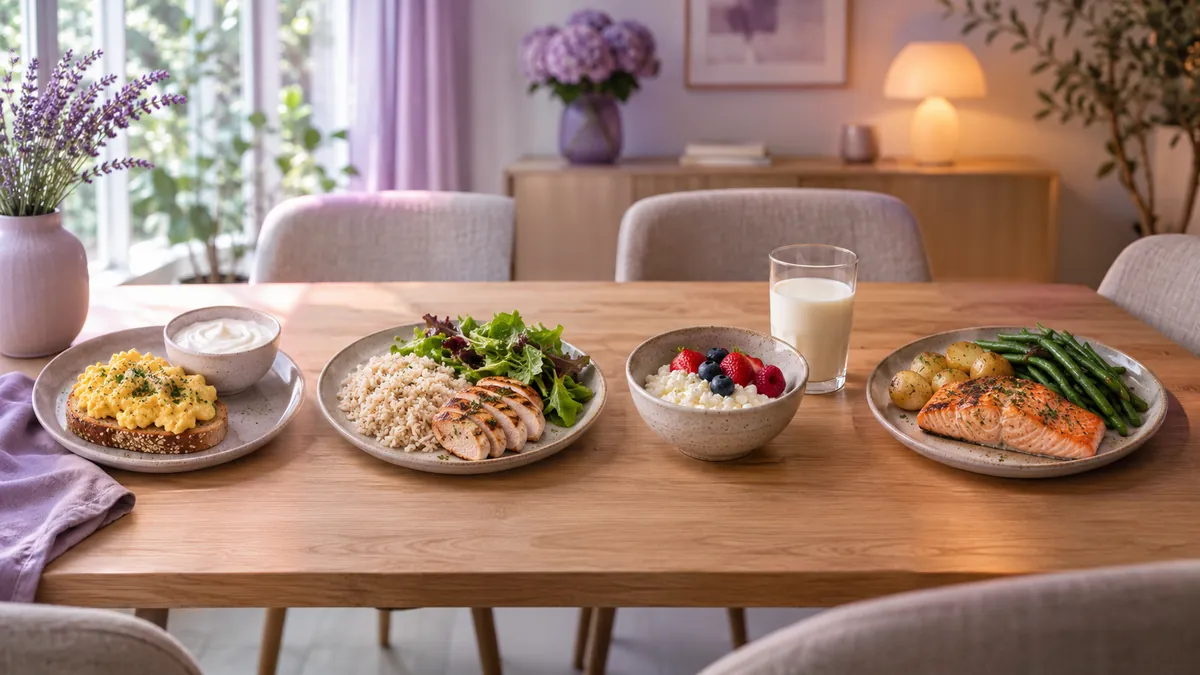
For a 70 kg lifter aiming at 2.0 g/kg:
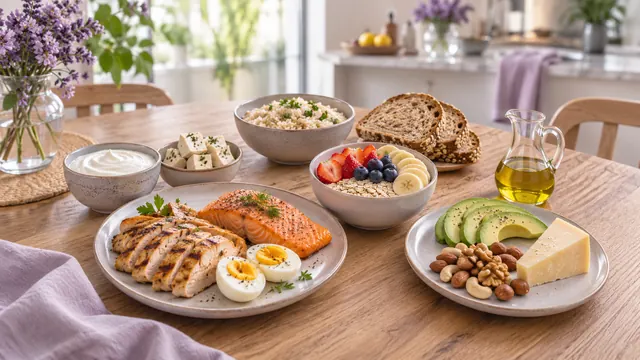
- Breakfast (35 g): 3 eggs scrambled, 150 g Greek yoghurt with fruit.
- Lunch (38 g): 120 g cooked chicken breast, rice, big salad.
- Snack (30 g): whey shake in milk, or 200 g cottage cheese.
- Dinner (37 g): 150 g fish or tempeh, vegetables, potatoes.
Vegetarian version: 200 g cottage cheese on toast at breakfast, lentils with rice and 100 g tofu at lunch, a tempeh stir-fry at dinner, and a glass of milk or a whey shake as the snack.
How much protein should I eat to lose weight?
In a calorie deficit, aim for the top of the range: 1.8–2.4 g/kg of bodyweight (or of a realistic goal weight if you have a lot to lose).
Three reasons. In a calorie deficit, the body will strip muscle for energy unless you give it a reason to keep it; protein plus resistance training is that reason. Protein is the most filling macro per calorie, so a higher-protein deficit is easier to stick to. And digesting protein costs 20–30% of its calories, versus about 5–10% for carbs and 0–3% for fat, so 100 kcal of protein nets you less. In Fitrang this is why fat-loss plans are built protein-first, then the remaining calories are filled with carbs and fat you enjoy. Set the deficit itself with the TDEE and daily calorie calculator, and pair the protein with lifting, for example the beginner 3-day workout split.
What are the most common protein mistakes?
- Counting the food weight as protein. 100 g of chicken is 31 g of protein, not 100.
- One huge dinner. Spreading it across 3–4 meals works better for muscle and for hunger.
- Skipping breakfast protein, then wondering why 4 pm cravings hit.
- Guessing portions. Household measures are wildly inconsistent; weigh in grams for a week and you will calibrate your eye.
- Relying on powder for most of it. Whey is a convenient top-up; whole foods bring fibre, iron, zinc and B12 along for the ride.
The bottom line
Eat 1.6–2.2 g of protein per kg of bodyweight a day if you train (1.8–2.4 g/kg while losing fat), split into 3–4 meals of 25–40 g that include breakfast. Get most of it from whole foods like eggs, Greek yoghurt, lentils, tofu, chicken and fish; whey is a convenient top-up, not a requirement.
Frequently asked questions
Is 0.8 g per kg of protein enough?
It is enough to prevent deficiency in a sedentary adult, which is what the RDA is designed for. If you lift weights, are losing fat, or are over 60, the evidence points to 1.2–2.2 g/kg for better muscle retention, fullness and recovery.
Can I eat too much protein in one meal?
Your body absorbs all of it, but the muscle-building response per meal plateaus around 0.4–0.55 g/kg (about 30–40 g for most people). Extra protein in one sitting is still used for energy and other tissues; it is just less efficient for muscle than spreading it out.
Is a high-protein diet bad for my kidneys?
Not for healthy kidneys. Studies up to around 2–3 g/kg in healthy adults have not found harm. People with existing kidney disease have medical protein limits and should follow their doctor's advice.
Do vegetarians and vegans need more protein?
A little. Plant proteins are slightly less digestible and some are low in one essential amino acid, so mixing sources (lentils with rice, tofu with grains) and aiming for the top of your range covers it. Soya, tofu, tempeh, lentils, chickpeas, dairy and whey or pea protein all work.
Does protein timing around workouts matter?
Far less than the daily total. A protein-rich meal within a couple of hours before or after training is sensible, and the old 30-minute anabolic window has not held up in research. Hit your daily grams, spread them over the day, and train.
Should I calculate protein from my current weight or my goal weight?
If you are close to a healthy weight, use current weight. If you carry a lot of extra body fat, use a realistic goal weight or the top of the healthy BMI range for your height; otherwise the number becomes unrealistically large.
Keep reading
 Macros made simpleFit protein in with carbs and fat
 Navy body-fat method explainedTape-measure body fat with a calculator
 Beginner 3-day workout splitThe training that makes protein count
 What one short night does to your resultsSleep, hunger and muscle
Sources
- Jäger R et al. International Society of Sports Nutrition position stand: protein and exercise. Journal of the International Society of Sports Nutrition 2017;14:20. PubMed
- Morton RW et al. A systematic review, meta-analysis and meta-regression of the effect of protein supplementation on resistance training-induced gains in muscle mass and strength in healthy adults. British Journal of Sports Medicine 2018;52:376–384. PubMed
- Schoenfeld BJ, Aragon AA. How much protein can the body use in a single meal for muscle-building? Implications for daily protein distribution. Journal of the International Society of Sports Nutrition 2018;15:10. PubMed
- Helms ER, Zinn C, Rowlands DS, Brown SR. A systematic review of dietary protein during caloric restriction in resistance trained lean athletes: a case for higher intakes. International Journal of Sport Nutrition and Exercise Metabolism 2014;24(2):127–138. PubMed
- Bauer J et al. Evidence-based recommendations for optimal dietary protein intake in older people: a position paper from the PROT-AGE Study Group. Journal of the American Medical Directors Association 2013;14(8):542–559. PubMed
- WHO/FAO/UNU. Protein and amino acid requirements in human nutrition. WHO Technical Report Series 935, 2007. who.int
- National Academies of Sciences, Engineering, and Medicine. Dietary Reference Intakes for Energy, Carbohydrate, Fiber, Fat, Fatty Acids, Cholesterol, Protein, and Amino Acids (2005). nap.nationalacademies.org
This article is general information for healthy adults, not medical advice. If you have a medical condition, are pregnant, or take medication, talk to a doctor or registered dietitian before changing your diet, sleep or training.