
Nutrition · Macros
Macros made simple: protein, carbs and fat for your goal
Key takeaways
- 4 · 4 · 9kcal per gram of protein, carbs and fatNational Academies DRI, 2005
- 1.6–2.2 g/kgprotein for building or keeping muscleISSN (Jäger), 2017
- 20–35%of calories from fat, at least 0.5 g per kgInstitute of Medicine, 2005
- 14 gfibre per 1,000 kcal (25 g at least)Institute of Medicine, 2005
- 0.83 g/kgminimum protein for healthy adults (safe level)WHO/FAO/UNU, 2007
DefinitionMacros (macronutrients) are the three nutrients that supply calories: protein and carbohydrate at 4 kcal per gram and fat at 9 kcal per gram.
Most adults need 25–30 g of fibre a day, and the macro split matters far less than total calories and protein. Calories decide whether you lose or gain weight; macros decide what you lose or gain. Work out your daily burn first with the calorie (TDEE) calculator, then pick a direction in the fat loss, muscle gain or recomp guide.
Macros (protein, carbohydrate and fat) also decide how full you feel and how well you train. You do not need a fancy split or a special diet. You need three numbers in a sensible order, and a rough idea of which everyday foods supply them. This guide gives you both, with everyday food examples and a calculator that uses the same rules as the Fitrang app.
How do I calculate my macros? Macro calculator for fat loss and muscle gain
Your daily protein, carbs, fat and fibre
Example: 70 kg, 2,100 kcal, fat loss, 1.6 g/kg protein, fat at 28%: 112 g protein (21%), 65 g fat (28%), 267 g carbs (51%) and at least 29 g fibre.
How do I work out my macros step by step?
- Find your calories. Estimate your daily burn (TDEE) and set a deficit for fat loss or a small surplus for muscle gain. Example: 2,100 kcal.
- Set protein from bodyweight. Multiply bodyweight in kg by 1.6–2.2 if you lift (1.0–1.2 if you do not). 70 kg × 1.6 = 112 g protein, which is 448 kcal.
- Set fat as a share of calories. Take 20–35% of calories from fat and divide by 9, keeping at least 0.5 g per kg. 28% of 2,100 kcal = 588 kcal ÷ 9 ≈ 65 g fat.
- Fill the rest with carbs. Subtract protein and fat calories from the total and divide by 4. (2,100 − 448 − 588) ÷ 4 ≈ 267 g carbs.
- Add a fibre target. Aim for 14 g of fibre per 1,000 kcal, at least 25 g. 2,100 kcal ≈ 29 g fibre.
- Check the trend, then adjust calories. Track for 2–3 weeks. If your weekly weight trend is not moving as planned, change calories, not the split.
What are macros, and why do they matter?
Macros are the three nutrients that give your body calories: protein, carbohydrate and fat. Protein and carbohydrate give 4 kcal per gram, fat gives 9 (alcohol, not a nutrient you need, gives 7). If you know your grams, you know your calories: 112 g protein × 4 + 267 g carbs × 4 + 65 g fat × 9 ≈ 2,100 kcal.
Each one has a job. Protein builds and repairs muscle and is the most filling. Fat makes hormones and carries vitamins A, D, E and K. Carbs are the main fuel for hard training and your brain. When calories and protein are matched, research finds low-carb and high-carb diets lose about the same fat, so after protein and a fat minimum, the split is mostly about what you enjoy and can stick to.
How much protein should I eat per day for my goal?
Protein comes first because it is the one that changes your body composition. In a deficit it protects muscle; in a surplus it builds it. Our full protein guide has a per-meal calculator; the short version:
| Goal | g per kg a day | 70 kg person |
|---|---|---|
| Minimum for healthy adults (WHO/FAO/UNU safe level; US RDA 0.8) | 0.83 | 58 g |
| Active, not lifting | 1.0–1.2 | 70–85 g |
| Building muscle | 1.6–2.2 | 112–154 g |
| Losing fat while lifting | 1.8–2.4 | 126–168 g |
Plant proteins are a little less digestible, and grain protein is low in the amino acid lysine. Many vegetarian plates get most of their protein from bread, rice and pasta, so pairing them with lentils, beans, Greek yoghurt, cottage cheese, tofu or eggs matters. Fitrang suggests 1.6 g/kg when you lift, the evidence-based level where muscle gains plateau on average, and lets you raise it towards 2.2.
How much fat do I need?
Most adults need 20–35% of calories from fat, and at least 0.5 g per kg of bodyweight. Fat is the macro people cut too hard when dieting. The US Institute of Medicine's acceptable range is 20–35% of calories, and sports nutrition reviews advise not dropping below about 0.5 g per kg of bodyweight for long, because very low fat intakes are linked to lower testosterone in men and disrupted cycles in women. For a 70 kg person that floor is 35 g a day.
Fitrang's defaults sit in the middle: 28% for a cut, 25% for a max cut or a bulk (leaving more room for protein or training carbs) and 30% to maintain.

How many carbs should I eat a day to lose weight?
Whatever is left once protein and fat are set. On 2,100 kcal with 112 g protein and 65 g fat, that is about 267 g, roughly half your calories, which is close to what most people already eat. On a hard cut, carbs shrink first; on a bulk, most extra calories go to carbs.
If you train hard, carbs refill muscle glycogen and keep sessions strong; very low-carb diets can make high-rep work and sport feel flat. If you sit most of the day and prefer fewer carbs, that is fine as long as protein and fibre stay up. Either way, choose mostly whole grains (wholemeal bread and pasta, brown rice, oats, barley, quinoa), beans and lentils, fruit and vegetables, and keep sugar and white flour as treats.
How much fibre should I eat per day?
The Institute of Medicine sets 14 g of fibre per 1,000 kcal: about 25 g for most women and 30–38 g for men. A large Lancet review of observational studies and trials found the biggest drops in heart disease, diabetes and early death at 25–29 g a day or more. Most people eat well below that once their diet leans on white bread, white rice and packaged snacks.
Fitrang sets your fibre target at 14 g per 1,000 kcal with a floor of 25 g. Easy wins: wholemeal bread over white, a serving of lentils, beans or chickpeas every day, vegetables at two meals, a fruit a day with the skin where you can eat it, and a spoon of flaxseed or chia in yoghurt. Raise fibre gradually and drink water with it.
What are the macros of common foods?
| Food (portion) | kcal | Protein | Carbs | Fat | Fibre |
|---|---|---|---|---|---|
| Lentils, cooked (150 g) | ≈ 175 | 13.5 g | 30 g | 0.6 g | 12 g |
| Chickpeas, cooked (150 g) | ≈ 245 | 13 g | 41 g | 4 g | 11 g |
| Cheddar cheese (30 g) | ≈ 120 | 7 g | 0.4 g | 10 g | 0 |
| Cottage cheese, 4% fat (200 g) | ≈ 195 | 22 g | 7 g | 8.5 g | 0 |
| Plain yoghurt, whole milk (200 g) | ≈ 120 | 7 g | 9 g | 6.5 g | 0 |
| Greek yoghurt, whole milk (150 g) | ≈ 145 | 13.5 g | 6 g | 7.5 g | 0 |
| Egg, large (1) | ≈ 72 | 6 g | 0.4 g | 5 g | 0 |
| Chicken breast, cooked (100 g) | ≈ 165 | 31 g | 0 | 3.6 g | 0 |
| Tofu, firm (150 g) | ≈ 215 | 26 g | 4 g | 13 g | 3.5 g |
| Milk, 2% fat (250 ml) | ≈ 130 | 8.5 g | 12 g | 5 g | 0 |
| White rice, cooked (about 1 cup, 150 g) | ≈ 195 | 4 g | 42 g | 0.4 g | 0.6 g |
| Wholemeal bread (1 slice, 30 g) | ≈ 75 | 3.7 g | 13 g | 1 g | 2 g |
| Oats, dry (40 g) | ≈ 150 | 5 g | 27 g | 3 g | 4 g |
| Peanuts, dry roasted (30 g) | ≈ 175 | 7.5 g | 6 g | 15 g | 2.5 g |
| Cooking oil (1 teaspoon, 5 g) | 45 | 0 | 0 | 5 g | 0 |
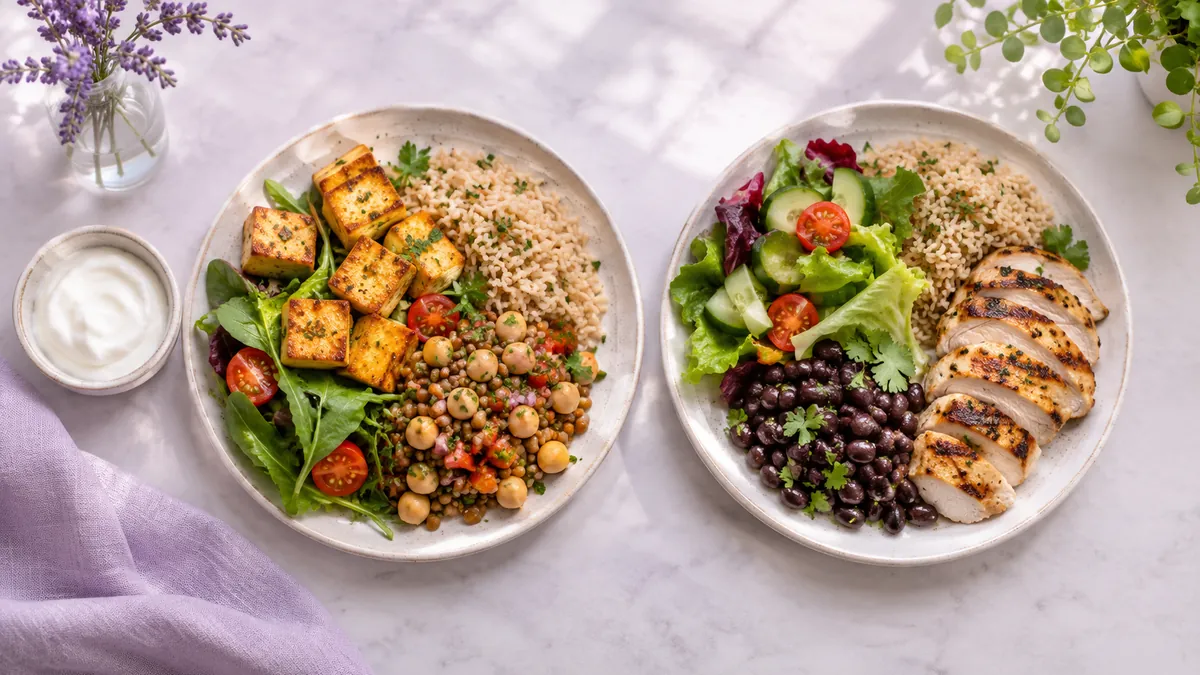
What does a 2,100 kcal, 110 g protein day look like?
Vegetarian (≈ 105–115 g protein):
- Breakfast: 200 g cottage cheese on 2 slices of wholemeal toast with tomato, tea or coffee: about 29 g protein.
- Lunch: lentil soup or salad (200 g cooked lentils), 1 cup rice, vegetables: about 23 g.
- Snack: 150 g Greek yoghurt with fruit, 30 g roasted peanuts: about 20 g.
- Dinner: tofu stir-fry (150 g firm tofu) with vegetables cooked in 2 teaspoons of oil, 1 cup noodles: about 31 g.
- Through the day: milk in tea or coffee and a glass of milk: about 8–10 g.
With eggs and chicken (≈ 110–120 g protein):
- Breakfast: 3-egg omelette with onions and tomatoes, 2 slices of wholemeal toast: about 25 g.
- Lunch: grilled chicken (120 g cooked), 1 cup rice, 100 g cooked lentils or beans, salad: about 50 g.
- Snack: 200 g plain yoghurt with a banana: about 8 g.
- Dinner: 120 g baked fish or chicken, a medium potato, vegetables: about 32 g.
Neither needs powder, though a scoop of whey (22–25 g protein) is a convenient fix on a busy day.

How do I read a nutrition label for macros?
- Check the basis. Most labels show values per 100 g, per serving, or both. The "serving" may be far smaller than what you eat: a 30 g serve of a 150 g bag of crisps.
- Protein per 100 kcal is the quick test for "high protein" claims. Chicken breast gives about 19 g per 100 kcal; many protein bars give 6–8 g, with more sugar and fat than protein.
- Carbohydrate includes sugars. Look at "added sugars" separately; WHO advises keeping free sugars under 10% of calories, ideally under 5%.
- Total fat, then saturated and trans fat. Trans fat should read 0 g; "partially hydrogenated" in the ingredients means it is there.
- Ingredients are listed by weight. If sugar, refined flour or palm oil come first, the "healthy" label on the front is marketing.
What are the most common macro mistakes?
- Chasing carbs to zero. "Carbs make you fat" is one of the most common diet myths. Cutting out bread, rice and pasta completely often leaves people tired, constipated and back to old habits in weeks. Reduce portions instead.
- Cutting fat too low. Below about 0.5 g/kg for weeks, hormones and mood suffer. Keep at least 20% of calories from fat.
- Counting beans or lentils as your protein. A 150 g serving gives about 13 g. Add Greek yoghurt, cottage cheese, tofu, eggs, fish or chicken.
- Forgetting cooking oil. Oil is pure fat at 9 kcal a gram; one untracked tablespoon a meal is 400 kcal a day.
- Hitting macros, ignoring fibre and micronutrients. Macros are the frame; vegetables, fruit, pulses and whole grains fill in iron, calcium, potassium and vitamins. See the vitamins and minerals most diets miss.
- Changing the split instead of the calories. If you are not losing, the split is rarely the problem. Check calories and your weekly weight trend first.
The bottom line
Set protein first at 1.6–2.2 g per kg of bodyweight, then fat at 20–35% of calories and never below 0.5 g/kg, and let carbs fill the rest, with about 14 g of fibre per 1,000 kcal. Total calories decide weight change; protein decides how much of it is muscle. Weigh oils and nuts, which carry the most hidden calories.
Frequently asked questions
What is a good macro split for fat loss?
Set protein at 1.6–2.4 g per kg of bodyweight, fat at about 25–30% of calories (and at least 0.5 g/kg), and let carbs fill the rest. For many people on a cut that works out near 25–30% protein, 25–30% fat and 40–50% carbs.
Is 40/40/20 or 40/30/30 better?
Neither is magic. Fixed percentages ignore bodyweight, so the protein can end up too low on low calories or needlessly high on high calories. Setting protein in g/kg first, then fat, then carbs gives a split that fits you.
Do I need to hit my macros exactly?
No. Aim to get protein within about 10 g and calories within about 100 kcal of target most days. Carbs and fat can swap freely as long as fat stays above your minimum.
Are carbs bad for weight loss?
No. When calories and protein are the same, studies find low-carb and higher-carb diets lose about the same amount of fat. Choose the balance you can keep, and prefer whole grains, pulses, fruit and vegetables.
How much fibre should I eat a day?
About 14 g per 1,000 kcal, which is 25 g for most women and 30–38 g for most men. Research links 25–29 g a day or more with lower risk of heart disease and diabetes.
Can vegetarians hit their macros?
Yes. Combine lentils, beans or chickpeas with Greek yoghurt, cottage cheese, milk, tofu or tempeh at each meal, keep an eye on oil and cheese fat, and use whey or pea protein only if it is convenient.
Keep reading
 How much protein do I need?Grams per kg by goal, with a per-meal calculator
 How many calories should I eat?TDEE, deficits and surpluses, with a calculator
 Fat loss, muscle gain or recomp?Pick your body goal and a healthy target
Sources
- WHO/FAO/UNU. Protein and amino acid requirements in human nutrition. WHO Technical Report Series 935, 2007. who.int
- U.S. Department of Agriculture, Agricultural Research Service. FoodData Central. fdc.nal.usda.gov
- Jäger R et al. International Society of Sports Nutrition position stand: protein and exercise. Journal of the International Society of Sports Nutrition 2017;14:20. PubMed
- Aragon AA et al. International Society of Sports Nutrition position stand: diets and body composition. Journal of the International Society of Sports Nutrition 2017;14:16. PubMed
- Helms ER, Aragon AA, Fitschen PJ. Evidence-based recommendations for natural bodybuilding contest preparation: nutrition and supplementation. Journal of the International Society of Sports Nutrition 2014;11:20. PubMed
- Iraki J, Fitschen P, Espinar S, Helms E. Nutrition recommendations for bodybuilders in the off-season: a narrative review. Sports 2019;7(7):154. PubMed
- National Academies of Sciences, Engineering, and Medicine. Dietary Reference Intakes for Energy, Carbohydrate, Fiber, Fat, Fatty Acids, Cholesterol, Protein, and Amino Acids (2005). nap.nationalacademies.org
- Reynolds A, Mann J, Cummings J, Winter N, Mete E, Te Morenga L. Carbohydrate quality and human health: a series of systematic reviews and meta-analyses. The Lancet 2019;393(10170):434–445. PubMed
- World Health Organization. Saturated fatty acid and trans-fatty acid intake for adults and children: WHO guideline (2023). who.int
- World Health Organization. Healthy diet (fact sheet). who.int
- Morton RW et al. A systematic review, meta-analysis and meta-regression of the effect of protein supplementation on resistance training-induced gains in muscle mass and strength in healthy adults. British Journal of Sports Medicine 2018;52:376–384. PubMed
This article is general information for healthy adults, not medical advice. If you have a medical condition, are pregnant, or take medication, talk to a doctor or registered dietitian before changing your diet, sleep or training.