Body · Goals
Fat loss, muscle gain or recomp: picking your body goal (and what 'ideal' really means)

Key takeaways
- 18.5–24.9healthy BMI (WHO); 18.5–22.9 if you are of Asian descentWHO Expert Consultation, Lancet 2004
- 94 / 80 cmwaist that signals abdominal obesity in men / women of European descent (90 / 80 cm if South Asian, Chinese or Japanese)IDF consensus, 2006
- < 0.5waist-to-height ratio: keep your waist under half your heightAshwell et al., Obesity Reviews 2012
- 0.5–1%of bodyweight a week: a fat-loss pace that keeps muscleHelms et al., JISSN 2014
- ≈ 1 kgmuscle a month at best in year one, much less afterIraki et al., Sports 2019
DefinitionBody recomposition is losing fat and gaining muscle at the same time, so the scale barely moves while your waist shrinks and your lifts go up.
"Should I cut or bulk?" is the most common question new lifters ask, and the most common mistake is picking the goal you want rather than the one your body needs. A skinny-fat beginner who bulks gets fatter; a lean person who cuts for months gets weaker and hungrier. This guide explains what "ideal" really means, which numbers to look at (BMI, body fat and your waist), how to pick a goal, and how fast each goal can realistically go. The tool below uses the same rules the Fitrang app uses. If you are new to lifting, gain muscle no faster than about 1 kg a month in your first year. Body recomposition means losing fat and gaining muscle at the same time, so your weight barely changes while your shape does.
Should I lose fat or build muscle first?
Your suggested goal and a healthy target weight
Example: a 32-year-old man, 170 cm and 78 kg, has a BMI of 27.0 (overweight on the WHO scale, increased risk on the scale for people of Asian descent). Suggested goal: fat loss. Suggested target: 64–68 kg (BMI 23 for his height), about 15–31 weeks away at 0.5–1% a week.
Healthy weight for 170 cm: 53–72 kg (WHO) or 53–66 kg (Asian descent).
What does an "ideal" body actually mean?
There is no single ideal weight. There is a healthy range (where the risk of diabetes, heart disease and early death is lowest) and, inside it, a range that looks and performs the way you want. Health researchers use three quick checks, each with blind spots:
- BMI (weight ÷ height²) is free and fast, but cannot tell muscle from fat. A muscular lifter can read "overweight"; a thin person with little muscle can read "normal" while carrying too much fat.
- Body fat % is closer to what you care about, but every home method has error: a tape (the Navy method) is about ±3–4%, smart scales swing with hydration.
- Waist-to-height ratio tracks the fat around your organs, the kind that drives most of the risk. It needs only a tape.
What is a healthy BMI, and is it lower for people of Asian descent?
The WHO healthy range is 18.5–24.9; 25–29.9 is overweight and 30 or more is obese. This is the standard used worldwide. In 2004 a WHO expert consultation looked at Asian populations and found that diabetes and heart-disease risk starts rising at lower BMIs than in people of European descent. It proposed extra public-health "action points" at 23 (increased risk) and 27.5 (high risk), and many Asian guidelines now treat 23 or more as overweight.
| Category | WHO (everyone) | Asian descent (WHO action points) |
|---|---|---|
| Underweight | < 18.5 | < 18.5 |
| Healthy | 18.5–24.9 | 18.5–22.9 |
| Overweight / increased risk | 25–29.9 | 23–27.4 |
| Obese / high risk | 30+ | 27.5+ |
Why the difference? At the same BMI, people of Asian descent, South Asians most of all, on average carry more body fat, more of it around the belly, and less muscle: the "thin-fat" body type. That is why a 70 kg, 170 cm man of South Asian descent (BMI 24.2) sits in the WHO healthy range but already in the increased-risk band. Fitrang's suggestions use the WHO band so they work worldwide; if you are of Asian descent, treat 23 as your soft upper line and lean on your waist and body fat to decide.
What is the ideal body fat percentage for men and women by age?
Women naturally carry more essential fat than men (for hormones and reproduction), and a healthy body carries a little more fat with age. Fitrang uses these bands, based on the American Council on Exercise categories and nudged up at 40 and 60:
| Age | Men: healthy | Men: fit | Women: healthy | Women: fit |
|---|---|---|---|---|
| 18–39 | 11–20% | 15–20% | 21–28% | 24–28% |
| 40–59 | 13–23% | 18–23% | 23–31% | 27–31% |
| 60+ | 14–24% | 19–24% | 24–32% | 28–32% |
Above about 22% for men or 32% for women, most coaches would get leaner before trying to build muscle, and that is the line Fitrang's goal suggestion uses. These numbers agree well with research that linked BMI to measured body fat (Gallagher 2000), which put a healthy range for adults under 40 at roughly 8–19% for men and 21–32% for women.
Why does my waist matter more than my weight?
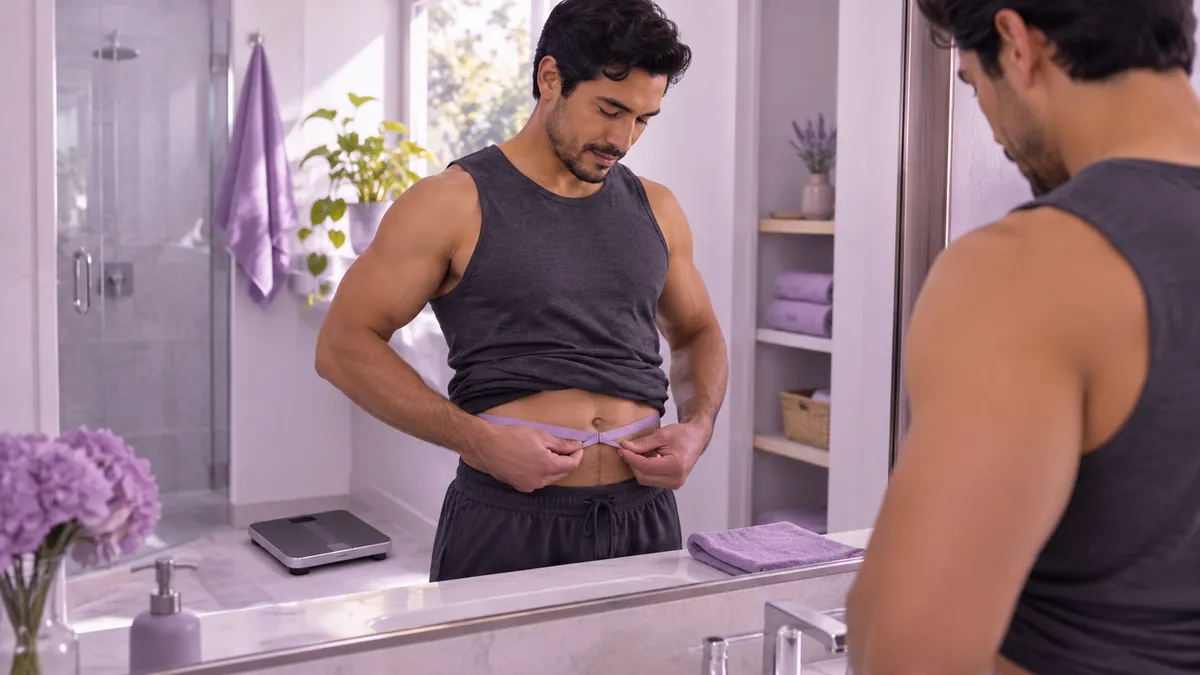
Fat stored deep in the belly (visceral fat) is the most harmful kind, and your waist is the cheapest way to track it. A large review of over 300,000 adults found that waist-to-height ratio predicted diabetes and heart risk better than BMI or waist alone. The rule is simple: keep your waist under half your height. At 170 cm that means under 85 cm.
Waist cut-offs for abdominal obesity differ by ethnic group. The International Diabetes Federation (IDF) uses these:
| Ethnic group | Men | Women |
|---|---|---|
| European descent (Europid) | 94 cm+ | 80 cm+ |
| South Asian | 90 cm+ | 80 cm+ |
| Chinese | 90 cm+ | 80 cm+ |
| Japanese | 90 cm+ | 80 cm+ |
| South and Central American | 90 cm+ | 80 cm+ |
| Sub-Saharan African, Middle Eastern | 94 cm+ | 80 cm+ |
Measure at the navel, standing relaxed, after breathing out. If your weight is "normal" but your waist is over half your height, your goal is fat loss, whatever the scale says.
How do I pick between fat loss, muscle gain and recomp?
Work down this list and stop at the first one that fits:
- BMI under 18.5? Muscle gain. You need more body, and lifting plus a small surplus builds it.
- BMI 25 or more, or a waist over half your height? Fat loss. Keep lifting so the weight that comes off is fat, not muscle.
- Healthy BMI but body fat at or above 22% (men) or 32% (women)? Fat loss or a recomp. This is the "skinny-fat" zone: bulking here mostly adds fat.
- Healthy BMI and healthy body fat? Maintain, recomp, or a lean bulk if you want visibly more muscle. This is the place to choose by what you want, not what you need.
Fitrang's goal sheet runs the same checks and offers three choices, Lose, Maintain or Gain, each with a pace you pick. The pace is how hard you push: a gentle cut (10% under maintenance), a cut (20%) or a max cut (25%); a lean bulk (10% over), a bulk (15%) or a max bulk (20%). Our TDEE calculator and calorie guide shows what each pace means in kcal and kg a week.

How fast can I lose fat without losing muscle?
Aim for 0.5–1% of your bodyweight a week. For an 80 kg person that is 0.4–0.8 kg. Faster than that, and more of what you lose is muscle: in a study of elite athletes, the group losing 0.7% a week kept their strength and gained lean mass, while the group losing 1.4% a week did not. Reviews of contest-prep research reach the same 0.5–1% band.
- Lots to lose (BMI over 30)? The top of the range is fine at first; early weeks also drop water.
- Already lean? Stay near 0.5%. The leaner you are, the more muscle a fast cut costs.
- Always: keep protein at 1.6–2.2 g per kg (how much protein per day you need) and keep lifting. That is the signal that tells your body to keep muscle.
Fitrang flags a pace that loses more than 1% of your bodyweight a week as "faster than safe for muscle".
How much muscle can I really gain in a month?
Less than social media suggests, and less each year you train. These are rules of thumb from coaching research for people who lift seriously, eat enough protein and sleep well:
| Training age | Muscle a month (men) | Muscle a month (women) | Scale gain to aim for |
|---|---|---|---|
| Year 1 (beginner) | ≈ 0.7–1 kg | ≈ 0.35–0.5 kg | 0.25–0.5% of bodyweight a week |
| Years 2–3 (intermediate) | ≈ 0.3–0.5 kg | ≈ 0.15–0.25 kg | about 0.25% a week |
| 3+ years (advanced) | ≈ 0.1–0.25 kg | ≈ 0.05–0.12 kg | slow; mostly hold a small surplus |
Without lifting, a surplus is simply weight gain. The app's "Where you're heading" chart assumes that only about 15% of each kg is muscle if you do not lift, against about half if you do.
What is body recomposition, and who can do it?
Recomposition ("recomp") means losing fat and gaining muscle at the same time, so the scale barely moves while your waist shrinks and your lifts go up. It used to be called impossible. It is not, but it works best for:
- Beginners and people returning after a break (muscle memory is real).
- People with more body fat, who have energy to spare.
- Anyone who was under-eating protein or training without progression.
In one well-known trial, young men eating 40% under maintenance with high protein (2.4 g/kg) and hard training lost 4.8 kg of fat and gained 1.2 kg of lean mass in four weeks. That was extreme and supervised; the everyday version is gentler.
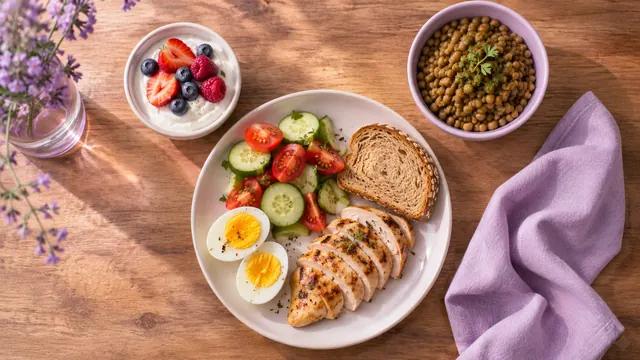
How to recomp: eat at maintenance or a gentle cut (about 10% under), keep protein at 1.6–2.2 g/kg, follow a program that adds weight or reps over time (a beginner 3-day workout split is plenty), and sleep 7–9 hours (why one short night slows fat loss). Judge progress by your waist, photos and strength every 2–4 weeks, not the daily scale. Good main lifts to build it around: the goblet squat, Romanian deadlift, push-up and dumbbell row; for protein, lean on Greek yogurt, cottage cheese, eggs and lentils.
How do I set a realistic target weight?
A good target is one you can reach in months, not years, and hold without misery. Fitrang suggests one this way:
- If you know your body fat: it keeps your current lean mass and asks what you would weigh at the low end of the fit band (for a man under 40, 15–18%). If you are already leaner than that, it suggests about where you are. The answer is kept inside BMI 18.5–24.9.
- If you don't: BMI 23 for your height, plus or minus 2 kg.
- If you are gaining: 3–5 kg above where you are now, mostly muscle.
Example: a man weighing 85 kg at 28% body fat has about 61 kg of lean mass. At 15–18% body fat he would weigh 72–75 kg, so the suggestion is around 71–75 kg. At 0.5–1% a week that is about 14–28 weeks of work, longer with breaks. Set it, then let the "Where you're heading" chart show where your current pace lands you in 3 or 6 months.
What are the most common goal mistakes?
- Bulking when skinny-fat. If your waist is over half your height, cut or recomp first; you will look better sooner.
- Cutting forever. After 12–16 weeks of dieting, a few weeks at maintenance resets hunger and training.
- Judging by one weigh-in. Water moves the scale 1–2 kg day to day. Look at the weekly trend.
- Chasing a number from your college days. A target 3–5 kg away that you reach beats a perfect one you abandon.
- Ignoring the lower Asian cut-offs. If you are of Asian descent with BMI 23–24.9 and a growing waist, act now; it is easier than at 27.
The bottom line
Lose fat first if your BMI is 25 or more (23 or more if you are of Asian descent), your waist is over half your height or above your ethnic cut-off (94 cm for European men, 90 cm for Asian men, 80 cm for women), or body fat is above about 22% (men) or 32% (women). Gain muscle if your BMI is under 18.5. In between, recomp: eat near maintenance, lift 3 times a week and eat 1.6–2.2 g/kg of protein. Lose no more than 0.5–1% of bodyweight a week.
Frequently asked questions
Should I lose fat or build muscle first?
If your BMI is 25 or more (23 or more if you are of Asian descent), your waist is more than half your height, or your body fat is above about 22% for men or 32% for women, lose fat first while lifting. If you are underweight, build muscle first. In between, eat around maintenance and recomp.
What is a healthy BMI?
The WHO healthy range is 18.5–24.9 for adults worldwide. If you are of Asian descent, a WHO expert consultation in 2004 found that risk rises from a BMI of 23, with a second action point at 27.5, and many Asian guidelines treat 23 or more as overweight, so 18.5–22.9 is the safer healthy range.
Can I lose fat and gain muscle at the same time?
Yes, especially if you are new to lifting, returning after a break, or carrying extra fat. Eat at maintenance or about 10% below, keep protein at 1.6–2.2 g/kg, lift with progressive overload and sleep well. Track your waist and strength, because the scale may barely move.
How fast should I lose weight?
About 0.5–1% of your bodyweight a week, which is 0.4–0.8 kg for an 80 kg person. Faster loss costs more muscle and is harder to keep up. Early weeks can drop faster because of water.
What body fat percentage looks fit?
Roughly 15–20% for men and 24–28% for women under 40 is lean and athletic yet easy to keep. Visible abs usually need 10–12% (men) or 18–20% (women), which most people find hard to hold all year.
Is waist-to-height ratio better than BMI?
For heart and diabetes risk, research suggests it is a better screening tool, because it tracks belly fat. Keep your waist under half your height. Use it alongside BMI, not instead of it.
Keep reading
 How many calories should I eat?TDEE, deficits and surpluses, with a calculator
 Macros made simpleProtein, carbs and fat for your goal
 Navy body-fat method explainedMeasure body fat with a tape
 How much protein do I need?Grams per kg by goal, with a calculator
Sources
- WHO Expert Consultation. Appropriate body-mass index for Asian populations and its implications for policy and intervention strategies. The Lancet 2004;363(9403):157–163. PubMed
- Alberti KGMM, Zimmet P, Shaw J. Metabolic syndrome: a new world-wide definition. A consensus statement from the International Diabetes Federation. Diabetic Medicine 2006;23(5):469–480. PubMed
- Yajnik CS, Yudkin JS. The Y-Y paradox. The Lancet 2004;363(9403):163. PubMed
- Ashwell M, Gunn P, Gibson S. Waist-to-height ratio is a better screening tool than waist circumference and BMI for adult cardiometabolic risk factors: systematic review and meta-analysis. Obesity Reviews 2012;13(3):275–286. PubMed
- Gallagher D et al. Healthy percentage body fat ranges: an approach for developing guidelines based on body mass index. American Journal of Clinical Nutrition 2000;72(3):694–701. PubMed
- Garthe I, Raastad T, Refsnes PE, Koivisto A, Sundgot-Borgen J. Effect of two different weight-loss rates on body composition and strength and power-related performance in elite athletes. International Journal of Sport Nutrition and Exercise Metabolism 2011;21(2):97–104. PubMed
- Helms ER, Aragon AA, Fitschen PJ. Evidence-based recommendations for natural bodybuilding contest preparation: nutrition and supplementation. Journal of the International Society of Sports Nutrition 2014;11:20. PubMed
- Iraki J, Fitschen P, Espinar S, Helms E. Nutrition recommendations for bodybuilders in the off-season: a narrative review. Sports 2019;7(7):154. PubMed
- Longland TM, Oikawa SY, Mitchell CJ, Devries MC, Phillips SM. Higher compared with lower dietary protein during an energy deficit combined with intense exercise promotes greater lean mass gain and fat mass loss: a randomized trial. American Journal of Clinical Nutrition 2016;103(3):738–746. PubMed
- Barakat C, Pearson J, Escalante G, Campbell B, De Souza EO. Body recomposition: can trained individuals build muscle and lose fat at the same time? Strength and Conditioning Journal 2020;42(5):7–21. doi.org
- World Health Organization. Obesity and overweight (fact sheet). who.int
This article is general information for healthy adults, not medical advice. If you have a medical condition, are pregnant, or take medication, talk to a doctor or registered dietitian before changing your diet, sleep or training.