Training · Programs
Workout programs in Fitrang: which one should you pick?

Key takeaways
- 16ready-made programs in Fitrang, all freeFitrang, November 2026
- 2–3 daysa week of full-body training for novicesACSM position stand, 2009
- 2× / weekper muscle grows it better than onceSchoenfeld meta-analysis, 2016
- 150–300 minmoderate cardio a week, plus 2 strength daysWHO guidelines, 2020
- 4–8 weeksbetween deload weeks for experienced liftersBell Delphi consensus, 2023
DefinitionA workout program is a fixed plan of exercises, sets, reps and training days that you repeat for weeks, adding a little weight or reps over time.
The rest of the quick picks: want pure strength? Strength 5×5. Nervous about free weights? Machine Starter. Six days a week? Push / Pull / Legs run twice. No gym but some experience? Home Upper / Lower. For heart and lungs, Walk to Run or Run Base Builder. A workout program is a fixed weekly plan of workouts, exercises, sets and reps that gets a little harder each week; following one beats making up sessions as you go.
Open Train → Programs in Fitrang and you will see rows: New to lifting, Home workouts, HIIT and Cardio, plus Push / Pull / Legs and Upper / Lower for people with some experience. Every card tells you who it is for, how many days, about how long a session takes and what the week looks like. This guide goes one step further: it lists every program with its real workouts, helps you choose with a short quiz, and explains how to progress, when to switch and when to take an easy week.

Which Fitrang program should I pick?
Answer four questions. The chooser uses the same logic a coach would: train each muscle about twice a week, do not jump into six lifting days as a beginner, and match the program to the place you will actually train.
Pick your program
Most common answer: 3 days, build muscle, new, gym → Full Body A/B (Mon A, Wed B, Fri A; about 45 minutes). The table below lists every program.
Your pick
Full Body A/B
The whole body three times a week. The simplest way to start.
How do all the Fitrang programs compare?
| Program | Who it's for | Days | Session | Where | Best for | Split |
|---|---|---|---|---|---|---|
| Full Body A/B | New to lifting | 3 | ~45 min | Gym | Muscle + strength | Two full-body workouts, alternated |
| Strength 5×5 | New to lifting | 3 | ~50 min | Gym | Strength | Two barbell workouts, alternated |
| Machine Starter | New to lifting | 3 | ~40 min | Gym | Muscle, easiest to learn | One machine full-body workout |
| Dumbbell Basics | New to lifting | 3 | ~40 min | Gym | Muscle, minimal kit | Two dumbbell workouts, alternated |
| Push / Pull / Legs | Some experience | 3 | ~60 min | Gym | Muscle | Push, pull and legs days (run twice for 6 days) |
| Upper / Lower | Some experience | 4 | ~55 min | Gym | Muscle + strength | Upper and lower days, each twice a week |
| Home Bodyweight | New, no equipment | 3 | ~30 min | Home | General fitness, no gym | One bodyweight circuit |
| Home Upper / Lower | Some experience, no equipment | 4 | ~35 min | Home | Muscle, no gym | Upper and lower days, each twice a week |
| Core at Home | Any level, no equipment | 3 | ~20 min | Home | Core, add-on | One floor core workout |
| Bodyweight HIIT | Some experience, no equipment | 3 | ~20 min | Home | Fitness, short on time | One interval circuit, 30 s rests |
| Gym HIIT | Some experience | 3 | ~25 min | Gym | Fitness, short on time | Two sprint workouts, alternated |
| Jump Rope HIIT | Any level | 3 | ~20 min | Home | Fitness, minimal kit | Rope rounds with floor moves |
| Walk to Run | New to exercise | 3 | ~30 min | Outdoors | Cardio, from zero | Walk–jog intervals |
| Run Base Builder | Any level | 3 | ~40 min | Outdoors | Cardio / endurance | Two easy runs, one interval day |
| Cycling Base | Any level | 3 | ~35 min | Gym | Cardio, easy on joints | Two steady rides, one interval ride |
| Rowing Intervals | Some experience | 3 | ~30 min | Gym | Cardio, whole body | One steady row, one interval day, repeat |
Session times are Fitrang's estimates including rest, not including a 5–10 minute warm-up. All strength programs leave the weights blank: you fill them in on day one and the "previous" column carries them forward.
What is the best workout program for beginners?
Four programs sit in the New to lifting row. They share the same backbone: three sessions a week, a rest day between, and a handful of exercises that cover squatting, hinging, pushing and pulling. That matches the American College of Sports Medicine advice for novices: train the whole body 2–3 days a week with 1–3 sets of 8–12 reps on multi-joint exercises.
- Full Body A/B (3 days, ~45 min; Mon A · Wed B · Fri A). The whole body three times a week. The simplest way to start. Key moves: back squat, bench press, dumbbell row, deadlift, overhead press, lat pulldown, walking lunge, plank.
- Strength 5×5 (3 days, ~50 min; Mon A · Wed B · Fri A). Three big lifts, five sets of five. Add a little weight every session. Key moves: back squat every session, bench press and barbell row (A), overhead press and one heavy set of deadlift (B).
- Machine Starter (3 days, ~40 min; Mon Go · Wed Go · Fri Go). Machines guide the movement, so it’s the easiest way to learn. Key moves: leg press, chest press, machine row, machine overhead press, seated leg curl, machine crunch.
- Dumbbell Basics (3 days, ~40 min; Mon A · Wed B · Fri A). One pair of dumbbells, two simple workouts. Key moves: goblet squat, dumbbell bench press, dumbbell row, dumbbell Romanian deadlift, seated overhead press, reverse lunge, dead bug.
How to choose between them: if your gym has a squat rack and you are happy learning barbell lifts, take Full Body A/B (balanced) or Strength 5×5 (strength-first, fewer exercises, longer rests). If the barbell area intimidates you, start on Machine Starter for 4–8 weeks, then move to Full Body A/B. If your gym is crowded or you train in a building gym with only dumbbells, Dumbbell Basics does the same job.
What should I run after my first 6 months?
Once your beginner gains slow down (you are no longer adding weight most sessions), more weekly sets help, and splitting the body across days lets you fit them in without two-hour sessions.
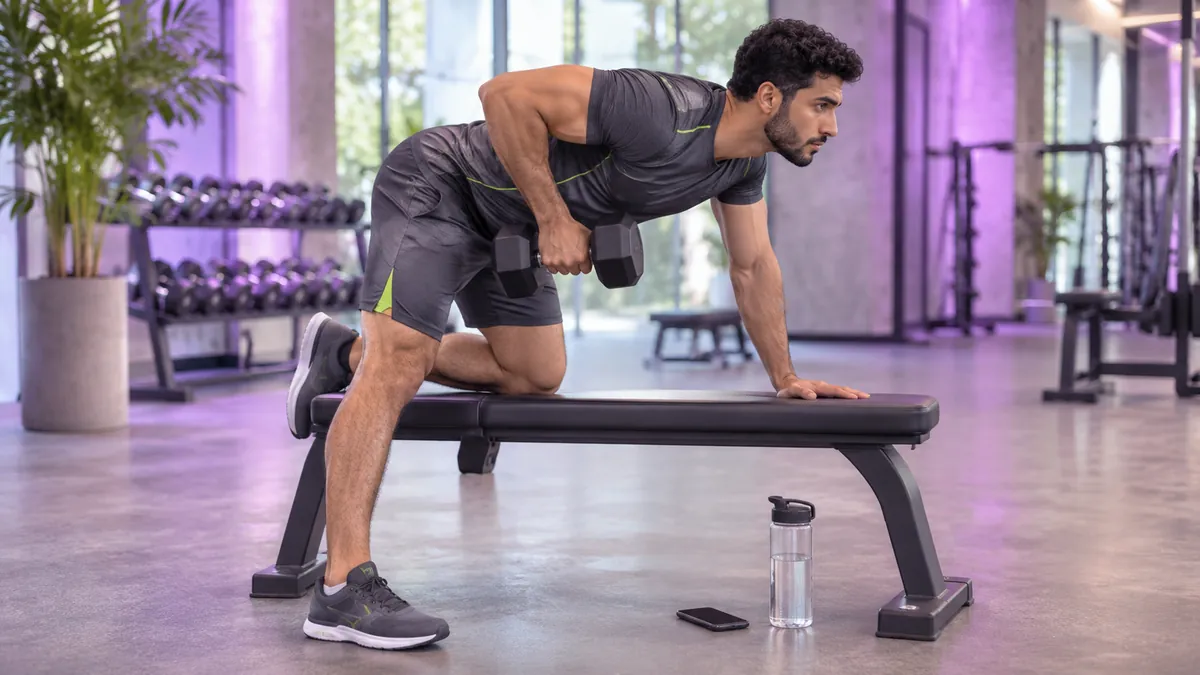
- Upper / Lower (4 days, ~55 min; Mon Upper · Tue Lower · Thu Upper · Fri Lower). Each muscle twice a week, with a rest day between. Key moves: bench press 4×6, barbell row 4×8, overhead press, lat pulldown, back squat 4×6, Romanian deadlift, Bulgarian split squat, lying leg curl.
- Push / Pull / Legs (3 days, ~60 min; Mon Push · Wed Pull · Fri Legs). Pushing, pulling and legs on their own days. Run it twice a week when you have 6 days. Key moves: bench press 4×8, dumbbell overhead press, deadlift 3×5, pull-up, barbell row, back squat 4×6, Romanian deadlift, leg press, face pull.
Upper / Lower is the natural next step: four days, each muscle twice a week, and only about 55 minutes a session. Push / Pull / Legs on three days hits each muscle once a week, which is fine for maintenance but slower for growth; the program shines when you run it twice through on six days. Meta-analyses find that, for the same weekly volume, training a muscle at least twice a week grows it slightly better than once, mainly because it spreads the sets out so each one is done fresh.
What is the best home workout program with no equipment?
- Home Bodyweight (3 days, ~30 min; Mon Go · Wed Go · Fri Go). Push-ups, squats and planks. No gym needed. Key moves: push-up, bodyweight squat, inverted row, glute bridge, dead bug, plank.
- Home Upper / Lower (4 days, ~35 min; Mon Upper · Tue Lower · Thu Upper · Fri Lower). Two upper and two lower days with just your body weight. Key moves: push-up, pike push-up, inverted row, bench dip, diamond push-up, reverse lunge, single-leg glute bridge, step-up, side plank.
- Core at Home (3 days, ~20 min; Mon Go · Wed Go · Fri Go). A short core workout on the floor. No equipment. Key moves: dead bug, plank, side plank, reverse crunch, bird dog, hollow hold.
Bodyweight training builds real muscle as long as sets are close to failure; studies comparing push-ups with bench press at similar effort show similar gains in beginners. The catch is progression: when 20 push-ups feel easy, make the move harder (feet raised, slower lowering, diamond hands) instead of only adding reps. A pull-up bar or a sturdy table for inverted rows makes a big difference to back training at home.
Should I do HIIT or cardio as well as weights?
- Bodyweight HIIT (3 days, ~20 min; Mon Go · Wed Go · Fri Go). Hard bursts with short rests. Done in 20 minutes. Key moves: jumping jacks, burpee, jump squat, mountain climber, high knees, jumping lunge.
- Gym HIIT (3 days, ~25 min; Mon Bike · Wed Ski · Fri Bike). Bike, ropes, ski and sled sprints. Two workouts, turn about. Key moves: assault bike 8×30 s, battle ropes, ball slam, ski erg 8×30 s, sled push, wall ball.
- Jump Rope HIIT (3 days, ~20 min; Mon Go · Wed Go · Fri Go). Rope rounds with a few floor moves in between. Key moves: jump rope 10×1 min, burpee, shoulder tap, plank to push-up.
- Walk to Run (3 days, ~30 min; Mon Go · Wed Go · Fri Go). Short easy jogs with walks in between. Run a little longer each week. Key moves: 5 min walk, 6 × (1 min jog + 2 min walk), 5 min walk.
- Run Base Builder (3 days, ~40 min; Tue Easy · Thu Fast · Sat Easy). Two easy runs and one interval day. Key moves: easy 5 km run + 10 min stretching; intervals: 1.5 km easy, 8 × 30 s sprints, 1.5 km easy.
- Cycling Base (3 days, ~35 min; Mon Steady · Wed Intervals · Fri Steady). Two steady rides and one interval ride on the bike. Key moves: 30 min steady stationary bike; intervals: 10 min easy, 8 × 30 s assault bike, 5 min easy.
- Rowing Intervals (3 days, ~30 min; Tue Steady · Thu Intervals · Sat Steady). Whole-body cardio on the rower: one steady row, one interval day, repeat. Key moves: 20 min steady row; intervals: 6 × 2 min row, 3 × 1 min jump rope.
The WHO recommends 150–300 minutes of moderate activity or 75–150 minutes of vigorous activity a week, plus muscle strengthening on two or more days. That is why the best long-term setup for most people is one strength program and a little cardio, not either one alone. A good combination: Full Body A/B on Monday, Wednesday and Friday, and a brisk 30-minute walk or one Cycling Base ride on two other days. Keep HIIT to one to three short sessions a week; it is hard on recovery, and more is not better.
How do I progress on a program?
A program only works if the work gets a little harder over time. This is progressive overload, and it is the single most important rule in training.
- Double progression (Full Body A/B, Upper / Lower, PPL, Dumbbell Basics, Machine Starter): keep the weight the same until you hit the planned reps on every set, then add the smallest jump available (2.5 kg on a barbell, the next dumbbell up) and build the reps back up.
- Linear progression (Strength 5×5): if you completed all 5×5, add 2.5 kg next session (5 kg on squat and deadlift while it lasts). Miss reps twice in a row at the same weight? Drop 10% and build back.
- Bodyweight programs: add one or two reps a session, then move to a harder variation.
- Cardio programs: add time before speed. In Walk to Run, stretch the jogs a little each week (1 min → 2 → 3) and shorten the walks.
Fitrang helps here: on your first set of each exercise it shows a quiet next-weight hint based on last time. If every working set hit the top of the rep range at RPE 8 or easier, it suggests adding 2.5 kg (upper body) or 5 kg (lower body); if you missed reps twice, it says hold; after a very hard week it suggests 5% lighter. It never fills the weight in for you.
Want the full theory (sets, reps, RIR, rest times, weekly volume)? Read how to work out: the complete guide.
When should I switch programs?
Program-hopping is the most common reason beginners stall. Switch only for one of these reasons:
- Your schedule changed. You now have four days instead of three: Full Body A/B → Upper / Lower.
- You have stalled for 3–4 weeks on most lifts despite good sleep, enough food and a deload. Beginner programs like 5×5 run out after roughly 3–6 months of steady linear gains.
- Your goal changed. Training for a 5 km run? Add Run Base Builder and drop to two strength days.
- You genuinely dislike it. The program you will do beats the "optimal" one you skip.
What is a deload, and when do I need one?
A deload is a planned easy week. An international expert consensus defines it as "a period of reduced training stress designed to mitigate physiological and psychological fatigue, promote recovery, and enhance preparedness for subsequent training." Coaches in that study most often used one every 4–8 weeks for advanced lifters; beginners need them less often.
A simple rule for Fitrang programs:
- Every 8–12 weeks, or sooner if joints ache, sleep is poor and lifts drop two sessions in a row.
- Keep the same workouts, but do half the sets at about 60–70% of your usual weights, and stop well short of failure.
- After a week, go back to your previous weights. Most people come back slightly stronger.
Fitrang's muscle freshness view helps you spot fatigue early: it shows which muscles are fresh, recovering or tired from your last 10 days of sets, with harder sets counting for more.

What else decides whether a program works?
Two things outside the gym matter as much as the program itself. First, food: aim for 1.6–2.2 g of protein per kg of body weight a day if you want muscle; for vegetarians that means planning Greek yogurt, lentils, tofu, cottage cheese or eggs into every meal. Second, sleep, which decides how much of your weight loss is fat: on less than 6 hours, the same session feels harder and more of any weight you lose comes from muscle. Third, a clear goal: decide whether this block is for fat loss, muscle gain or recomposition, because the same program pairs with a calorie deficit for one and a small surplus for the other. Log your workouts, meals and sleep for a month and the pattern becomes obvious.
The bottom line
Most beginners should run a 3-day full-body plan (such as Full Body A/B) for at least 8–12 weeks, adding weight or reps whenever every set hits the top of the range. With no gym, start on a bodyweight program. Move to Upper / Lower or Push / Pull / Legs only once progress stalls, and switch for a reason, not out of boredom.
Frequently asked questions
What is the best workout program for a beginner?
A 3-day full-body program such as Fitrang's Full Body A/B: every muscle three times a week, the main lifts practised each session, and a missed day costs little. Choose Strength 5×5 if strength is the main goal, or Machine Starter if free weights feel intimidating.
Is Push / Pull / Legs good for beginners?
It works, but on three days it trains each muscle only once a week, which is slower for growth than a full-body plan. It is best for people with six months or more of training who can run it twice a week on six days.
How long should I follow one program?
At least 8–12 weeks, and as long as you are still making progress. Switch when your schedule or goal changes, or when you have stalled for 3–4 weeks despite good sleep, enough food and a deload week.
Can I combine two Fitrang programs?
Yes, if they train different things: a strength program on three days plus Walk to Run, Cycling Base or Core at Home on other days is a good mix. Avoid two full strength programs at once; it doubles the fatigue, not the results.
Can I build muscle with home bodyweight workouts?
Yes, especially as a beginner, if you take sets close to failure and keep making the moves harder (slower lowering, feet raised, single-leg versions). Home Bodyweight is a good start; Home Upper / Lower adds volume once you have trained for a few months.
Do I need a deload week?
Beginners rarely need one in the first 8–12 weeks. After that, take an easy week (half the sets at 60–70% of your usual weights) every 8–12 weeks, or sooner if your lifts drop two sessions in a row and you feel run down.
Are Fitrang's programs free?
Yes. All the ready-made programs in Fitrang are free to add and use, including the workout log, rest timer and progress history.
Keep reading
 How to work out: the complete guideSets, reps, RIR, rest and weekly volume
 Beginner 3-day workout splitFull-body A/B/A vs push/pull/legs
 How much protein do I need?Grams per kg by goal, with a calculator
 What one short night does to your resultsWhy recovery starts in bed
 Fat loss, muscle gain or recomp?Pick the goal your program serves
Sources
- American College of Sports Medicine. Progression models in resistance training for healthy adults (position stand). Medicine & Science in Sports & Exercise 2009;41(3):687–708. PubMed
- World Health Organization. WHO guidelines on physical activity and sedentary behaviour (2020). who.int
- Schoenfeld BJ, Ogborn D, Krieger JW. Effects of resistance training frequency on measures of muscle hypertrophy: a systematic review and meta-analysis. Sports Medicine 2016;46(11):1689–1697. PubMed
- Schoenfeld BJ, Ogborn D, Krieger JW. Dose-response relationship between weekly resistance training volume and increases in muscle mass: a systematic review and meta-analysis. Journal of Sports Sciences 2017;35(11):1073–1082. PubMed
- Bell L, Strafford BW, Coleman M, Androulakis Korakakis P, Nolan D. Integrating deloading into strength and physique sports training programmes: an international Delphi consensus approach. Sports Medicine – Open 2023;9:87. PubMed
- Kikuchi N, Nakazato K. Low-load bench press and push-up induce similar muscle hypertrophy and strength gain. Journal of Exercise Science & Fitness 2017;15(1):37–42. PubMed
- Morton RW et al. A systematic review, meta-analysis and meta-regression of the effect of protein supplementation on resistance training-induced gains in muscle mass and strength in healthy adults. British Journal of Sports Medicine 2018;52(6):376–384. PubMed
This article is general information for healthy adults, not medical advice. If you have a medical condition, are pregnant, or take medication, talk to a doctor or registered dietitian before changing your diet, sleep or training.