Free tool · Weight loss
Calorie deficit calculator
Your calories to lose weight
Example: 30-year-old man, 175 cm, 80 kg, moderately active: maintenance 2,711 kcal; to lose 0.5 kg a week eat about 2,160 kcal (−551 a day); 72 kg in about 16 weeks.
How it works
1. Maintenance (TDEE) = Mifflin-St Jeor BMR × activity, as in the TDEE calculator.
Daily deficit = weekly loss (kg) × 7,700 ÷ 7 (or lb × 3,500 ÷ 7)
Calories to eat = TDEE − daily deficit, never below 1,200 (women) or 1,500 (men)
Weeks to goal = (weight − goal weight) ÷ weekly loss
Weeks to goal is a straight-line estimate. Real loss slows as you get lighter, because a smaller body burns less, so re-run the calculator every 4–5 kg (10 lb) lost. NIH guidance for adults with overweight is 0.5–1 kg (1–2 lb) a week; lean, active people keep more muscle at 0.5–1% of body weight a week.
Safety
Frequently asked questions
How big should my calorie deficit be?
Most adults do well with 300–750 kcal a day below maintenance, or 10–25% of TDEE. That loses about 0.25–0.75 kg (0.5–1.5 lb) a week while keeping hunger and muscle loss manageable.
How many calories do I need to burn to lose 1 kg?
About 7,700 kcal, or 3,500 kcal per pound. A deficit of 1,100 kcal a day is needed to lose 1 kg a week, which is too much for many people.
What is the minimum I should eat?
Without medical supervision, don't go below 1,200 kcal a day for women or 1,500 kcal for men. Below that it is hard to get enough protein, vitamins and minerals.
Why has my weight loss stopped?
Usually the deficit is smaller than logged (portions, oils, weekends), water is masking fat loss, or a lighter body now burns less. Check the weekly average weight over 2–3 weeks, then lower calories by 100–150 kcal or add steps.
Should I combine the deficit with exercise?
Yes. Strength training 2–3 times a week and enough protein (1.6–2.2 g/kg) help you lose fat rather than muscle.
Keep reading
 How many calories should I eat?TDEE, deficits and surpluses explained
 Fat loss, muscle gain or recomp?Pick a body goal and a healthy target
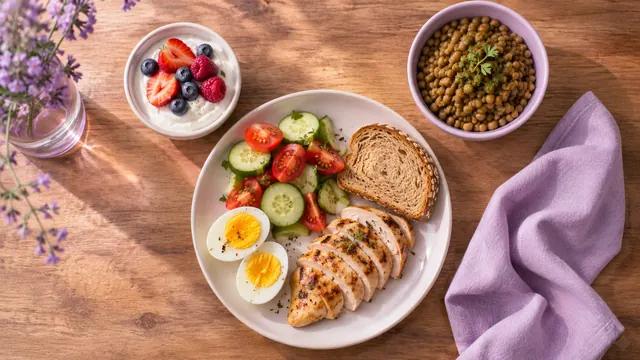 How much protein do I need?Keep muscle while you lose fat
More free calculators
- TDEE calculator
- Protein calculator
- Macro calculator
- BMI calculator
- Body fat calculator
- Water intake calculator
- One rep max calculator
Sources
- Mifflin MD, St Jeor ST et al. A new predictive equation for resting energy expenditure in healthy individuals. American Journal of Clinical Nutrition 1990;51(2):241–247. PubMed
- Hall KD, Sacks G, Chandramohan D et al. Quantification of the effect of energy imbalance on bodyweight. The Lancet 2011;378(9793):826–837. PubMed
- National Heart, Lung, and Blood Institute (NIH). Clinical Guidelines on the Identification, Evaluation, and Treatment of Overweight and Obesity in Adults, 1998. NCBI Bookshelf
- National Institute of Diabetes and Digestive and Kidney Diseases (NIH). Body Weight Planner. niddk.nih.gov
- Aragon AA et al. International Society of Sports Nutrition position stand: diets and body composition. Journal of the International Society of Sports Nutrition 2017;14:16. PubMed
- Helms ER, Aragon AA, Fitschen PJ. Evidence-based recommendations for natural bodybuilding contest preparation: nutrition and supplementation. Journal of the International Society of Sports Nutrition 2014;11:20. PubMed
Estimates for healthy adults, not medical advice. If you are under 18, pregnant or breastfeeding, have a medical condition or take medication, ask a doctor or registered dietitian before changing how you eat.