Free tool · Strength
One rep max calculator
Your estimated 1RM
Example: 80 kg for 5 reps: Epley 93.5 kg, Brzycki 90 kg, average 91.5 kg; 90% training max 82.5 kg.
| Reps | % of 1RM | Weight | Best for |
|---|---|---|---|
| 1 | 100% | 91.5 kg | Strength |
| 2 | 95% | 87 kg | Strength |
| 3 | 93% | 85.5 kg | Strength |
| 4 | 90% | 82.5 kg | Strength |
| 5 | 87% | 80 kg | Strength |
| 6 | 85% | 78 kg | Muscle size |
| 8 | 80% | 73.5 kg | Muscle size |
| 10 | 75% | 69 kg | Muscle size |
| 12 | 67% | 61.5 kg | Muscle size |
| 15 | 65% | 59.5 kg | Endurance |
How it works
Epley: 1RM = weight × (1 + reps ÷ 30)
Brzycki: 1RM = weight × 36 ÷ (37 − reps)
Estimate = average of the two; a single rep counts as your 1RM
Training weight = 1RM × % from the table
The two formulas stay within about 4% of each other up to 10 reps (Epley reads a little higher below 10, and they meet at 10), then drift apart quickly, because fatigue, technique and muscle-fibre make-up matter more in long sets. Studies comparing prediction equations find they track bench press and squat well from sets under about 10 reps, but tend to under-estimate the deadlift. Re-check every 4–8 weeks from a recent hard set rather than testing a true max.
| Goal | Reps per set | % of 1RM |
|---|---|---|
| Strength | 1–5 | 85–100% |
| Muscle size | 6–12 | 67–85% |
| Muscular endurance | 12+ | under 67% |
Most beginners grow fastest on 6–12 reps with 1–3 reps left in reserve. See the workout guide for sets, rest and progression, and the beginner gym workout plan for a full week.
Safety
Frequently asked questions
What is a one-rep max?
Your one-rep max (1RM) is the heaviest weight you can lift for a single repetition with good form. Programs use percentages of it to set training weights.
How accurate is a 1RM calculator?
From a hard set of 3–8 reps, estimates usually land within a few percent of a tested max for the bench press and squat. Accuracy drops above 10 reps and for the deadlift, which formulas tend to under-estimate.
Epley or Brzycki: which formula is best?
Neither is best for everyone. Up to 10 reps they stay within about 4% of each other, with Epley slightly higher; above 10 reps Brzycki climbs faster and both get less reliable. This calculator shows both and uses their average.
Should beginners test their 1RM?
Usually not. Estimating from a set of 5–8 reps is safer and accurate enough. Beginners progress best by adding reps or a little weight each week with good form.
How do I use my 1RM to choose training weights?
Multiply it by the percentage for your rep target: about 85% for 5 reps, 75% for 10 reps and 67% for 12 reps. Pick a weight that leaves 1–3 reps in reserve.
Keep reading
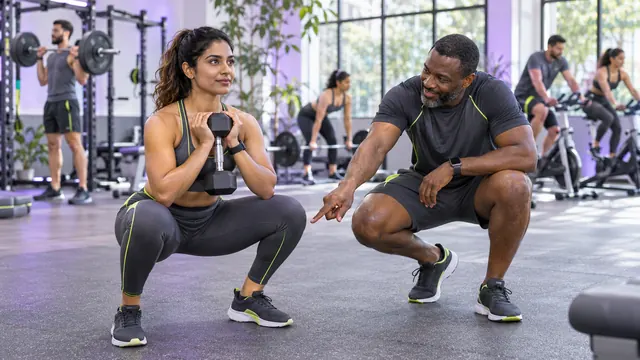 Workout guideSets, reps, rest and how to progress
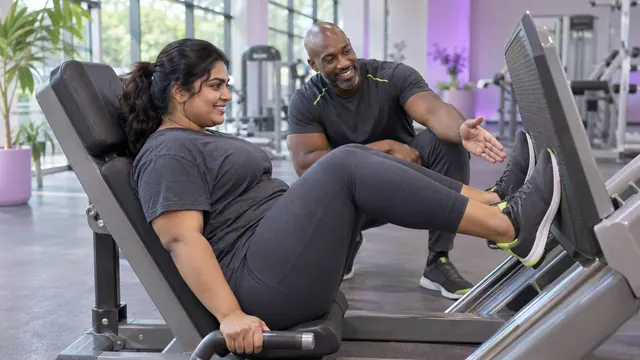 Beginner gym workout planA full first week, step by step
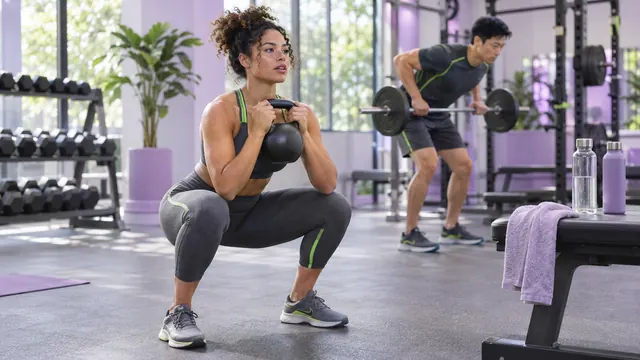 Beginner 3-day workout splitThree sessions a week, full body
More free calculators
- TDEE calculator
- Calorie deficit calculator
- Protein calculator
- Macro calculator
- BMI calculator
- Body fat calculator
- Water intake calculator
Sources
- Epley B. Poundage chart. In: Boyd Epley Workout. Lincoln, NE: Body Enterprises, 1985.
- Brzycki M. Strength testing: predicting a one-rep max from reps-to-fatigue. Journal of Physical Education, Recreation & Dance 1993;64(1):88–90. doi.org
- LeSuer DA, McCormick JH, Mayhew JL, Wasserstein RL, Arnold MD. The accuracy of prediction equations for estimating 1-RM performance in the bench press, squat, and deadlift. Journal of Strength and Conditioning Research 1997;11(4):211–213.
- Haff GG, Triplett NT (eds). Essentials of Strength Training and Conditioning, 4th ed. National Strength and Conditioning Association. Human Kinetics, 2016 (percent of 1RM and repetitions table).
- American College of Sports Medicine. Progression models in resistance training for healthy adults (position stand). Medicine & Science in Sports & Exercise 2009;41(3):687–708. PubMed
Estimates for healthy adults, not medical advice. If you are under 18, pregnant or breastfeeding, have a medical condition or take medication, ask a doctor or registered dietitian before changing how you eat.