Training · Beginners
Beginner gym workout plan: 3 days a week for 8 weeks
Key takeaways
- 2–3 daysa week, 1–3 sets of 8–12 reps, is the novice starting pointACSM position stand, 2009
- 2× / weekper muscle builds more than once a weekSchoenfeld meta-analysis, 2016
- No differencein muscle or strength between machines and free weights, compared directlyHaugen meta-analysis, 2023
- 1.6 g/kgprotein a day, the point where gains level off on averageMorton meta-analysis, 2018
DefinitionDouble progression is a way to add load: you keep the same weight until you reach the top of a rep range on every set, then add the smallest weight step and work back up from the bottom of the range.
Walking into a gym for the first time is easier with a plan on your phone. This one uses machines and dumbbells, which are simple to learn and easy to load in small steps, and it trains every major muscle twice or three times a week. Each exercise links to an animated demo in the Fitrang exercise library. Already comfortable with barbells? Our beginner 3-day split is the next step.
What is a good beginner gym workout plan?
Train three days a week, for example Monday, Wednesday and Friday, alternating Workout A and Workout B: A-B-A one week, B-A-B the next. Each workout has four lifts and a plank, 3 sets of 8–12 reps, with 1–2 minutes' rest. Together they cover legs, chest, back, shoulders and core.
| Workout | Exercise | Sets × reps | Rest |
|---|---|---|---|
| A | Leg press | 3 × 8–12 | 2 min |
| Machine chest press | 3 × 8–12 | 90 s | |
| Lat pulldown | 3 × 8–12 | 90 s | |
| Dumbbell Romanian deadlift | 3 × 8–12 | 2 min | |
| Plank | 3 × 20–40 s | 60 s | |
| B | Goblet squat | 3 × 8–12 | 2 min |
| Dumbbell overhead press | 3 × 8–12 | 90 s | |
| Seated cable row | 3 × 8–12 | 90 s | |
| Dumbbell Romanian deadlift | 3 × 8–12 | 2 min | |
| Plank | 3 × 20–40 s | 60 s |
Why should beginners train full body three days a week?
Because it trains each muscle two to three times a week, which builds more muscle than once a week at the same total work, and every session lets you practise the main movements. The American College of Sports Medicine recommends novices train 2–3 days a week with 8–12 reps. A missed session costs little: you just do the next workout.
Split routines that train one body part a day (chest day, leg day) give each muscle one session a week. They suit experienced lifters on five or six days, not someone fitting the gym around work. The research behind these numbers is explained in our guide to sets, reps and rest.
What do Workout A and Workout B involve?
Each workout pairs a squat-type leg exercise, a push, a pull and a hip hinge, then finishes with a plank. Workout A uses the leg press, chest press and lat pulldown; Workout B uses the goblet squat, dumbbell overhead press and seated cable row. Both include the dumbbell Romanian deadlift for hamstrings, glutes and lower back.
Workout A
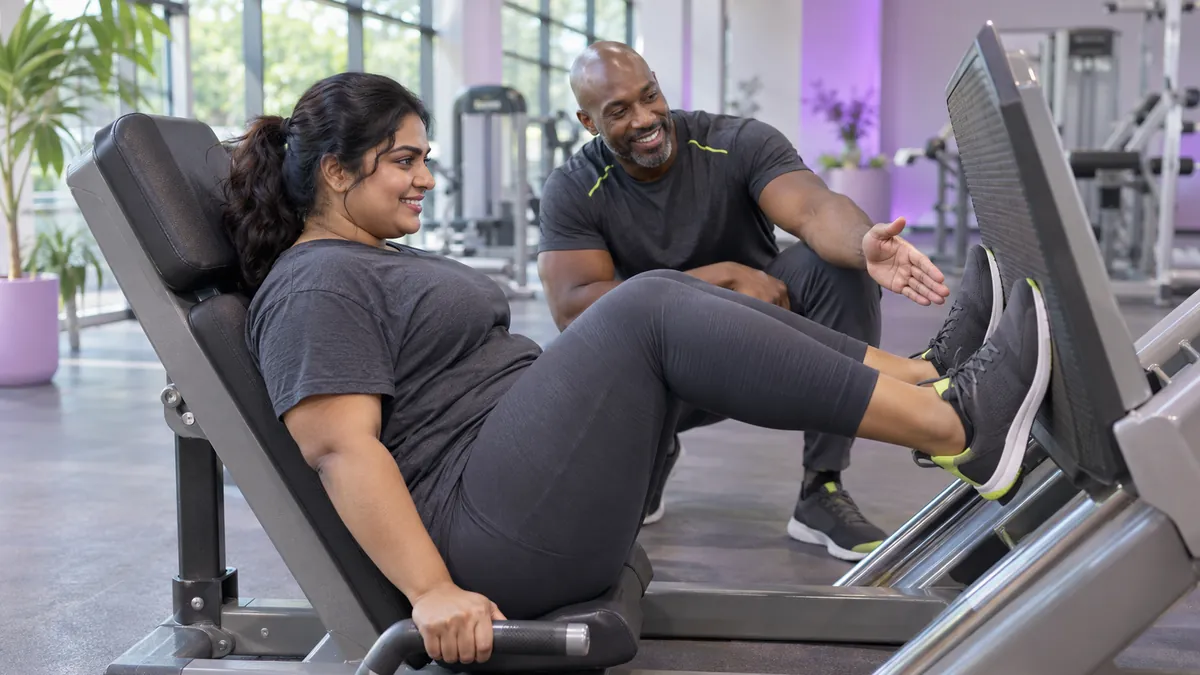
- Leg press: feet shoulder-width on the platform, lower until knees are bent about 90°, push through your whole foot. 3 × 8–12.
- Machine chest press: handles at mid-chest, shoulder blades back against the pad, press without locking hard. 3 × 8–12.
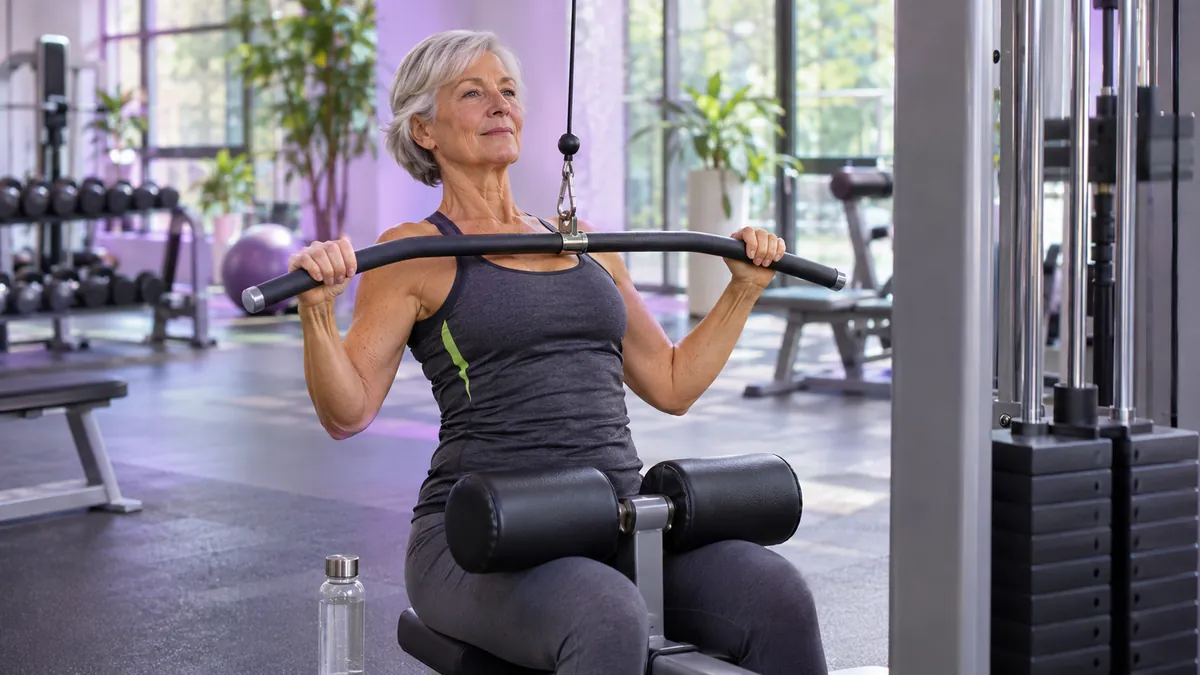
- Lat pulldown: pull the bar to your upper chest, elbows down and back, no leaning far back. 3 × 8–12.
- Dumbbell Romanian deadlift: soft knees, push your hips back with a flat back until you feel the hamstrings, then stand tall. 3 × 8–12.
- Plank: forearms under shoulders, body in a straight line. 3 × 20–40 s.
Workout B
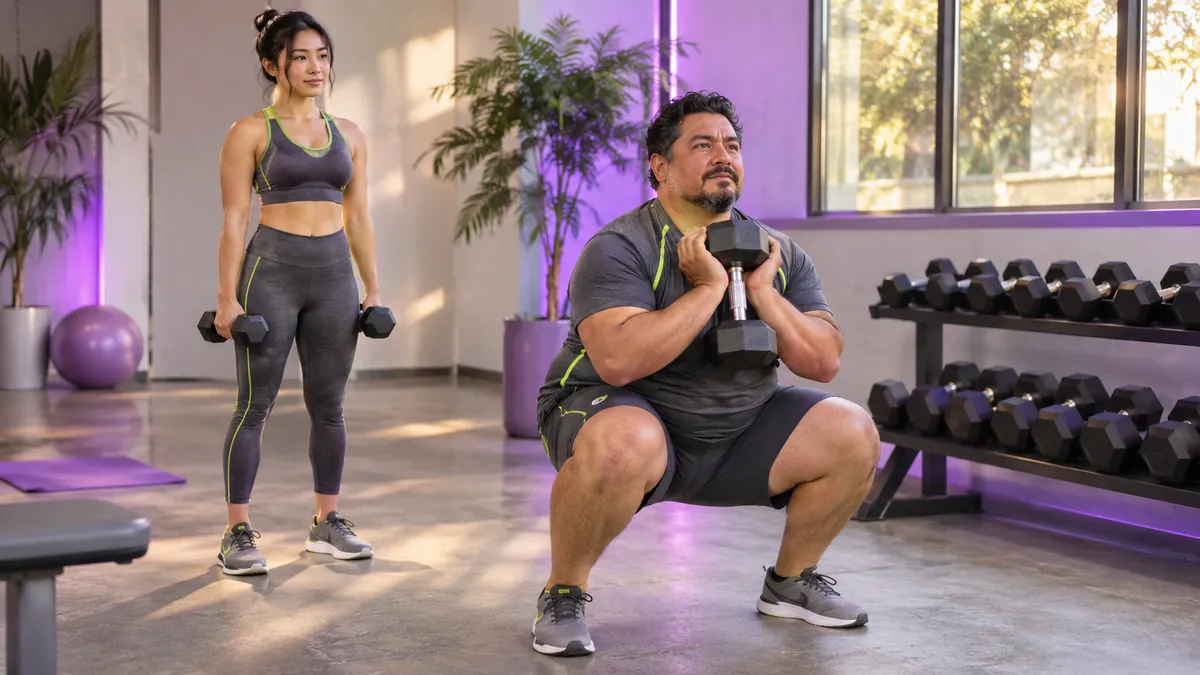
- Goblet squat: hold a dumbbell at your chest, sit down between your heels, chest up. 3 × 8–12.
- Dumbbell overhead press: seated or standing, press from shoulders to overhead without arching your lower back. 3 × 8–12.
- Seated cable row: sit tall, pull the handle to your lower ribs, squeeze shoulder blades together. 3 × 8–12.
- Dumbbell Romanian deadlift: as in Workout A. 3 × 8–12.
- Plank: 3 × 20–40 s.
How should a beginner warm up in 5 minutes?
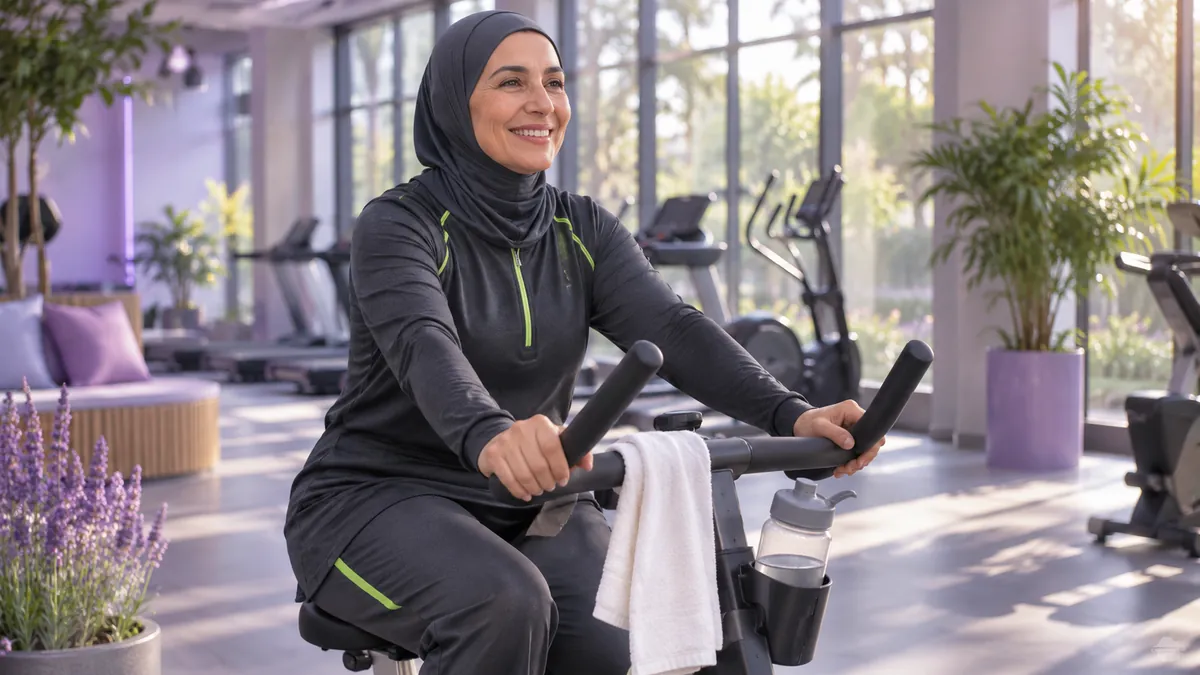
Do 3–5 minutes of easy cardio (bike, rower, cross-trainer or brisk walk) until you are slightly warm, then one or two light sets of the first exercise: about half your working weight for 8–10 easy reps. That prepares the exact muscles and joints you are about to use. Long static stretching before lifting is not needed.
If you sit all day, add 30 seconds of hip-flexor stretch per side and some arm circles; our guide for people who sit all day has more.
How much weight should a beginner start with?
Start with a weight you can lift for 12 clean reps with 2–3 more left in the tank. That usually lands around 60–70% of your one-rep maximum, the range ACSM gives novices. If your form slips, it is too heavy; if 12 feels easy, go up next set. Skip one-rep max testing in your first months.
Starting weight helper
Example shown: goblet squat, 16 kg for 10 clean reps. Estimated one-rep max about 21 kg (16 × (1 + 10 ÷ 30)). Start your sets of 12 at 13–15 kg (60–70%); 16 kg is your top weight for sets of 10.
Form first: watch the goblet squat demo before you load up.
How do I progress over 8 weeks?
Use double progression: keep the weight the same until you reach 12 reps on all 3 sets, then add the smallest step (the next dumbbell or plate) and build back up from 8. Use 2 sets in weeks 1–2 while you learn, 3 sets in weeks 3–7, and an easier week 8 before you repeat with heavier weights.
| Weeks | Sets × reps | Effort | Goal |
|---|---|---|---|
| 1–2 | 2 × 10–12 | Easy: 3+ reps left | Learn each movement, find your weights |
| 3–4 | 3 × 8–12 | Moderate: 2–3 reps left | Add reps each session; add weight at 3 × 12 |
| 5–7 | 3 × 8–12 | Harder: 1–2 reps left | Keep adding reps or weight; log every set |
| 8 | 2 × 8–10 | Easy, about 10% lighter | Recover; then restart week 3 with your new weights |
If you miss the bottom of the range two sessions in a row, drop the weight about 10% and build back up; poor sleep or too little food is often the reason. After week 8, keep going with this plan or move to the barbell 3-day split, and browse Fitrang's free programs for what comes next.
Start this week, step by step
- Pick three non-consecutive days. Monday, Wednesday and Friday, or any three days with a rest day between.
- Alternate Workout A and B. A-B-A in week 1, B-A-B in week 2, and so on.
- Warm up for 5 minutes. Easy cardio, then one or two light sets of the first exercise.
- Choose a weight for 12 clean reps. Stop each set with 2–3 reps left; use 2 sets in weeks 1–2 and 3 sets from week 3.
- Add weight at 3 × 12. When all three sets reach 12 reps, add the smallest step and build back up from 8.
- Take an easy week 8. Two lighter sets per exercise, then restart week 3 with your new weights.
Should beginners use machines or free weights?
Either works. A 2023 meta-analysis that compared them directly found no difference in strength or muscle growth between machine and free-weight training, though each made people better at the type of lift they practised. Machines are easier to learn and safer to push hard alone, so this plan starts with them and adds dumbbells.
A sensible path: machines and dumbbells for the first one to three months, then add barbell squats, bench presses and deadlifts if you enjoy them. If you only ever use machines and dumbbells, you can still get strong and fit.
What should I know before my first day at the gym?
Go at a quieter time (mid-morning or early afternoon), bring a towel and water, wipe down equipment after use, and re-rack your weights. Ask staff to show you how to adjust the machines; it is part of their job. Everyone started as a beginner, and most people are focused on their own workout.
- Save the plan on your phone so you know exactly what is next.
- If a machine is busy, do the next exercise and come back.
- Expect some muscle soreness for a day or two after the first sessions; it fades as you adapt.
What should beginners eat and how much should they sleep?
Eat enough protein, about 1.6 g per kg of bodyweight a day (up to 2.2 g), spread over three or four meals, and sleep 7–9 hours. Muscle is built between sessions, not during them. Eat enough total calories too: a large deficit slows strength gains, while a small one is fine for fat loss.
For a 70 kg person that is about 110–155 g of protein a day. See how much protein you need for food examples, and what one short night does for why sleep matters for recovery.
How do I track this plan?
Write down every set: the weight and the reps. In Fitrang you can build this plan as a routine; each exercise has an animated demo, there is a rest timer, and the log shows last session's weights next to each lift. It works offline in the gym, so a bad signal does not matter.
The bottom line
Go to the gym three days a week and alternate two full-body workouts built from seven machine and dumbbell lifts: leg press, chest press, lat pulldown, goblet squat, overhead press, seated row and Romanian deadlift, plus a plank. Do 3 sets of 8–12 reps, add weight when you hit 12 on every set, take an easy week 8, and eat about 1.6 g of protein per kg with 7–9 hours of sleep.
Frequently asked questions
How many days a week should a beginner go to the gym?
Three days a week is ideal for most beginners: enough to train each muscle two or three times a week, with a rest day between sessions. Two days still works well; four or more is rarely needed in the first months.
How long should a beginner workout last?
About 45 to 60 minutes including a 5-minute warm-up. With four lifts and a plank at 3 sets each and 1 to 2 minutes' rest, most people finish in under an hour. Weeks 1 and 2 with 2 sets are shorter.
Should beginners use machines or free weights?
Either. Studies comparing them directly found similar strength and muscle gains. Machines are easier to learn and safer to push hard on alone, so they are a good start; add dumbbells and barbells as you gain confidence.
How much weight should I lift as a beginner?
A weight you can lift for 12 clean reps with 2 or 3 reps left in the tank, roughly 60 to 70% of your maximum. Start light, learn the movement, and add the smallest step when you can do 12 reps on all three sets.
How long until I see results?
Most beginners get noticeably stronger within the first few weeks as they learn the movements. Visible muscle usually takes longer, often around two to three months of consistent training with enough protein and sleep.
Is this plan suitable for women?
Yes. Men and women gain strength and muscle from the same principles, and this plan is the same for everyone. Choose weights that suit you and progress at your own pace. Pregnant? Get your clinician's approval and adapt the exercises with them.
What if I can only train twice a week?
Do Workout A and Workout B once each, with at least two days between them. Two full-body sessions still train every muscle twice a week and give good results for beginners.
Keep reading
 Beginner 3-day workout splitThe barbell version, with a weekly planner
 Which Fitrang workout program should you pick?16 free programs compared, with a chooser
 Sets, reps and rest explainedThe complete workout guide
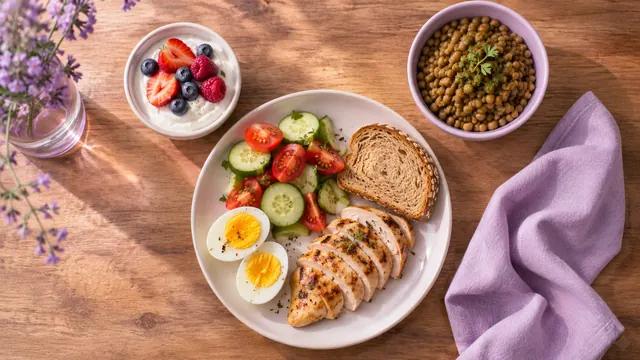 How much protein do I need?The other half of building muscle
Sources
- American College of Sports Medicine. Progression models in resistance training for healthy adults (position stand). Medicine & Science in Sports & Exercise 2009;41(3):687–708. PubMed
- Schoenfeld BJ, Ogborn D, Krieger JW. Effects of resistance training frequency on measures of muscle hypertrophy: a systematic review and meta-analysis. Sports Medicine 2016;46(11):1689–1697. PubMed
- Haugen ME, Vårvik FT, Larsen S, et al. Effect of free-weight vs. machine-based strength training on maximal strength, hypertrophy and jump performance: a systematic review and meta-analysis. BMC Sports Science, Medicine and Rehabilitation 2023;15(1):103. PubMed
- Schoenfeld BJ, Grgic J, Ogborn D, Krieger JW. Strength and hypertrophy adaptations between low- vs. high-load resistance training: a systematic review and meta-analysis. Journal of Strength and Conditioning Research 2017;31(12):3508–3523. PubMed
- Morton RW, Murphy KT, McKellar SR, et al. A systematic review, meta-analysis and meta-regression of the effect of protein supplementation on resistance training-induced gains in muscle mass and strength in healthy adults. British Journal of Sports Medicine 2018;52(6):376–384. PubMed
- World Health Organization. WHO guidelines on physical activity and sedentary behaviour (2020). who.int
This article is general information for healthy adults, not medical advice. If you have a medical condition, are pregnant, or take medication, talk to a doctor or registered dietitian before changing your diet, sleep or training.