
Training · Guide
Strength training over 50: plan, protein and safety

Key takeaways
- 2–3 daysa week of resistance training is safe and effective for older adults, including power workNSCA position statement, 2019
- 3–8%of muscle mass is lost per decade after about 30, faster after 60, without trainingVolpi review, 2004
- 1.0–1.2 g/kgdaily protein for healthy adults over 65; 1.2 g/kg or more if activePROT-AGE group, 2013
- 3+ daysa week of balance and strength activity for adults 65 and overWHO guidelines, 2020
DefinitionSarcopenia is the gradual loss of muscle mass, strength and function with age, which raises the risk of falls and losing independence.
Many people over 50 have been told to "take it easy". For muscles and bones, the evidence says the opposite: the less you use them, the faster they go. This guide gives a joint-friendly 2-day plan, a 3-day option, balance work, a protein calculator, the bone nutrients that matter, and a plain list of who should get medical advice before starting.
Is it too late to start strength training at 50 or 60?
No. People who start lifting in their 50s, 60s, 70s and even later gain strength and muscle, and the National Strength and Conditioning Association calls resistance training safe and effective for older adults when it is well planned. Gains come a little slower than at 25, but the starting point matters less than simply beginning.
The first few weeks bring the fastest improvements, mostly from your nervous system learning to use the muscle you already have. Getting out of a chair, carrying shopping and climbing stairs often feel easier within a month or two, well before the mirror shows much change.
What happens to your muscles after 50?
Without training, muscle mass shrinks slowly from around age 30, by roughly 3–8% per decade according to a widely cited review, and the loss speeds up after 60. Strength and power drop even faster than size. Age-related loss of muscle and function is called sarcopenia, and it raises the risk of falls and losing independence.
Bone follows a similar path, especially in women after menopause. The good news is that both muscle and bone respond to load at any age. Resistance training is the most direct way to slow the decline, and protein, vitamin D, calcium and sleep support it.
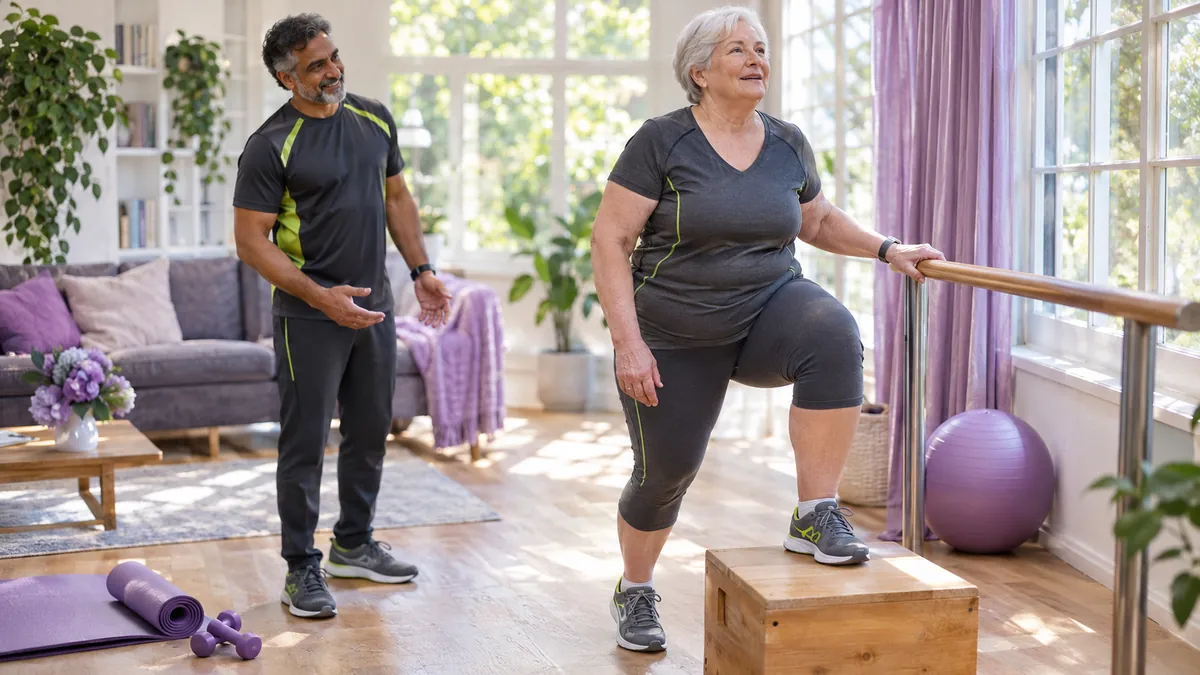
What is a safe 2-day strength plan for over-50s?
Two full-body sessions a week, two or three days apart, are enough to start. Use machines, dumbbells and body weight rather than heavy barbells while you learn. Begin with 1–2 sets of 8–12 reps per exercise, slow and controlled, and build up to 2–3 sets over the first six to eight weeks.
| Day | Exercise | Sets × reps |
|---|---|---|
| A | Goblet squat (to a bench if needed) | 2–3 × 8–12 |
| Machine chest press | 2–3 × 8–12 | |
| Seated cable row | 2–3 × 10–12 | |
| Glute bridge | 2–3 × 10–15 | |
| Farmer's carry | 2–3 × 20–30 m | |
| B | Leg press | 2–3 × 10–12 |
| Step-up (hold a rail) | 2 × 8–10 each leg | |
| Lat pulldown | 2–3 × 10–12 | |
| Incline push-up | 2 × 6–12 | |
| Single-leg calf raise (hold support) | 2 × 10–15 each leg |
3-day option: once two days feel easy, alternate A and B on three days a week (A, B, A then B, A, B). The NSCA position statement supports 2–3 sessions a week, with loads that progress over months towards 70–85% of your one-rep max (a weight you could lift about 6–12 times). You never need to test a one-rep max.
Warm up with five minutes of walking or cycling and a light first set. Effort should feel "somewhat hard" to "hard", with two or three reps still in the tank, never straining or holding your breath.
How three of the moves look
Why do balance and power matter after 65?
Because falls, not weak muscles alone, are what usually cost older adults their independence. The WHO advises everyone 65 and over to do varied activity that emphasises balance and strength on three or more days a week. Power, the ability to move quickly, fades faster than strength and helps you catch yourself when you trip.
- Balance: stand on one leg while brushing your teeth (hold the sink), walk heel to toe along a hallway, and use single-leg moves such as step-ups.
- Power: once a move is solid, lift the weight up at a brisk, controlled speed and lower it slowly. The NSCA statement includes this kind of power training for older adults.
- Everyday strength: carries, getting up from the floor and sit-to-stand from a chair are training too.
How much protein do you need after 50?
The PROT-AGE expert group recommends 1.0–1.2 g of protein per kg of body weight a day for healthy older adults and at least 1.2 g/kg for those who exercise, with 1.2–1.5 g/kg for many with acute or chronic illness. Spread it evenly: about 25–30 g of protein at each main meal works better than one large protein dinner.
PROT-AGE wrote its advice for people over 65. In your 50s, the same range is a sensible floor, and if you lift hard you can use the general muscle-building range of about 1.6 g/kg in our protein guide. People with severe kidney disease may need to limit protein; ask your doctor.
Your protein target after 50
Worked example: 75 kg (165 lb), active: 1.2–1.5 g/kg = 90–113 g a day, or 30–38 g at each of 3 meals. Light activity uses 1.0–1.2 g/kg (75–90 g for the same person).
Practical ways to reach 25–30 g at a meal: two or three eggs with a pot of Greek yogurt, a palm-and-a-half of fish or chicken, a large bowl of lentils with tofu, or cottage cheese on wholegrain toast. Appetite often falls with age, so protein-dense foods and a glass of milk with meals help. More food lists are in our protein guide.

Do you need extra vitamin D and calcium for your bones?
The US National Institutes of Health set calcium at 1,200 mg a day for women from 51 and men from 71 (1,000 mg for men 51–70), and vitamin D at 600 IU (15 mcg) a day to age 70, then 800 IU (20 mcg). Food first; supplement only if diet or a blood test falls short.
Dairy, calcium-set tofu, fortified plant milks, tinned fish with bones and leafy greens supply calcium. Vitamin D comes from sunlight, oily fish, eggs and fortified foods, and many people in less sunny places or who spend most time indoors run low. Ask your doctor before taking high-dose supplements. Our vitamins and minerals guide lists the best food sources.
How should recovery and progress change with age?
Expect to need a little more recovery between hard sessions, which is why two or three full-body days work better than training every day. Add weight in small steps, only when you can do the top of your rep range on every set with good form. Sleep, protein and walking on rest days all speed recovery.
- Progress slowly: one or two more reps, then the smallest weight jump (often 1–2.5 kg, about 2–5 lb).
- Soreness: mild muscle soreness for a day or two is normal; joint pain is not.
- Sleep 7–9 hours: recovery and appetite both depend on it; see what one short night does to your results.
- Keep walking: it does not replace lifting, but it helps the heart, mood and recovery.
Who should see a doctor before starting?
Most healthy people can start light strength training without a check-up, but get medical advice first if you have chest pain or pressure, uncontrolled high blood pressure, heart or lung disease, diabetes with complications, osteoporosis or a past fracture, recent surgery, or dizziness or fainting. Also ask if you take medicines that affect your heart rate or balance.
Bring your plan to the appointment. A record of what you have been doing (sessions, weights, weight trend, protein) makes the conversation more useful than "I've started going to the gym".
How do I follow a plan and keep records in Fitrang?
Build the 2-day plan above as two routines from Fitrang's library of 460+ exercises, each with an animated demo, or start with the Machine Starter program, which uses easy-to-learn machines. Each session shows last time's weights so progress stays gradual, and a 30- or 90-day doctor report can be printed for check-ups.
- Create routines A and B in Train, or pick a program and set your training days.
- Log each set; use the rest timer and follow the next-weight hint (add, hold or ease off).
- Log weight and track protein against your target in Diet.
- Before a check-up, open the doctor report in You and print or share the PDF.
The bottom line
It is never too late to start. After 50, lift 2–3 days a week with a full-body plan on machines, dumbbells and body weight, progress slowly towards challenging loads, and add balance work, especially after 65. Eat 1.0–1.2 g/kg of protein a day (1.2 g/kg or more if active) in 25–30 g meals, cover vitamin D and calcium, and see a doctor first if you have heart, blood-pressure or bone problems.
Frequently asked questions
Can you build muscle after 50?
Yes. Adults in their 50s, 60s and older gain strength and muscle with regular resistance training; gains may be a little slower than in younger people. Two or three sessions a week plus enough protein are the main ingredients.
How many days a week should a 60-year-old lift?
Two to three days a week. The NSCA position statement supports 2–3 sessions a week for older adults, and the WHO advises adults 65 and over to do balance and strength activity on three or more days a week.
What exercises should over-50s avoid?
No exercise is banned for everyone, but avoid moves that cause sharp joint pain, very heavy lifts before your technique is solid, and fast twisting under load. With osteoporosis, ask a physiotherapist about deep spinal bending and twisting. Machines and dumbbells are easier starting points.
How much protein do I need after 50?
The PROT-AGE group recommends 1.0–1.2 g per kg a day for healthy older adults and 1.2 g/kg or more if you are active, spread as about 25–30 g per meal. A 75 kg active person needs roughly 90–113 g a day.
Is walking enough after 60?
Walking is excellent for the heart, but it does not keep muscle and bone strong on its own. The WHO recommends muscle-strengthening activity at least twice a week for all adults, and balance work for those 65 and over, in addition to walking.
Do I need a doctor's clearance to start lifting?
Not always. Healthy people can usually start with light training. See a doctor first if you have chest pain, uncontrolled blood pressure, heart or lung disease, osteoporosis, recent surgery, dizziness, or take medicines that affect heart rate or balance.
Keep reading
 How much protein do I need?Grams per kg by goal, with a calculator
 Vitamins and mineralsVitamin D, calcium, B12 and a gap checker
 How to work out: the complete guideSets, reps, rest and progressive overload
 What one short night does to your resultsWhy recovery starts in bed
Sources
- Fragala MS, Cadore EL, Dorgo S et al. Resistance training for older adults: position statement from the National Strength and Conditioning Association. Journal of Strength and Conditioning Research 2019;33(8):2019–2052. PubMed
- Volpi E, Nazemi R, Fujita S. Muscle tissue changes with aging. Current Opinion in Clinical Nutrition and Metabolic Care 2004;7(4):405–410. PubMed
- Bauer J, Biolo G, Cederholm T et al. Evidence-based recommendations for optimal dietary protein intake in older people: a position paper from the PROT-AGE Study Group. Journal of the American Medical Directors Association 2013;14(8):542–559. PubMed
- World Health Organization. WHO guidelines on physical activity and sedentary behaviour (2020). who.int
- NIH Office of Dietary Supplements. Calcium: fact sheet for health professionals. ods.od.nih.gov
- NIH Office of Dietary Supplements. Vitamin D: fact sheet for health professionals. ods.od.nih.gov
This article is general information for healthy adults, not medical advice. If you have a medical condition, are pregnant, or take medication, talk to a doctor or registered dietitian before changing your diet, sleep or training.