Life stages · Guide
Teen fitness (13–17): workouts, food and sleep
Key takeaways
- 60 mina day, on average, of moderate-to-vigorous activity for ages 5–17WHO guidelines, 2020
- 3 daysa week of vigorous activity and muscle- and bone-strengthening workWHO guidelines, 2020
- 8–10 hof sleep a night for teenagers aged 13–18AASM consensus, 2016
- 0.85 g/kgprotein a day meets the needs of most 14–18-year-olds, easily covered by normal mealsUS Institute of Medicine, 2005
DefinitionResistance training is any exercise that makes muscles work against a force, such as body weight, bands, free weights or machines.
This guide is for teenagers who want to get fitter or stronger, and for the parents, guardians and coaches helping them. It covers how much to move, whether lifting is safe, a sample week, food and sleep, and the warning signs that mean it is time to talk to a doctor. It does not cover weight loss: at this age, that conversation belongs with a doctor and your family.
How much exercise does a teenager need?
The World Health Organization advises everyone aged 5–17 to average at least 60 minutes a day of moderate-to-vigorous physical activity, mostly aerobic, across the week. On at least three of those days, include vigorous activity and exercise that strengthens muscles and bones. More than 60 minutes brings extra benefit, and less recreational screen time helps too.
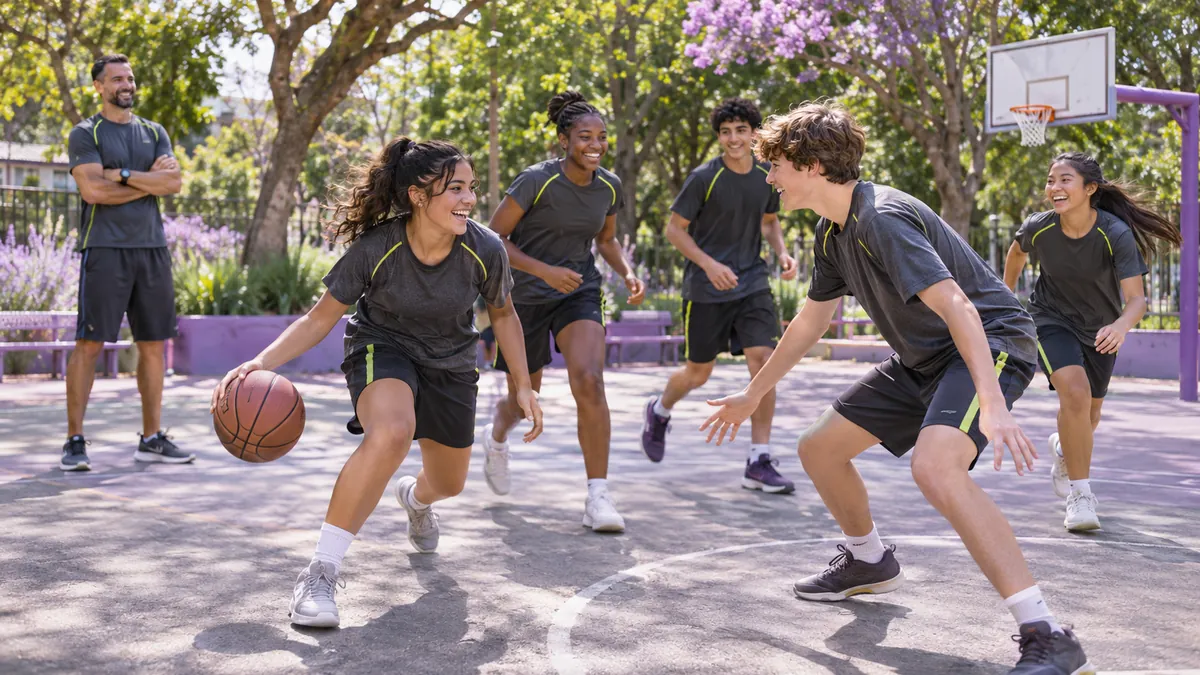
"Moderate" means you breathe faster but can still talk: brisk walking, cycling to school, a relaxed swim. "Vigorous" means you can only say a few words: running, football, basketball, fast swimming, dance practice. Bone-strengthening activity involves impact, like jumping, skipping, running and racket sports. School sport, PE, active travel and play with friends all count.
Is it safe for teenagers to lift weights?
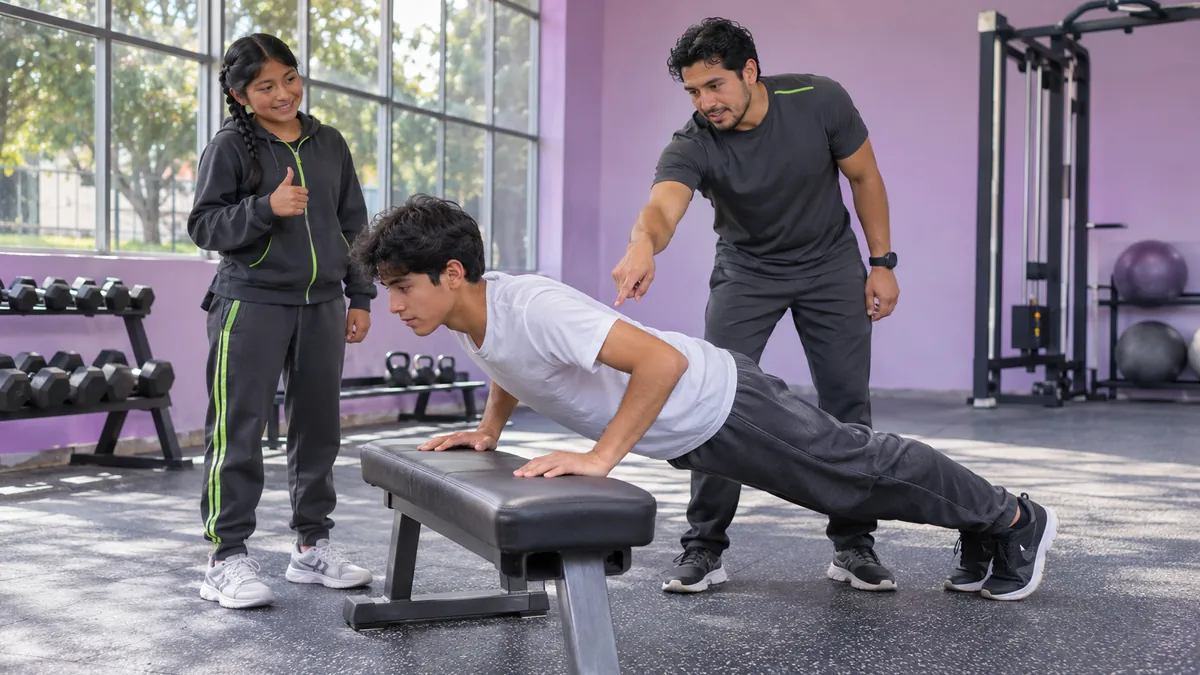
Yes, when it is supervised and technique comes first. The American Academy of Pediatrics, the National Strength and Conditioning Association and an international consensus of sports-medicine groups all say well-run resistance training is safe and beneficial for young people. Most injuries happen with no supervision, poor form or weights that are too heavy, often at home.
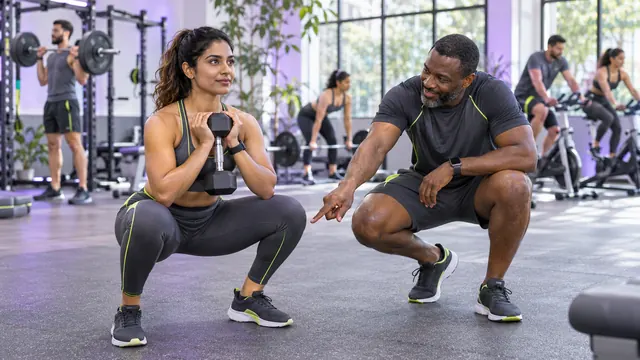
The old worry that lifting "stunts growth" or damages growth plates is not supported when training is properly supervised; these position statements found no evidence of harm to growth from well-designed programs. The benefits include stronger muscles and bones, better sport performance, fewer sports injuries and more confidence. A qualified coach, PE teacher or trainer should teach the moves and check form.
- Learn the move before adding weight: body weight or a light dumbbell or bar first.
- Stay in control: smooth reps, no jerking, no bouncing.
- No max-out contests: testing how much you can lift once is not needed and adds risk.
- Have a spotter or use safety bars for any lift over your face or on your back.
What does a good weekly plan look like for a 13–17-year-old?
A good week mixes sport or play most days, two or three short strength sessions, and at least one easy day. The table below is an example for a teen not already training hard for a team. Teens in a sports program should follow their coach's plan, adding strength work only in agreement with the coach.
| Day | Activity | Time |
|---|---|---|
| Mon | Team sport, PE or a run with friends | 60 min |
| Tue | Supervised strength session (below) + cycle or walk home | 40 + 20 min |
| Wed | Active play: basketball, swimming, dance, skating | 60 min |
| Thu | Team sport or PE | 60 min |
| Fri | Supervised strength session + skipping or jumping games | 40 + 15 min |
| Sat | Longer outing: hike, bike ride, match, swim | 60–120 min |
| Sun | Rest or an easy walk | — |
A beginner strength session (two or three times a week, never on back-to-back days): 1–3 sets of 6–15 reps of each move, with a minute or two of rest. The NSCA youth statement uses this kind of range. Add weight in small steps only when every rep looks the same.
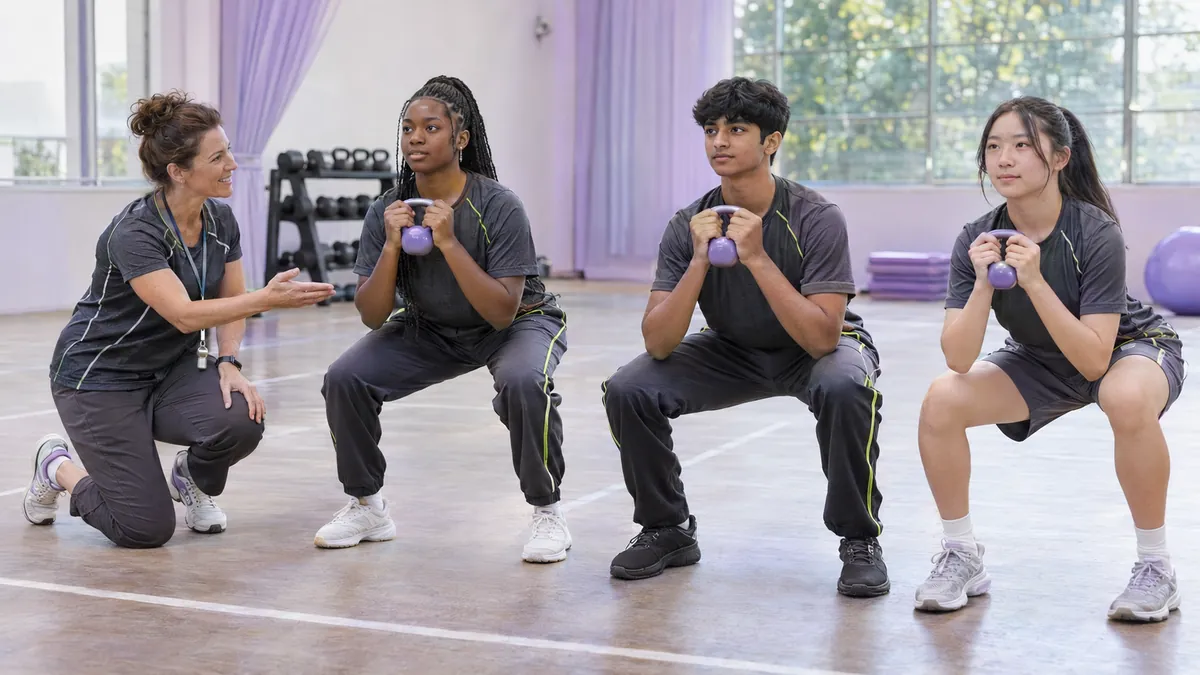
- Goblet squat (start with body weight)
- Push-up (or incline push-up on a bench)
- Inverted row under a bar or table
- Reverse lunge
- Glute bridge
- Plank and dead bug
Warm up first with 5–10 minutes of easy jogging, skipping and moving through each exercise without weight. You can see an animated form guide for each move by tapping it, or browse the full exercise library.
How much protein and food does a teenager need?
The US recommended amount for ages 14–18 is about 0.85 g of protein per kg of body weight a day, roughly 46 g for girls and 52 g for boys at reference weights. Regular meals usually cover this. Growth and sport raise total energy needs, so eat enough, at regular times, and never skip meals to "make weight".
Protein comes easily from everyday foods: a glass of milk or a pot of yogurt (about 8–10 g), two eggs (about 12 g), a bowl of beans or lentils, a piece of chicken or fish, tofu, paneer, nuts and seeds. A plate with some protein, a starchy food such as rice, bread, pasta or potatoes, and vegetables or fruit at each meal covers most of what a growing, active body needs. You can check any food's values in our food database.
Two minerals matter especially during the growth years. Teens need 1,300 mg of calcium a day (dairy, calcium-set tofu, fortified plant milk, sardines) and iron, at 11 mg for boys and 15 mg for girls, who lose iron with periods (meat, beans, lentils, fortified cereal, leafy greens). These are US recommended amounts from the National Institutes of Health.
Should teenagers diet or count calories to lose weight?
No, not on their own. The American Academy of Pediatrics advises against dieting in teenagers and recommends that families focus on healthy habits, not weight. Dieting, skipping meals and talk about weight are linked to a higher risk of eating disorders. If a doctor has concerns about a teen's weight, they will plan any changes with the family.
What helps instead, according to the same AAP report: regular family meals, plenty of activity, less screen time, enough sleep, and talking about health and strength rather than size or shape. Parents can help most by not commenting on a teen's body or their own, and by never teasing about weight. Teen bodies change a lot during puberty; gaining weight while growing is normal.
Do teenagers need protein powder, creatine or other supplements?
No. The American Academy of Pediatrics notes that supplements are often contaminated with substances not on the label, and that for most young athletes they add little beyond what puberty, good food and training already bring. The AAP also says energy drinks have no place in the diets of children and teenagers.
That includes pre-workouts, fat burners and "test boosters", which often contain large doses of caffeine or banned substances. Water is the right drink for most sport; for long, hot sessions a coach or doctor can advise on more. If a doctor finds a real shortage, such as low iron or vitamin D, they will recommend the right dose.
How much sleep does a teenager need?
Eight to ten hours a night, according to the American Academy of Sleep Medicine's consensus for ages 13–18. Sleep is when the body recovers from training and does much of its growing, and short sleep makes it harder to focus, learn and stay in a good mood. Late-night screens are one of the most common things that push bedtime back.
- Keep a similar bedtime and wake time, including at weekends where you can.
- Put phones, tablets and gaming away 30–60 minutes before bed, ideally out of the bedroom.
- Avoid caffeine from cola, coffee and energy drinks in the afternoon and evening.
- Our guide to what one short night does to your results explains why it matters for training.
What are the warning signs of disordered eating in teenagers?
Warning signs include skipping meals, cutting out whole food groups, strict food rules, intense fear of gaining weight, rapid weight change, exercising through illness or injury, distress when a workout is missed, hiding food or eating in secret, and periods stopping. Eating disorders are serious but treatable, and early help works best.
The US National Institute of Mental Health lists these and other signs, such as dizziness, feeling cold all the time and constant talk about weight, shape or calories. Eating disorders affect boys and girls, and every body size. For boys, an obsession with getting bigger or leaner, or with muscle-building supplements, can be part of it.
How can parents and coaches help a teen who wants to get fit?
Keep it fun, varied and focused on skills and health rather than looks. Find a qualified coach or a school or club program for strength training, praise effort and progress instead of size or weight, eat together often, and protect sleep. Teens copy what adults do, so being active as a family is one of the strongest signals.
- Ask about qualifications: look for a coach trained to work with young people.
- Watch the load across sports: pain that lasts, constant tiredness or falling grades can mean too much training.
- Book a check-up before a new competitive sport, as many schools and clubs require.
- Keep the doctor in the loop for any health condition, injury or concern about eating.
Can teenagers use Fitrang?
Fitrang's terms require users to be at least 13 years old. If you are 13–17, set it up together with a parent or guardian and keep your account private. Use it to log workouts, sleep and water. Do not set weight-loss or calorie goals: the app's targets are built for adults, not for growth and puberty.
- With a parent or guardian, create a free account and set Social to private (or leave it off).
- Build your strength session as a routine in Train, using the animated demos to check form.
- Log each session, plus sleep and water; the streak rewards showing up, not weight.
- Share anything you are unsure about with your parent, coach or doctor.
The bottom line
Teenagers need about an hour of activity a day, with hard exercise and strength work on three days a week. Strength training is safe and useful when a qualified adult teaches the technique. Eat regular, balanced meals, sleep 8–10 hours, and skip dieting, calorie counting and supplements. Anything worrying, from chest pain to feelings about food and weight, is a reason to talk to a parent, guardian or doctor.
Frequently asked questions
How much exercise should a 15-year-old get?
The WHO recommends an average of at least 60 minutes a day of moderate-to-vigorous activity for ages 5–17, with vigorous activity and muscle- and bone-strengthening exercise on at least three days a week.
At what age can you start lifting weights?
Children and teenagers can do resistance training once they can follow instructions and practise good technique, usually around 7–8 years old for simple body-weight work, according to youth position statements. At any age it should be supervised by a qualified adult, with technique before load.
Does lifting weights stunt growth?
There is no evidence that properly supervised resistance training harms growth or growth plates. Position statements from the American Academy of Pediatrics, the NSCA and an international consensus found it safe and beneficial when well supervised. Injuries mostly happen without supervision or with poor technique.
How much protein does a teenager need?
About 0.85 g per kg of body weight a day for ages 14–18, or roughly 46 g for girls and 52 g for boys at reference weights. Regular meals with milk, yogurt, eggs, beans, lentils, fish, meat or tofu usually cover it without protein powder.
Should teenagers take protein powder or creatine?
The American Academy of Pediatrics does not recommend performance-enhancing supplements for young people. They are often contaminated and add little over what puberty, good food and training bring. If a doctor finds a deficiency, they will advise on the right supplement and dose.
Is it OK for a teenager to diet?
Teens should not diet on their own. The American Academy of Pediatrics advises focusing on healthy habits rather than weight, because dieting is linked to a higher risk of eating disorders. If weight is a health concern, a doctor will plan any changes with the family.
Keep reading
 What one short night does to your resultsWhy recovery starts in bed
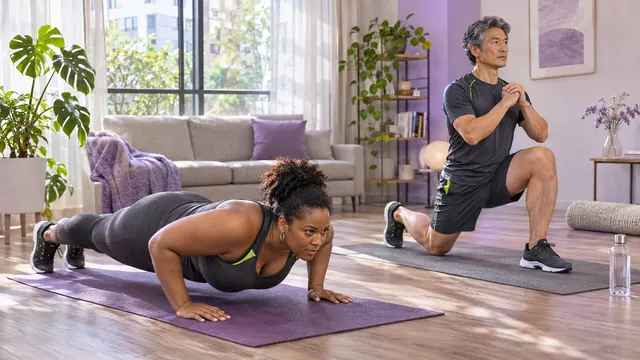 Home workout with no equipmentBody-weight moves you can do anywhere
 How to work out: the complete guideSets, reps, rest and good form
 Vitamins and mineralsCalcium, iron, vitamin D and more
Sources
- World Health Organization. WHO guidelines on physical activity and sedentary behaviour (2020). who.int
- Stricker PR, Faigenbaum AD, McCambridge TM; Council on Sports Medicine and Fitness. Resistance training for children and adolescents. Pediatrics 2020;145(6):e20201011. PubMed
- Faigenbaum AD, Kraemer WJ, Blimkie CJ et al. Youth resistance training: updated position statement paper from the National Strength and Conditioning Association. Journal of Strength and Conditioning Research 2009;23(5 Suppl):S60–S79. PubMed
- Lloyd RS, Faigenbaum AD, Stone MH et al. Position statement on youth resistance training: the 2014 International Consensus. British Journal of Sports Medicine 2014;48(7):498–505. PubMed
- Paruthi S, Brooks LJ, D'Ambrosio C et al. Recommended amount of sleep for pediatric populations: a consensus statement of the American Academy of Sleep Medicine. Journal of Clinical Sleep Medicine 2016;12(6):785–786. PubMed
- Golden NH, Schneider M, Wood C; Committee on Nutrition, Committee on Adolescence, Section on Obesity. Preventing obesity and eating disorders in adolescents. Pediatrics 2016;138(3):e20161649. PubMed
- LaBotz M, Griesemer BA; Council on Sports Medicine and Fitness. Use of performance-enhancing substances. Pediatrics 2016;138(1):e20161300. PubMed
- Committee on Nutrition and the Council on Sports Medicine and Fitness. Sports drinks and energy drinks for children and adolescents: are they appropriate? Pediatrics 2011;127(6):1182–1189. PubMed
- Institute of Medicine. Dietary Reference Intakes for Energy, Carbohydrate, Fiber, Fat, Fatty Acids, Cholesterol, Protein, and Amino Acids. National Academies Press, 2005. nap.edu
- NIH Office of Dietary Supplements. Calcium: fact sheet for health professionals. ods.od.nih.gov
- NIH Office of Dietary Supplements. Iron: fact sheet for health professionals. ods.od.nih.gov
- National Institute of Mental Health. Eating disorders. nimh.nih.gov
This article is general information for teenagers and their parents or guardians, not medical advice. Talk to a doctor before starting a new sport or training plan, especially with a health condition, an injury or worries about eating or weight.