Life stages · Guide
Menopause: weight gain, belly fat and strength
Key takeaways
- 2×faster fat gain, with lean mass falling, from the start of the menopause transition to 2 years after the last periodSWAN study, 2019
- 10.6%of spine bone density lost over 10 years around menopause, 7.4% of it in the years closest to the final periodSWAN study, 2012
- +2.9%spine bone density after 8 months of supervised heavy lifting in postmenopausal women (controls lost 1.2%)LIFTMOR trial, 2018
- 1,200 mgof calcium a day recommended for women from age 51NIH Office of Dietary Supplements
DefinitionMenopause transition, or perimenopause, is the time of changing periods and hormones before the final menstrual period; menopause is confirmed after 12 months without a period.
Many women find that the clothes fit differently, the scale creeps up and the waist thickens in their late 40s and 50s, even when nothing else has changed. This guide explains what the research shows is happening to fat, muscle and bone, and what you can do about it with training and food. It does not replace advice on symptoms or hormone therapy, which only a doctor who knows your history can give.
Does menopause cause weight gain?
Not directly, according to the long-running SWAN study. Women's weight rose steadily through their 40s and did not speed up at menopause. What changed was the mix: from the start of the transition until about two years after the final period, the rate of fat gain doubled and lean (muscle) mass began to fall.
So the scale can look similar while your body changes underneath, with less muscle, more fat, and clothes fitting more tightly. After about two years past the final period, the study found these shifts levelled off. Less sleep, more stress and less movement in midlife can add to it, which is why habits matter as much as hormones.
Why does fat move to the belly during menopause?
Falling oestrogen shifts where the body stores fat. In a study that followed women for four years, all of them gained fat under the skin with age, but only those who became postmenopausal gained deep belly (visceral) fat. Their sleeping energy use and fat burning also fell, and physical activity dropped in the years before menopause.
Visceral fat matters because it is linked to higher risks of heart disease and type 2 diabetes. The same study pointed to the fix: the changes "can predispose to obesity if lifestyle changes are not made". Sit-ups will not target belly fat; a trial of six weeks of daily ab exercises found no reduction in belly fat. Overall fat loss and strength training do the job.
What happens to your bones during menopause?
Bone loss speeds up. In SWAN, women lost 10.6% of their spine bone density over ten years, and most of that (7.4%) came in the window from one year before to two years after the final period. Losing bone raises the risk of osteoporosis and fractures, especially of the spine, hip and wrist.
The Menopause Society recommends bone density testing for all women 65 and over, and earlier for postmenopausal women with risk factors such as a past fracture, low body weight, smoking or a family history of hip fracture. Weight-bearing and resistance exercise, enough calcium and vitamin D, not smoking and limiting alcohol are the everyday basics; medication is a decision for you and your doctor.
What is the best exercise for menopause?
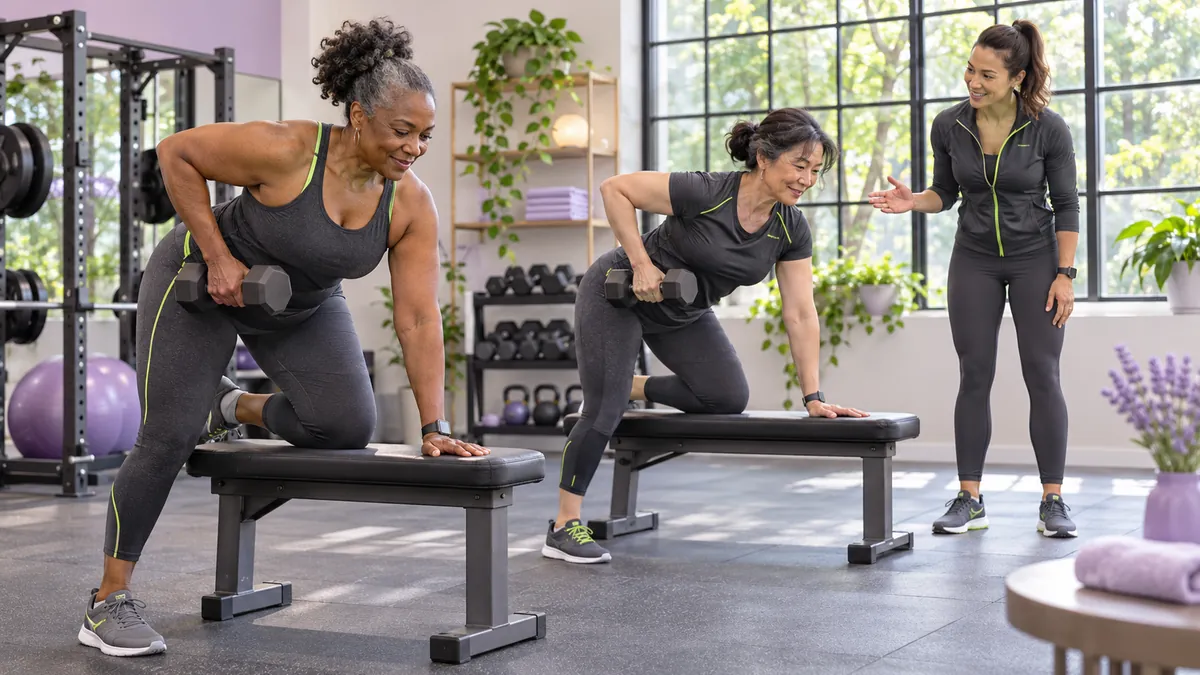
Strength training, two or three days a week, is the cornerstone, because it is one of the few things shown to build both muscle and bone. Add 150–300 minutes of moderate cardio, some impact work if your joints and pelvic floor allow, and balance practice. In the LIFTMOR trial, supervised heavy lifting improved spine bone density by 2.9%.
| Exercise | Sets × reps |
|---|---|
| Goblet squat | 3 × 8–12 |
| Dumbbell Romanian deadlift | 3 × 8–12 |
| Dumbbell bench press or push-up | 3 × 8–12 |
| Dumbbell row | 3 × 10–12 each arm |
| Step-up | 2 × 8–10 each leg |
| Farmer's carry | 3 × 30 m |
Start with weights you can lift 10–12 times with good form and build up over months; the goal is to make the last few reps of each set feel hard. The LIFTMOR women (average age about 65, with low bone mass) worked up to 5 sets of 5 at more than 85% of their maximum, always under close supervision. Do not copy those loads on your own; a qualified coach can take you there safely. Our strength training for women guide has a full 3-day plan.
The WHO recommends 150–300 minutes of moderate aerobic activity a week for all adults. Brisk walking, cycling, swimming and dancing all count. Some impact, like skipping, jogging or small jumps, adds a bone stimulus if your joints, pelvic floor and bones allow; ask a physiotherapist if you are unsure.
How much protein and calcium do you need during menopause?
Aim for about 1.0–1.2 g of protein per kg a day as a floor, and nearer 1.6 g/kg if you lift, spread over three or four meals. The NIH recommends 1,000 mg of calcium a day to age 50 and 1,200 mg from 51, with 600 IU (15 mcg) of vitamin D to age 70.
For a 70 kg (154 lb) woman, 1.2–1.6 g/kg is about 85–110 g of protein a day, or 25–35 g per meal. Good sources include eggs, Greek yogurt, milk, fish, chicken, tofu, tempeh, beans and lentils. Dairy, calcium-set tofu, fortified plant milks, sardines with bones and leafy greens supply calcium. Test before taking high-dose supplements, and ask your doctor about any dose. More in our protein guide and vitamin D guide.

How do you lose menopause belly fat?
By losing fat overall while keeping muscle, which shrinks the belly along with everything else. Eat a modest calorie deficit rather than a crash diet, keep protein high, lift two or three days a week, walk more, sleep well and keep alcohol low. You cannot choose where fat comes off first, but belly fat does respond.
A gentle deficit protects muscle and bone better than an aggressive one. Our guide to how many calories to eat to lose weight and the calorie deficit calculator help you set a sensible target. Measure your waist every few weeks as well as weighing yourself: with lifting, the tape often moves before the scale.
Does hormone therapy help with weight or strength?
Hormone therapy is a treatment for menopause symptoms such as hot flushes and night sweats, and for preventing bone loss, not a weight-loss treatment. The Menopause Society says that for healthy women under 60 or within 10 years of menopause, benefits often outweigh risks, but the decision depends on your health and history, so only your doctor can advise.
Non-hormonal treatments exist too for hot flushes, including some prescription medicines and cognitive behavioural therapy, according to The Menopause Society's 2023 statement. Whatever you and your doctor choose, training and nutrition still do the heavy lifting for muscle, bone and body composition.
How can Fitrang help through menopause?
Fitrang keeps the habits in one place: strength routines from 460+ exercises with animated demos, protein, calcium and vitamin D tracked against targets in Diet, sleep check-ins, and a weight and waist trend. A 30- or 90-day doctor report gives your doctor real data at your next appointment.
- Pick a program in Train, such as Full Body A/B, or build the session above as a routine.
- Log each set; the next-weight hint tells you when to add weight.
- Log meals and check protein and calcium coverage in Diet.
- Log weight and waist, and print the doctor report before appointments.
The bottom line
Menopause shifts the body towards more fat, especially around the belly, and less muscle, and bone loss speeds up around the final period. Strength training two or three days a week, regular cardio, enough protein (1.0–1.2 g/kg, more if lifting), 1,200 mg of calcium from 51 and vitamin D are your best tools. Symptoms, bone density testing and hormone therapy are decisions to make with your doctor.
Frequently asked questions
Why am I gaining weight during menopause?
In the SWAN study, weight rose steadily through midlife without speeding up at menopause, but from the start of the transition the rate of fat gain doubled and muscle began to fall. Falling oestrogen also shifts fat towards the belly. Less sleep and less activity often add to it.
What is the best exercise for menopause belly fat?
Strength training two or three days a week combined with regular cardio and a modest calorie deficit. Ab exercises alone do not burn belly fat; overall fat loss does, and lifting keeps muscle while you lose it.
Can strength training reverse bone loss after menopause?
It can improve it. In the LIFTMOR trial, postmenopausal women with low bone mass who did supervised heavy lifting twice a week improved spine bone density by 2.9% in eight months, while the control group lost 1.2%. People with osteoporosis need a supervised plan.
How much protein do women need after menopause?
At least 1.0–1.2 g per kg of body weight a day, and about 1.6 g/kg if you strength train, spread over three or four meals. For a 70 kg woman that is roughly 85–110 g a day.
Does HRT cause or prevent weight gain?
Hormone therapy is used for menopause symptoms and to prevent bone loss, not for weight. Whether it is right for you depends on your age, health and history, so it is a decision to make with your doctor.
Keep reading
 Strength training for womenPlan, myths and evidence
 Strength training over 50Plan, protein and safety
 Vitamin D deficiencySigns, tests and food sources
 How much protein do I need?Grams per kg by goal, with a calculator
Sources
- Greendale GA, Sternfeld B, Huang M et al. Changes in body composition and weight during the menopause transition. JCI Insight 2019;4(5):e124865. PubMed
- Lovejoy JC, Champagne CM, de Jonge L, Xie H, Smith SR. Increased visceral fat and decreased energy expenditure during the menopausal transition. International Journal of Obesity 2008;32(6):949–958. PubMed
- Greendale GA, Sowers M, Han W et al. Bone mineral density loss in relation to the final menstrual period in a multiethnic cohort: results from the Study of Women's Health Across the Nation (SWAN). Journal of Bone and Mineral Research 2012;27(1):111–118. PubMed
- Watson SL, Weeks BK, Weis LJ et al. High-intensity resistance and impact training improves bone mineral density and physical function in postmenopausal women with osteopenia and osteoporosis: the LIFTMOR randomized controlled trial. Journal of Bone and Mineral Research 2018;33(2):211–220. PubMed
- Vispute SS, Smith JD, LeCheminant JD, Hurley KS. The effect of abdominal exercise on abdominal fat. Journal of Strength and Conditioning Research 2011;25(9):2559–2564. PubMed
- The North American Menopause Society (now The Menopause Society). Management of osteoporosis in postmenopausal women: the 2021 position statement. Menopause 2021;28(9):973–997. PubMed
- The 2022 Hormone Therapy Position Statement of The North American Menopause Society Advisory Panel. The 2022 hormone therapy position statement of The North American Menopause Society. Menopause 2022;29(7):767–794. PubMed
- The 2023 nonhormone therapy position statement of The North American Menopause Society. Menopause 2023;30(6):573–590. PubMed
- Bauer J, Biolo G, Cederholm T et al. Evidence-based recommendations for optimal dietary protein intake in older people: a position paper from the PROT-AGE Study Group. Journal of the American Medical Directors Association 2013;14(8):542–559. PubMed
- Morton RW, Murphy KT, McKellar SR et al. A systematic review, meta-analysis and meta-regression of the effect of protein supplementation on resistance training-induced gains in muscle mass and strength in healthy adults. British Journal of Sports Medicine 2018;52(6):376–384. PubMed
- NIH Office of Dietary Supplements. Calcium: fact sheet for health professionals. ods.od.nih.gov
- NIH Office of Dietary Supplements. Vitamin D: fact sheet for health professionals. ods.od.nih.gov
- World Health Organization. WHO guidelines on physical activity and sedentary behaviour (2020). who.int
This article is general information for healthy adults, not medical advice. If you have a medical condition, are pregnant, or take medication, talk to a doctor or registered dietitian before changing your diet, sleep or training.