Training · Guide
Strength training for women: plan, myths and evidence
Key takeaways
- ES 0.07no meaningful difference between women and men in muscle growth from the same trainingRoberts meta-analysis, 2020
- +2.9%spine bone density in postmenopausal women after 8 months of supervised heavy lifting (controls lost 1.2%)LIFTMOR trial, 2018
- Trivialeffect of menstrual-cycle phase on strength and endurance performance, on averageMcNulty meta-analysis, 2020
- 1.6 g/kgdaily protein where extra muscle gains level off (up to 2.2 g/kg for some)Morton meta-analysis, 2018
DefinitionStrength training (resistance training) means making your muscles work against a load, such as dumbbells, barbells, machines, bands or your own body weight, and increasing that load over time.
Most gym advice for women is either "light weights, high reps, tone up" or a copy of a bodybuilder's routine. Neither fits the research. This guide covers what studies actually show, a simple 3-day plan with an optional lower-body focus, how heavy to go, food, and the life stages that change the rules: the menstrual cycle, pregnancy, and the years around menopause.
Do women build muscle and strength like men?
Relative to where they start, yes. A 2020 meta-analysis of studies that trained men and women the same way found no meaningful difference in muscle growth and similar lower-body strength gains, while women gained slightly more upper-body strength in relative terms. Men start with more muscle, so their absolute numbers are higher.
In practice this means the same training principles work for everyone: a few big exercises, enough hard sets, and a little more weight or reps over time. There is no separate "female" way to lift. What differs is mostly where you start and, for some, which life stage you are in.
The complete workout guide explains sets, reps, rest and progressive overload if any of those words are new.
Will lifting weights make me bulky?
No. Building noticeable muscle takes months of hard, progressive training, enough protein and usually eating more calories than you burn. It does not happen by accident from three sessions a week. What most women see instead is a firmer, more defined shape, because muscle is denser than fat and lifting helps you keep it while dieting.
Three things stand in the way of accidental bulk: energy (muscle needs a surplus to grow quickly), time (gains come slowly, even with perfect training), and hormones (women have far less testosterone on average). Physique athletes who look very muscular have usually trained for years with that exact goal.
Why does strength training matter even more for women?
Because women, on average, start with less muscle and bone and lose bone faster after menopause. Lifting is one of the few things shown to build both. In the LIFTMOR trial, postmenopausal women with low bone mass who lifted heavy, supervised, twice a week improved spine bone density by 2.9% in eight months, while the control group lost 1.2%.
Beyond bone, strength training helps you keep muscle while losing fat, makes daily tasks (stairs, shopping, children, suitcases) easier, and supports balance later in life. The WHO recommends muscle-strengthening activity on two or more days a week for all adults, women included, on top of 150–300 minutes of moderate cardio.
What is a good 3-day strength plan for women?
A full-body plan done three days a week, alternating two workouts (A, B, A one week, then B, A, B), is the simplest place to start. Each session takes about 45 minutes, trains every major muscle and gives each one about two sessions a week, which beats one long session per muscle for the same work.
| Workout | Exercise | Sets × reps |
|---|---|---|
| A | Goblet squat | 3 × 8–12 |
| Dumbbell bench press | 3 × 8–12 | |
| Lat pulldown | 3 × 10–12 | |
| Dumbbell Romanian deadlift | 3 × 8–12 | |
| Plank | 3 × 30–45 s | |
| B | Barbell hip thrust | 3 × 8–12 |
| Bulgarian split squat | 2–3 × 8–10 each leg | |
| Seated cable row | 3 × 10–12 | |
| Dumbbell overhead press | 3 × 8–12 | |
| Dead bug | 3 × 8 each side |
Lower-body focus option: many women want more glute and leg work. Add 2 sets of glute bridges or hip thrusts to workout A and do 2 sets instead of 3 on the overhead press. Keep at least one push and one pull in every session so your upper body and posture keep up.
Start with 2 sets per exercise for the first two weeks while you learn the moves, then go to 3. More detail on full-body versus push/pull/legs is in our beginner 3-day split guide.
How the three key lower-body lifts look
How much weight should a woman lift?
Pick a weight you can lift for 6–15 clean reps while stopping with one to three reps left in the tank. Muscle grows across that whole range as long as sets are hard, so the exact kilograms matter less than effort. If you can do more than 15 reps easily, the weight is too light.
A simple way to find your starting weights:
- Choose a weight you think you can lift 10 times.
- Do a set. If you could have done 4 or more extra reps, go heavier next set.
- If your form breaks before 8 reps, go lighter.
- Once you reach the top of the rep range on every set, add the smallest jump available (often 1–2.5 kg, about 2–5 lb) and build the reps back up.
"Toning" is not a different kind of training: the light-weight, endless-reps style mostly trains endurance and rarely gets hard enough to change your shape. Lifting heavy enough to make reps 8–12 a real challenge is what changes how you look and feel.
How much protein and food do women who lift need?
About 1.6 g of protein per kg of body weight a day, spread over three or four meals, is where extra muscle gains level off in research; some people benefit from up to 2.2 g/kg. For a 65 kg (143 lb) woman that is about 105 g a day, or roughly 25–35 g per meal.
Calories depend on the goal. To build muscle, eat at or slightly above maintenance. To lose fat while keeping muscle, a modest deficit of 10–25% works with lifting and high protein; crash diets cost muscle. Women who lift also need to watch iron, calcium and vitamin D, which are common gaps; see our vitamins and minerals guide. Food ideas and a calculator are in the protein guide.

Should I train differently during my menstrual cycle?
You do not need to. A 2020 meta-analysis of 51 studies found menstrual-cycle phase has, on average, a trivial effect on strength and endurance performance, and the evidence quality was low. Train as normal and adjust by how you feel on the day, not by a calendar that assumes everyone responds the same way.
Some women do feel weaker, more tired or crampy on certain days. On those days, use lighter weights, fewer sets or swap to a walk. That is ordinary listening-to-your-body, not a reason to plan the whole month around phases. Very heavy or painful periods, missed periods or periods that stop with heavy training are worth raising with a doctor.
Can I lift weights during pregnancy and after giving birth?
For most people, yes, with medical guidance. The WHO advises pregnant and postpartum women without contraindications to do at least 150 minutes of moderate activity a week, including muscle-strengthening work. Lifting experience helps, but this is a time to lower the effort, not chase new personal bests. Your midwife or doctor has the final say.
- Before you start or continue: check with your maternity team, especially with any complication.
- Keep effort moderate: you should be able to talk during a set.
- Avoid anything with a real risk of falls or blows to the belly.
- Stop and call your care team if you have bleeding, dizziness, chest pain, fluid leaking or painful contractions.
- After birth, especially after a caesarean or with pelvic-floor symptoms (leaking, heaviness) or a gap in the stomach muscles, a pelvic-health physiotherapist can plan your return.
How should women lift in their 40s, 50s and beyond?
Keep lifting, and keep it challenging. Muscle and bone become harder to hold on to with age, and bone loss speeds up around menopause, so progressive strength training matters more, not less. Recovery may take a little longer, so two or three full-body sessions a week with sensible progression usually work better than daily hard training.
- Load: the LIFTMOR results came from heavy, closely supervised lifting (5 sets of 5 at more than 85% of a one-rep max, twice a week for 30 minutes) in women aged about 65. If you are new, build up over months with a coach.
- Impact: some impact work (jumps, skipping) also helps bone, if your joints and pelvic floor allow it.
- Protein: aim for the upper half of the protein range and spread it evenly over the day.
- Balance: single-leg moves such as split squats and step-ups train balance alongside strength.
How do I follow a plan and see progress in Fitrang?
Pick a program in Train, Programs: Full Body A/B or Dumbbell Basics suit beginners at three days a week. Each workout shows last time's weights next to today's sets, so you always know what to beat. Over the weeks, Progress shows your strength level for each main lift and your personal records.
- Choose a program, or build your own routine from the plan above using the exercise library.
- Log each set's weight and reps; the rest timer runs between sets.
- Follow the next-weight hint on your first set: add, hold or ease off.
- Track protein against your target in Diet, and check your strength levels and PRs in Progress.
Workout logging works offline, so a basement gym with no signal is fine; it syncs later.
The bottom line
Women respond to lifting much like men do in relative terms, and they do not get bulky by accident. Lift 2–3 days a week with a full-body plan, make 6–15 reps hard, add weight slowly and eat about 1.6 g/kg of protein. Keep training through the cycle, adapt in pregnancy with medical advice, and keep lifting after menopause for your bones.
Frequently asked questions
Will lifting weights make women bulky?
No. Visible muscle growth takes months of progressive training, enough protein and usually a calorie surplus. Women also have much less testosterone on average. Most women who lift two or three times a week look firmer and leaner, not bulky.
How many days a week should women lift?
Two to three days is enough for most women. The WHO recommends muscle-strengthening activity on at least two days a week for all adults. A three-day full-body plan trains every muscle about twice a week, which is efficient for building strength.
Should women lift heavy?
Heavy enough that 6–15 reps are hard, stopping one to three reps short of failure. That is heavier than most "toning" routines. Very heavy work (five reps or fewer) is safe for many people with good coaching, but is not required to build muscle.
Can I lift weights during my period?
Yes. Research finds, on average, only a trivial effect of cycle phase on performance. If you feel tired or crampy, go lighter or do fewer sets that day. See a doctor for very heavy, painful or missing periods.
Is strength training safe in pregnancy?
For most people without complications, yes, at moderate effort and with your midwife or doctor's agreement. The WHO recommends at least 150 minutes of moderate activity a week, including muscle-strengthening work, in pregnancy and after birth. Avoid fall risks and stop if anything feels wrong.
How much protein does a woman need to build muscle?
About 1.6 g per kg of body weight a day, and up to 2.2 g/kg for some, spread over three or four meals. For a 65 kg woman that is roughly 105 g a day. Our protein guide has a calculator.
Cardio or weights for fat loss?
Fat loss comes mainly from a calorie deficit. Weights matter because they help you keep muscle while you lose fat, so the weight you lose is mostly fat. Add cardio for heart health; the WHO suggests 150–300 minutes of moderate activity a week.
Keep reading
 How to work out: the complete guideSets, reps, rest and progressive overload
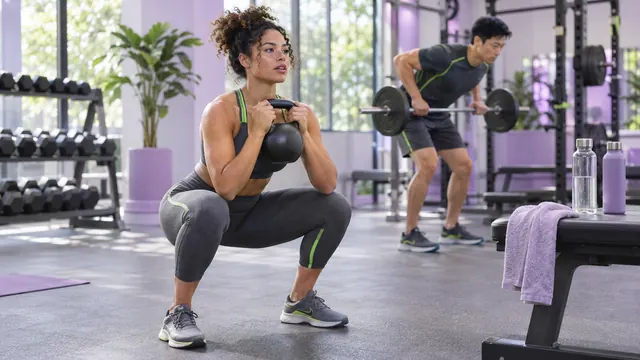 Beginner 3-day workout splitFull-body A/B/A vs push/pull/legs
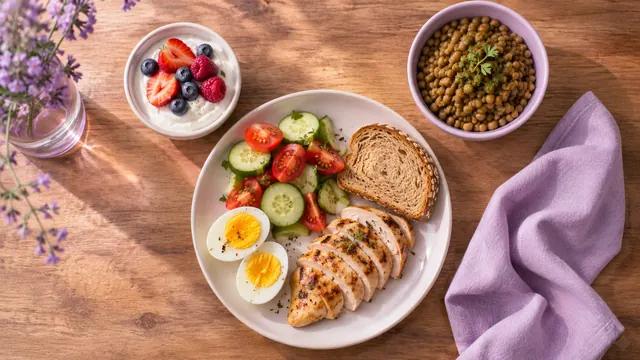 How much protein do I need?Grams per kg by goal, with a calculator
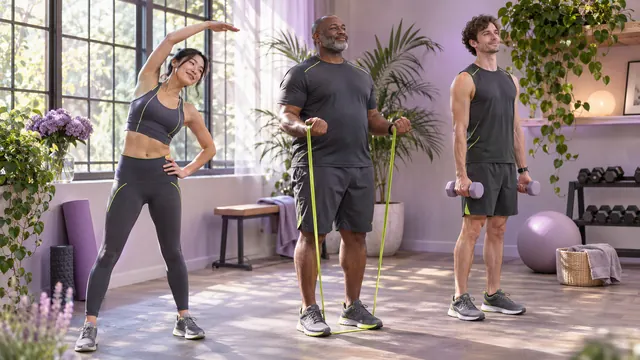 Fat loss, muscle gain or recomp?Pick the right goal first
Sources
- Roberts BM, Nuckols G, Krieger JW. Sex differences in resistance training: a systematic review and meta-analysis. Journal of Strength and Conditioning Research 2020;34(5):1448–1460. PubMed
- Watson SL, Weeks BK, Weis LJ et al. High-intensity resistance and impact training improves bone mineral density and physical function in postmenopausal women with osteopenia and osteoporosis: the LIFTMOR randomized controlled trial. Journal of Bone and Mineral Research 2018;33(2):211–220. PubMed
- McNulty KL, Elliott-Sale KJ, Dolan E et al. The effects of menstrual cycle phase on exercise performance in eumenorrheic women: a systematic review and meta-analysis. Sports Medicine 2020;50(10):1813–1827. PubMed
- Morton RW et al. A systematic review, meta-analysis and meta-regression of the effect of protein supplementation on resistance training-induced gains in muscle mass and strength in healthy adults. British Journal of Sports Medicine 2018;52(6):376–384. PubMed
- World Health Organization. WHO guidelines on physical activity and sedentary behaviour (2020), including pregnant and postpartum women. who.int
- Schoenfeld BJ, Grgic J, Ogborn D, Krieger JW. Strength and hypertrophy adaptations between low- vs. high-load resistance training: a systematic review and meta-analysis. Journal of Strength and Conditioning Research 2017;31(12):3508–3523. PubMed
- Refalo MC, Helms ER, Trexler ET, Hamilton DL, Fyfe JJ. Influence of resistance training proximity-to-failure on skeletal muscle hypertrophy: a systematic review with meta-analysis. Sports Medicine 2023;53(3):649–665. PubMed
This article is general information for healthy adults, not medical advice. If you have a medical condition, are pregnant, or take medication, talk to a doctor or registered dietitian before changing your diet, sleep or training.