Life stages · Guide
Pregnancy exercise and nutrition: key pointers
Key takeaways
- 150 mina week of moderate activity for pregnant women without complicationsWHO guidelines and ACOG, 2020
- 27 mgof iron a day in pregnancy, up from 18 mgACOG patient guidance
- 600 mcgof folic acid a day in pregnancy, with a 400 mcg supplement from before conceptionACOG patient guidance
- <200 mgof caffeine a day, about one to two regular cups of coffeeACOG 2010 (reaffirmed 2026); EFSA 2015
DefinitionModerate-intensity activity is exercise that raises your heart rate and breathing while you can still hold a conversation, such as brisk walking.
These are pointers, not a care plan. Every pregnancy is different, and your doctor, midwife or obstetric team knows your health, history and how things are going. Use this page to understand the general guidance and to bring better questions to your appointments.
Is it safe to exercise during pregnancy?
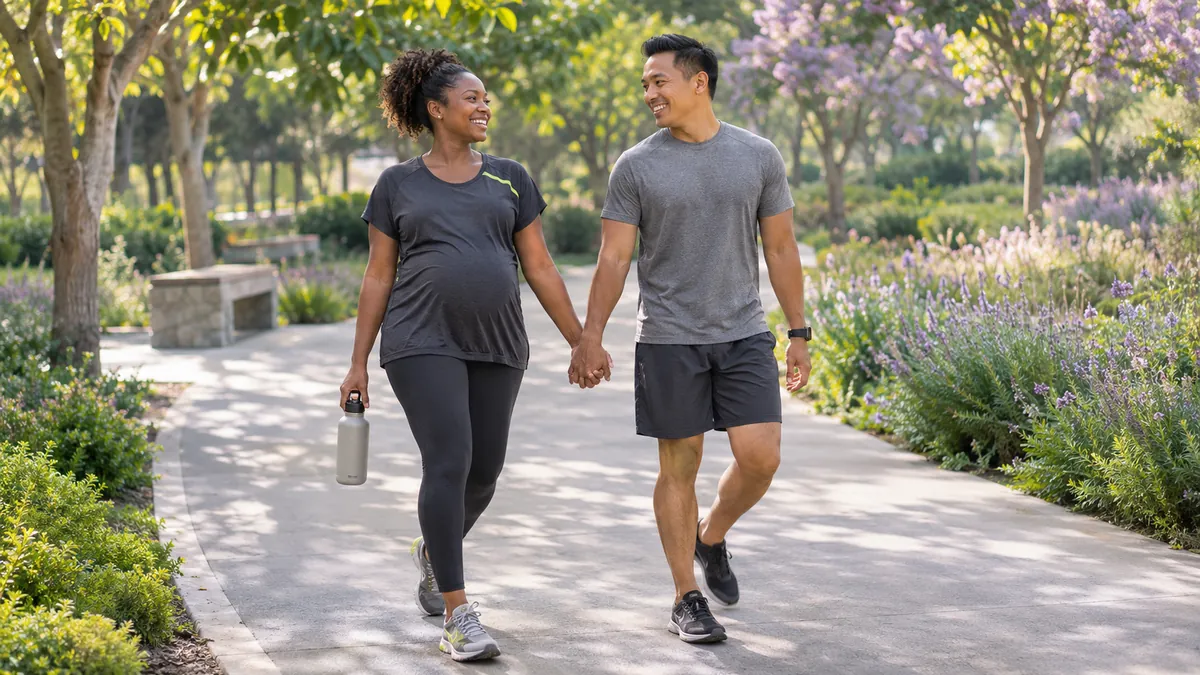
For most people with an uncomplicated pregnancy, yes. The American College of Obstetricians and Gynecologists says physical activity in pregnancy is safe and desirable when there are no medical or obstetric complications, and encourages women to continue or start safe activities. Your doctor or midwife should confirm it is right for you.
ACOG notes that women who exercise during pregnancy have been observed to have less gestational diabetes, fewer caesarean and assisted births, and shorter recovery after birth. If you were already active, including with vigorous exercise, you can usually carry on with adjustments. If you were inactive, start gently and build up.
How much exercise is recommended during pregnancy?
At least 150 minutes of moderate-intensity aerobic activity a week, according to both the WHO and ACOG, ideally spread over most days, for example 30 minutes on five days. The WHO also advises a variety of aerobic and muscle-strengthening activities, and adds that gentle stretching can help. All of this applies only with your care team's agreement.
Moderate means you can hold a conversation but not sing. If you have to stop to catch your breath mid-sentence, slow down. Ten-minute bouts count, which helps on days of tiredness or nausea, and some days will be lighter than others; that is normal.
Which exercises are good, and which should you avoid?
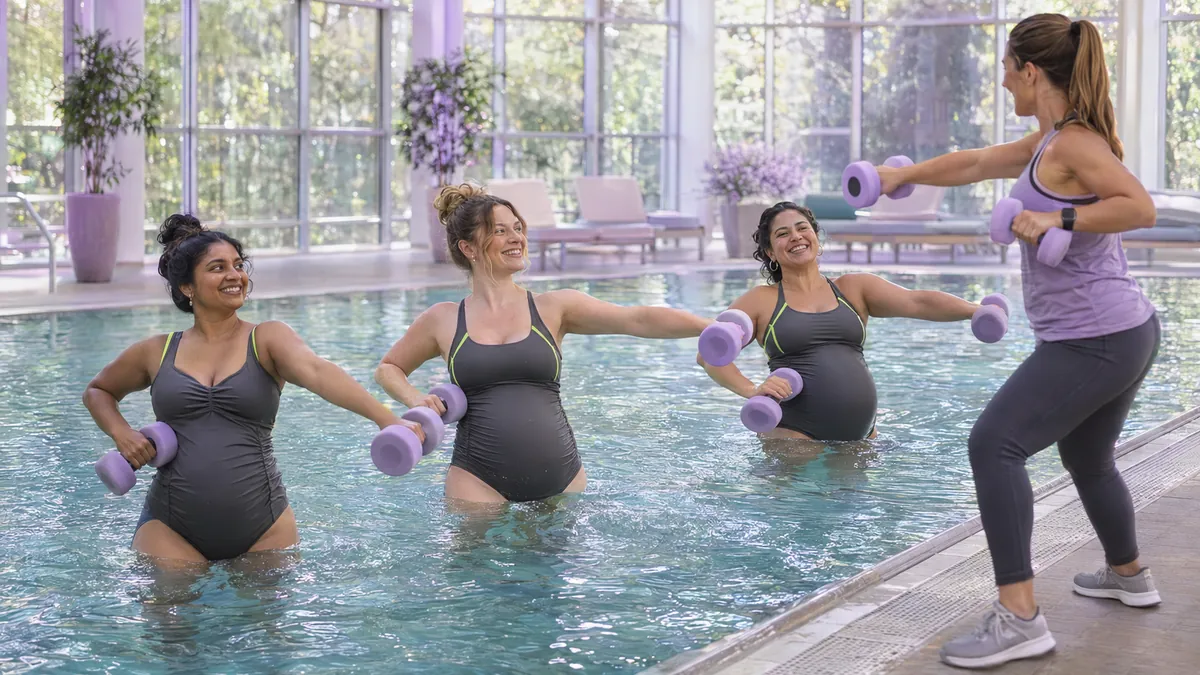
Walking, swimming and water aerobics, stationary cycling, and modified yoga and Pilates are usually good choices, along with light-to-moderate strength training. ACOG advises avoiding contact sports, activities with a high risk of falling, scuba diving, skydiving, hot yoga or hot Pilates, and exercise above 6,000 feet unless you already live at altitude.
| Usually good, with your care team's OK | Avoid during pregnancy |
|---|---|
| Brisk walking | Contact sports: boxing, ice hockey, football (soccer), basketball |
| Swimming and water aerobics | Fall risks: downhill skiing, water skiing, surfing, off-road cycling, gymnastics, horse riding |
| Stationary cycling | Scuba diving and skydiving |
| Modified yoga and Pilates | Hot yoga and hot Pilates (overheating) |
| Light-to-moderate strength training | Exercise above 6,000 ft (1,800 m) if you do not already live at altitude |
- Stay cool and drink water: avoid getting overheated, especially in the first trimester, and do not exercise outdoors in very hot or humid weather.
- Limit lying flat on your back: ACOG advises avoiding lying flat or standing still for long periods; use an incline bench or side-lying moves instead.
- Expect balance to change: your centre of gravity shifts, so avoid jerky, bouncy or high-impact moves and choose steady ones.
- Strength work: keep effort moderate (you can talk during a set), breathe steadily and do not hold your breath; experienced lifters should ask their care team how to adjust.
What are the warning signs to stop exercising?
Stop and call your doctor or midwife if you have vaginal bleeding, feel dizzy or faint, are short of breath before starting, or have chest pain, a headache, muscle weakness, calf pain or swelling, regular painful contractions, or fluid gushing or leaking from the vagina. These are ACOG's listed warning signs; do not exercise through them.
How much weight should you gain during pregnancy?
It depends on your weight before pregnancy. The US Institute of Medicine's ranges, endorsed by ACOG, run from 11.5–16 kg (25–35 lb) for a pre-pregnancy BMI of 18.5–24.9, to more for underweight and less for overweight or obesity. Your care team will tailor the target; these ranges are for a single baby.
| Pre-pregnancy BMI | Total gain |
|---|---|
| Under 18.5 (underweight) | 12.5–18 kg (28–40 lb) |
| 18.5–24.9 (healthy range) | 11.5–16 kg (25–35 lb) |
| 25.0–29.9 (overweight) | 7–11.5 kg (15–25 lb) |
| 30 or more (obesity) | 5–9 kg (11–20 lb) |
Twins and other multiple pregnancies have different ranges, and some health systems use different cut-offs or targets; follow your own care team's advice. Weight gain is rarely steady week to week, so do not worry about single weigh-ins.
Do you need to eat for two, or should you cut calories?
Neither. Pregnancy needs only a modest amount of extra food, and mostly later on, so "eating for two" overshoots. But pregnancy is not the time to diet, cut calories or try to lose weight. Eat regular, balanced meals, and if you are worried about your weight gain, ask your care team, who can refer you to a dietitian.
Build meals from vegetables and fruit, wholegrains or other starchy foods, protein such as beans, lentils, eggs, dairy, poultry, fish and lean meat, and some healthy fats. Small, frequent meals help with nausea and heartburn. If you have a history of an eating disorder, tell your care team early so they can support you.

Which nutrients matter most in pregnancy?
Folic acid, iron, calcium, vitamin D, choline and omega-3 fats are among the most important. ACOG's guidance lists 600 mcg of folic acid, 27 mg of iron, 1,000 mg of calcium (1,300 mg if you are 18 or younger), 600 IU of vitamin D and 450 mg of choline a day. A daily prenatal vitamin covers several of these.
| Nutrient | Daily amount | Food sources |
|---|---|---|
| Folic acid | 600 mcg (400 mcg as a supplement from at least 1 month before pregnancy) | Fortified cereals, leafy greens, beans, oranges |
| Iron | 27 mg | Lean red meat, poultry, fish, beans, lentils, fortified cereal |
| Calcium | 1,000 mg (1,300 mg if 18 or younger) | Milk, yogurt, cheese, sardines, leafy greens, fortified foods |
| Vitamin D | 600 IU (15 mcg) | Fortified milk, oily fish such as salmon, eggs |
| Choline | 450 mg | Milk, eggs, peanuts, soy foods |
ACOG advises a daily prenatal vitamin with at least 400 mcg of folic acid starting at least a month before pregnancy and through the first 12 weeks; people who have had a pregnancy affected by a neural tube defect may be advised a much higher dose, so ask your doctor. Your blood will be checked for anaemia, and your doctor may add iron. Do not add separate supplements, especially vitamin A, without advice. Browse foods by nutrient in our food database.
What about caffeine, alcohol and foods to avoid?
Keep caffeine under 200 mg a day, about one to two regular cups of coffee, as advised by ACOG and the European Food Safety Authority. Avoid alcohol altogether, since no amount is known to be safe in pregnancy. Skip high-mercury fish, raw fish and shellfish, and unpasteurised dairy, and ask about local food-safety advice.
- Caffeine is also in tea, cola, energy drinks and chocolate, so it adds up.
- Fish: ACOG suggests two or three servings a week of low-mercury fish for omega-3s, but advises avoiding bigeye tuna, king mackerel, marlin, orange roughy, shark, swordfish and tilefish, and limiting albacore (white) tuna to 6 oz (about 170 g) a week.
- Raw and unpasteurised foods: avoid raw fish and shellfish, including sushi, and choose pasteurised dairy.
- Alcohol: none. If you drank before you knew you were pregnant, tell your care team; stopping now still helps.
Can Fitrang help during pregnancy?
Fitrang can log walks, gentle workouts, sleep, water and meals, and its Nutrients screen shows how much iron, folate, calcium and vitamin D your food is providing. Its targets and calorie goals are designed for adults who are not pregnant, so do not use its weight-loss settings, and let your care team set your numbers.
- Turn off or skip any weight-loss goal; use maintenance or simply log without a goal.
- Log meals and check iron and folate coverage on the Nutrients screen.
- Log walks, swims and gentle sessions your care team has approved.
- Print the doctor report from You to take to appointments, if you find it useful.
The bottom line
With your doctor's or midwife's agreement, aim for at least 150 minutes of moderate activity a week, avoid contact sports, fall risks, scuba diving and overheating, and stop at any warning sign. Eat regular balanced meals without dieting, take a prenatal vitamin with folic acid, and know the key numbers: 27 mg of iron, 600 mcg of folic acid, under 200 mg of caffeine, no alcohol. Your care team sets your weight-gain target and any extra supplements.
Frequently asked questions
How much exercise should I do while pregnant?
If your doctor or midwife agrees, at least 150 minutes of moderate activity a week, such as 30 minutes on five days, according to the WHO and ACOG. Include some muscle-strengthening work, and keep the effort at a level where you can still talk.
What exercises should be avoided during pregnancy?
ACOG advises avoiding contact sports, activities with a high risk of falling (such as skiing, surfing, off-road cycling, gymnastics and horse riding), scuba diving, skydiving, hot yoga or hot Pilates, and exercise above 6,000 feet unless you already live at altitude.
How much iron do I need when pregnant?
27 mg a day, up from 18 mg before pregnancy. Most prenatal vitamins provide this. Your blood will be checked for anaemia, and your doctor may recommend extra iron if you need it.
How much caffeine is safe during pregnancy?
Less than 200 mg a day, according to ACOG and the European Food Safety Authority. That is roughly one to two regular cups of coffee; remember tea, cola, energy drinks and chocolate also contain caffeine.
How much weight should I gain during pregnancy?
It depends on your pre-pregnancy BMI. For a single baby, the Institute of Medicine ranges are 12.5–18 kg if underweight, 11.5–16 kg in the healthy range, 7–11.5 kg if overweight and 5–9 kg with obesity. Your care team will set your own target.
Can I diet or lose weight while pregnant?
Pregnancy is not the time to diet or cut calories to lose weight. Eat regular, balanced meals. If you are concerned about your weight or weight gain, talk to your doctor or midwife, who can refer you to a dietitian.
Keep reading
 Iron deficiency and iron-rich foodsSigns, tests and the best sources
 Vitamins and mineralsFolate, iron, calcium, vitamin D and more
 How much water a day?Daily needs and what counts
 Strength training for womenPlan, myths and life stages
Sources
- World Health Organization. WHO guidelines on physical activity and sedentary behaviour (2020). who.int
- American College of Obstetricians and Gynecologists. Physical activity and exercise during pregnancy and the postpartum period. Committee Opinion No. 804. Obstetrics & Gynecology 2020;135(4):e178–e188 (reaffirmed 2023). PubMed · acog.org
- American College of Obstetricians and Gynecologists. Exercise during pregnancy (patient FAQ). acog.org
- American College of Obstetricians and Gynecologists. Healthy eating during pregnancy (patient FAQ). acog.org
- Institute of Medicine and National Research Council. Weight Gain During Pregnancy: Reexamining the Guidelines. National Academies Press, 2009. NCBI Bookshelf
- American College of Obstetricians and Gynecologists. Weight gain during pregnancy. Committee Opinion No. 548, 2013 (reaffirmed 2026). acog.org
- American College of Obstetricians and Gynecologists. Moderate caffeine consumption during pregnancy. Committee Opinion No. 462, 2010 (reaffirmed 2026). acog.org
- EFSA Panel on Dietetic Products, Nutrition and Allergies. Scientific opinion on the safety of caffeine. EFSA Journal 2015;13(5):4102. efsa.europa.eu
- NIH Office of Dietary Supplements. Iron: fact sheet for health professionals. ods.od.nih.gov
- Centers for Disease Control and Prevention. About alcohol use during pregnancy. cdc.gov
This article is general information for healthy adults, not medical advice. If you have a medical condition, are pregnant, or take medication, talk to a doctor or registered dietitian before changing your diet, sleep or training.