Life stages · Plan
Fitness over 40: workout and nutrition plan
Key takeaways
- 150–300 minof moderate aerobic activity a week, or 75–150 min vigorous, for adultsWHO guidelines, 2020
- 2+ daysa week of muscle-strengthening activity for all major muscle groupsWHO guidelines, 2020
- 1.6 g/kgdaily protein where extra muscle gains from lifting level offMorton meta-analysis, 2018
- 7+ hoursof sleep a night for adultsAASM and SRS consensus, 2015
DefinitionProgressive overload means making training slightly harder over time, with more weight, reps or sets, so the body keeps adapting.
Your 40s are when many people notice that injuries linger, weight creeps on and the old "just go hard" approach stops working. The good news: metabolism is not the main culprit, and the body still responds well to training. This guide gives a weekly plan, two strength workouts, cardio and protein targets, recovery habits, and the health checks to put in the diary.
What is the best workout plan for someone in their 40s?
Three full-body strength sessions and two or three cardio sessions a week cover everything the WHO recommends. Keep strength days apart, put cardio on the days between, and take at least one full rest day. Each strength session takes about 45 minutes, and cardio can be as simple as brisk walking.
| Day | Session | Time |
|---|---|---|
| Mon | Strength A | 45 min |
| Tue | Brisk walk, cycle or swim (moderate) | 30–45 min |
| Wed | Strength B | 45 min |
| Thu | Intervals or a hilly route (if cleared for hard cardio) | 20–30 min |
| Fri | Strength A | 45 min |
| Sat | Long walk, hike, sport or a family bike ride | 45–90 min |
| Sun | Rest, or gentle mobility | — |
Short on time? Two strength sessions and three 30-minute brisk walks still meet the WHO minimums. Alternate A and B across weeks (A, B, A, then B, A, B).
What should a strength session look like after 40?
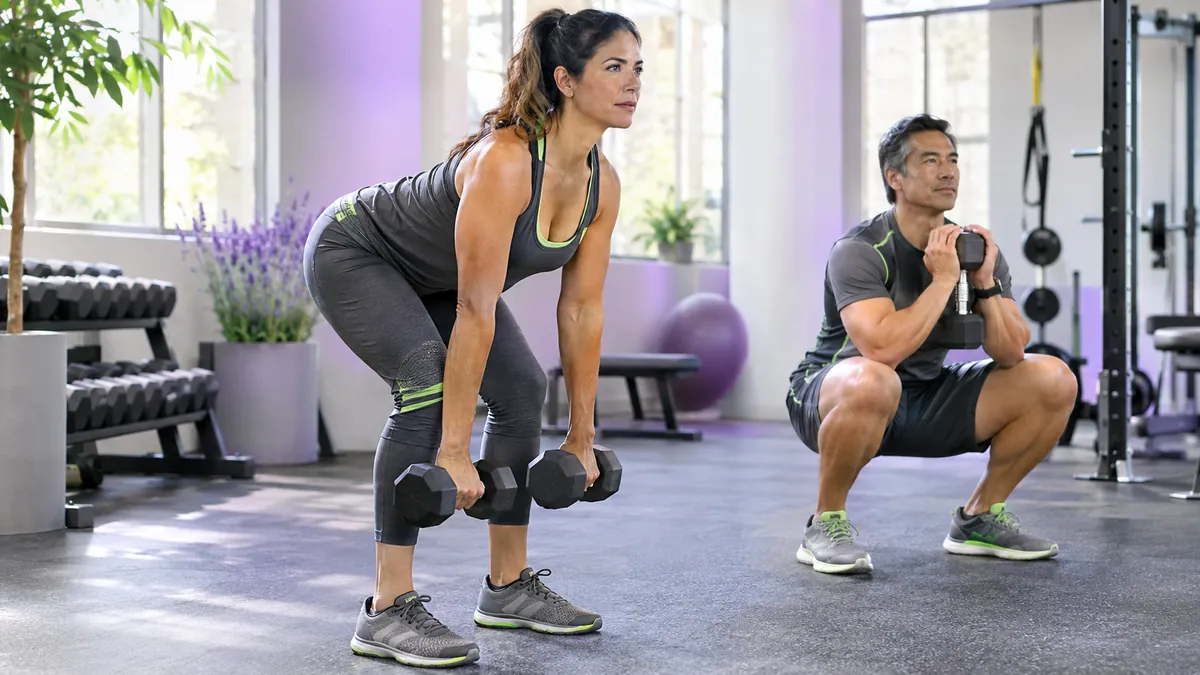
Pick one exercise for each main movement: a squat, a hip hinge, a push, a pull and a carry or core move. Do 2–3 sets of 8–12 reps, stopping with one to three reps left in the tank. Choose dumbbells, machines and body weight while you learn, and add weight in small steps.
| Day | Exercise | Sets × reps |
|---|---|---|
| A | Goblet squat | 3 × 8–12 |
| Dumbbell bench press | 3 × 8–12 | |
| Dumbbell row | 3 × 10–12 each arm | |
| Dumbbell Romanian deadlift | 3 × 8–12 | |
| Farmer's carry | 3 × 30 m | |
| B | Leg press or split squat | 3 × 10–12 |
| Lat pulldown | 3 × 10–12 | |
| Dumbbell overhead press | 3 × 8–12 | |
| Glute bridge or hip thrust | 3 × 10–15 | |
| Side plank | 3 × 20–40 s each side |
Warm up with five minutes of easy cardio and a light first set of your first exercise. If a move hurts a joint, swap it for a similar one (leg press for squats, for example) rather than pushing through. The complete workout guide covers sets, reps and progressive overload in detail.
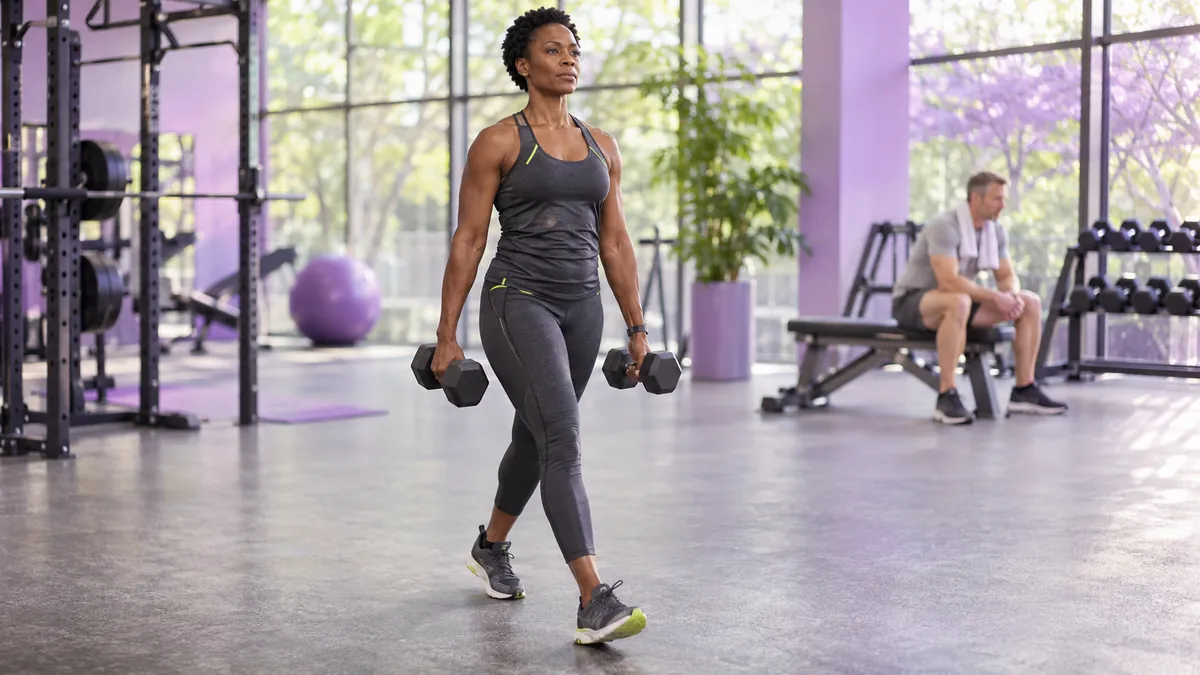
How three of the moves look
How much cardio do you need in your 40s?
The WHO recommends 150–300 minutes of moderate aerobic activity a week, 75–150 minutes of vigorous activity, or a mix, for all adults. Moderate means you can talk but not sing; brisk walking counts. If you are healthy and your doctor agrees, one shorter, harder session a week adds fitness in less time.
Cardio protects the heart, blood pressure and blood sugar, which become bigger concerns in your 40s. If you have been inactive, start with 10–20 minute walks and build by a few minutes each week. Low-impact choices such as cycling, swimming, rowing and the cross-trainer are kinder on knees and hips than running if those joints complain.
How do you lose weight after 40?
The same way as at 25: eat somewhat less than you burn, while lifting and eating enough protein to keep muscle. Research shows metabolism, adjusted for body size, is stable from about 20 to 60, so age alone is not the barrier. Busier days, less movement and muscle loss usually are. Avoid crash diets, which cost muscle.
Work out a modest daily deficit with the calorie deficit calculator, and read how many calories to eat to lose weight for the full method. Keep up the strength sessions while you diet: they tell your body to hold on to muscle while the fat comes off.
How much protein do you need after 40?
About 1.6 g per kg of body weight a day if you are strength training, the point where extra muscle gains levelled off in a large meta-analysis; some people benefit from more, up to about 2.2 g/kg. For an 80 kg (176 lb) person, 1.6 g/kg is about 128 g a day, or roughly 30–40 g per meal.
Spread protein over three or four meals rather than loading it at dinner. Eggs, Greek yogurt, milk, fish, chicken, lean meat, tofu, tempeh, beans and lentils are easy wins. If you have kidney disease, ask your doctor before raising protein. Work out your own number with the protein calculator, or see the high-protein foods list.

Why does recovery feel slower after 40, and what helps?
Recovery depends heavily on sleep, stress, food and how hard you trained, and all of those often get worse in your 40s with work and family. Sleep at least seven hours, keep most sets a few reps short of failure, avoid training the same muscles hard on back-to-back days, and take an easier week when you feel run down.
- Sleep: seven or more hours is the adult minimum; see what one short night does to your results.
- Easy weeks: every six to eight weeks, or whenever progress stalls and joints ache, do half the sets for a week.
- Alcohol: it worsens sleep quality; keep it light, especially on training days.
- Mobility: five minutes of moving through hips, upper back and shoulders on most days.
- Pain rules: muscle soreness for a day or two is normal; sharp or lasting joint pain is a reason to change the exercise and see a physiotherapist.
What health checks should you get in your 40s?
Ask your doctor which routine checks fit your age, sex, family history and country. In the US, the Preventive Services Task Force recommends blood-pressure screening for all adults, diabetes screening from 35 for people with overweight, mammograms every two years for women from 40, and colorectal cancer screening from 45. Other countries' programs differ.
- Blood pressure: checked regularly; high blood pressure often has no symptoms.
- Blood sugar: a test for prediabetes or type 2 diabetes, especially with overweight or a family history.
- Cholesterol and heart risk: your doctor can estimate your 10-year risk and advise.
- Cancer screening: breast, bowel and cervical screening as your national program advises.
- Eyes, teeth and mental health are part of the picture too.
Who should see a doctor before starting to exercise?
Under the American College of Sports Medicine's screening guidance, people who are inactive and have heart, kidney or metabolic disease such as diabetes, or symptoms like chest pain, breathlessness or dizziness, should get medical clearance before starting. Healthy people without symptoms can usually begin light-to-moderate exercise and build up gradually.
How do I follow this plan in Fitrang?
Build Strength A and B as two routines from Fitrang's library of 460+ exercises with animated demos, or pick a ready program such as Full Body A/B or Dumbbell Basics and set your training days. Each set shows last time's weight, your protein is tracked against a target, and a doctor report can be printed for check-ups.
- Create routines A and B in Train, or choose a program and your days.
- Log each set; follow the next-weight hint (add, hold or ease off).
- Log cardio sessions and sleep, and weigh in a few times a week.
- Before a check-up, print the 30- or 90-day doctor report from You.
The bottom line
Fitness in your 40s rests on the same pillars as ever, with more care for recovery: two or three full-body strength sessions, 150–300 minutes of moderate cardio, about 1.6 g/kg of protein if you lift, and seven or more hours of sleep. Lose weight with a modest deficit, not a crash diet. Book the routine checks your doctor recommends, and get cleared first if you have heart, kidney or metabolic disease or symptoms.
Frequently asked questions
What is the best exercise for over 40s?
A mix of strength training two or three days a week and 150–300 minutes of moderate cardio, such as brisk walking, cycling or swimming. Strength work keeps muscle and bone; cardio protects the heart, blood pressure and blood sugar.
How many days a week should a 40-year-old work out?
Four to six days of some activity is a good target: two or three strength sessions plus two or three cardio sessions, with at least one rest day. Two strength sessions and three 30-minute brisk walks still meet the WHO minimum.
Is it harder to lose weight after 40?
Not because of metabolism. Size-adjusted metabolism is stable from about 20 to 60. It often feels harder because people move less and lose muscle. A modest calorie deficit, regular strength training and enough protein work at 40 as they do at 25.
How much protein should a 40-year-old eat?
About 1.6 g per kg of body weight a day if you strength train, spread over three or four meals; that is about 128 g for an 80 kg person. People with kidney disease should ask their doctor first.
Can you build muscle in your 40s?
Yes. Adults of all ages gain muscle and strength with progressive resistance training and enough protein. Progress may be a little slower than at 20, and recovery may need more attention, but the same principles work.
Keep reading
 How often should you work out?Days per week by goal
 How much protein do I need?Grams per kg by goal, with a calculator
 Strength training over 50Plan, protein and safety
 How many calories to lose weightA safe daily target, step by step
Sources
- World Health Organization. WHO guidelines on physical activity and sedentary behaviour (2020). who.int
- Morton RW, Murphy KT, McKellar SR et al. A systematic review, meta-analysis and meta-regression of the effect of protein supplementation on resistance training-induced gains in muscle mass and strength in healthy adults. British Journal of Sports Medicine 2018;52(6):376–384. PubMed
- Watson NF, Badr MS, Belenky G et al. Recommended amount of sleep for a healthy adult: a joint consensus statement of the American Academy of Sleep Medicine and Sleep Research Society. Journal of Clinical Sleep Medicine 2015;11(6):591–592. PubMed
- Pontzer H, Yamada Y, Sagayama H et al. Daily energy expenditure through the human life course. Science 2021;373(6556):808–812. PubMed
- Riebe D, Franklin BA, Thompson PD et al. Updating ACSM's recommendations for exercise preparticipation health screening. Medicine and Science in Sports and Exercise 2015;47(11):2473–2479. PubMed
- US Preventive Services Task Force. Hypertension in adults: screening. uspreventiveservicestaskforce.org
- US Preventive Services Task Force. Prediabetes and type 2 diabetes: screening. uspreventiveservicestaskforce.org
- US Preventive Services Task Force. Breast cancer: screening. uspreventiveservicestaskforce.org
- US Preventive Services Task Force. Colorectal cancer: screening. uspreventiveservicestaskforce.org
This article is general information for healthy adults, not medical advice. If you have a medical condition, are pregnant, or take medication, talk to a doctor or registered dietitian before changing your diet, sleep or training.